
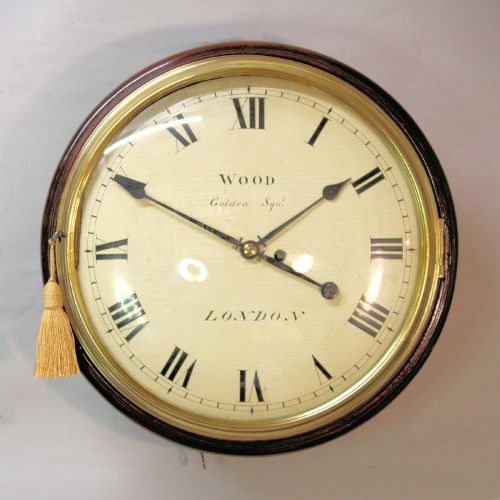


Regency Fusee Wall Clock
A regency fusee wall clock brings precise timekeeping and robust joinery into a room through clean mahogany cases and clear dials.
Regency Fusee Wall Clock
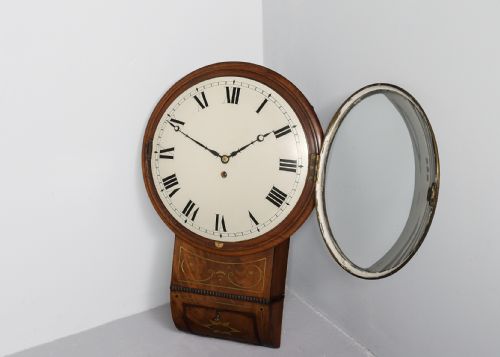
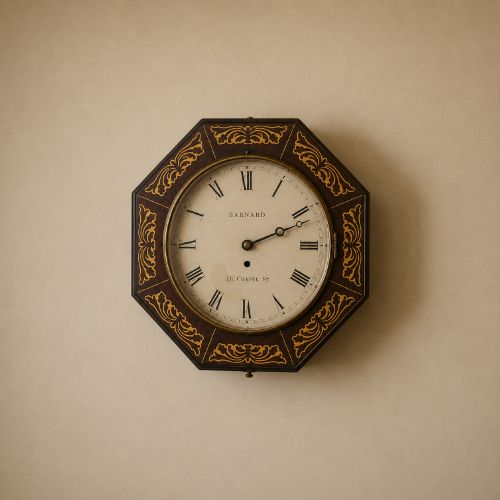
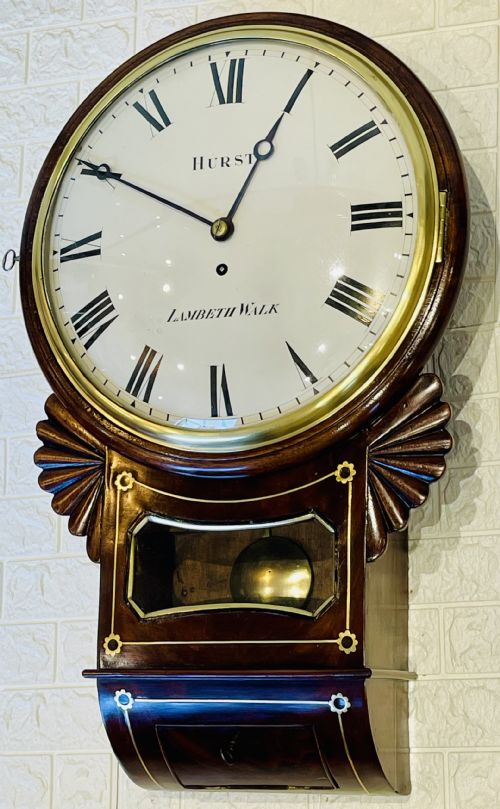
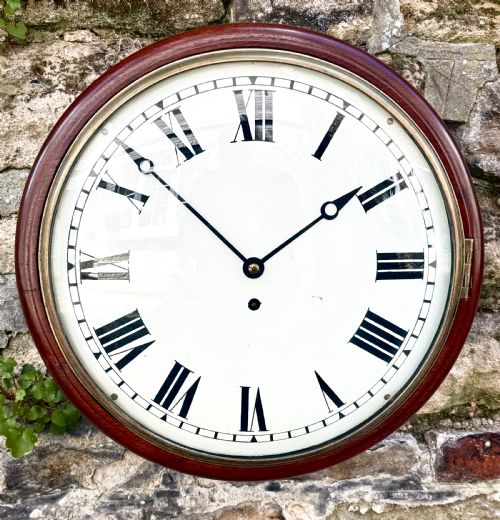
A regency fusee wall clock is a dependable timekeeper designed to mount directly onto a vertical surface, drawing energy from a spring-driven movement regulated by a fusee. You are most likely to encounter drop-dial variations, octagonal frames, and round wooden dial versions originating from the nineteenth century, Georgian era, and Regency period.
These clocks serve as functional architectural fittings that combine plain or brass-inlaid mahogany timber with convex glass covers. Makers from London and regional towns constructed them to maintain steady tension on the gear train for reliable daily or eight-day operation.
Materials and construction
Cases rely heavily on solid mahogany and occasional rosewood veneers, shaped into drumheads, octagons, or drop-dial silhouettes. Brass inlay and cast bezels provide structural definition and visual contrast against the dark timber.
Movements utilise iron and brass components driven by a fusee chain or cord that winds around a conical pulley. Dials are fashioned from wood, enamel, or metal, often featuring a convex shape protected by curved glass.
One robust railway-associated piece bears the cryptic mark GWR right on the dial, whispering of platform punctuality.
Distinguishing quality
Quality rests in the crispness of the timber carving, the precision of the brass inlay work, and the legibility of the dial lettering. Finer examples display harmonious proportions between the main dial housing and the lower drop box.
The sophistication of the movement and the signature of a reputable maker elevate the stature of an individual piece. Original glass, well-preserved wooden dials, and intact brass fittings demonstrate superior historical integrity.
Barnard·Cording of London·Thomas Connold of Alysham·John Wilson·Kleyser of London·Osborn of Kingsbridge·Haley and Milner·John Thwaites·J Beckett of London·Halliday and Rich of Bridgwate·James Duncan·James Tupman·Thomas Lindey·Edwin Fisher·George Younge·Grey Leicester
The Regency Fusee Wall Clock Glossary
- Fusee
- A conical pulley designed to equalise the torque of the mainspring as it winds down. This mechanism ensures consistent power delivery to the escapement for accurate timekeeping.
- Drop dial
- A clock case featuring an extended lower section beneath the main dial, often housing a pendulum bob or weight. It allows a compact clock face to sit above a graceful hanging enclosure.
- Convex dial
- A clock face that curves outward toward the viewer. This convex form reduces glare from interior lighting and improves legibility from oblique angles.
- Bezel
- The metal or wooden ring that holds the protective glass cover in place over the clock face. Hinged bezels allow direct access to the hands and dial for adjustment.
- Timepiece
- A clock that measures and indicates the passage of hours and minutes without a striking mechanism. Many wall clocks of this era function purely as timepieces.
Regency Fusee Wall Clock: Frequently Asked Questions
How do I wind a fusee wall clock?
Use the appropriate winding key on the dial arbor to turn clockwise until resistance meets you. Care must be taken not to overwind the mainspring.
Ensure the key matches the square of the winding arbor to prevent slipping and potential damage to the movement.
What is the purpose of a fusee?
The fusee ensures that the force driving the clock gears remains steady whether the mainspring is fully wound or nearly spent. Without it, timekeeping would become erratic as spring tension drops.
The conical pulley achieves this by altering the leverage of the chain as it transfers power across the movement.
Where were these clocks originally hung?
These clocks typically hung in public hallways, merchants' offices, and domestic receiving rooms where reliable time was essential. Their wall-mounted design saved valuable floor space in busy environments.
The drop-dial format provided a clear visual focal point at eye level.
How do I distinguish a Regency period clock?
Regency pieces often display specific decorative vocabularies such as brass inlay, convex wooden dials, and restrained mahogany veneers. Makers during this era favoured clean geometric lines over heavy ornamentation.
Examining the internal movement construction alongside the cabinet style helps confirm the date of manufacture.