


Regency Four Door Cabinet
A regency four door cabinet brings architectural presence to a room, offering deep timber grain and generous storage across four symmetrical lower doors.

Regency Four Door Cabinet
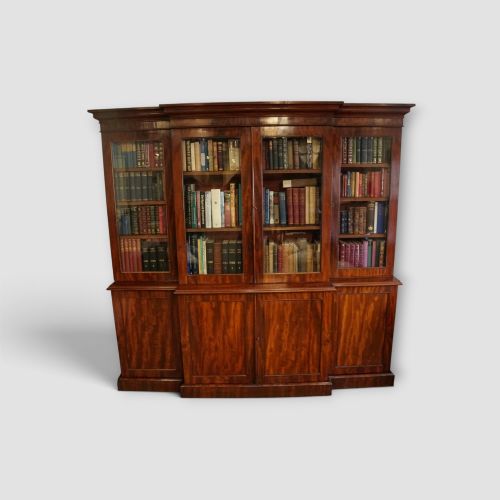
A regency four door cabinet presents a substantial architectural presence, typically featuring four lower doors across a breakfront or sideboard form. These pieces emerge predominantly from the nineteenth century, spanning Regency, George IV, and Victorian periods.
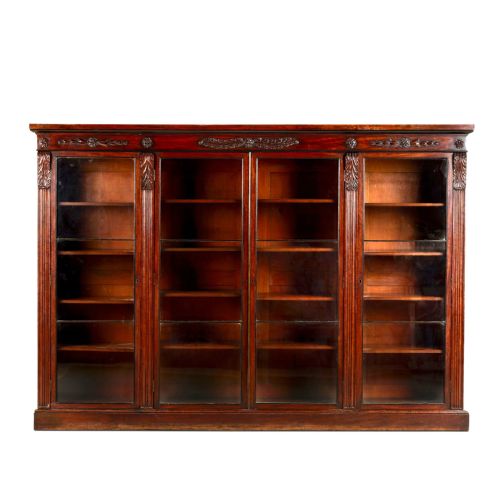
The versions most commonly met on this page include flame mahogany and rosewood timber configurations, occasionally paired with glazed upper bookcase sections or arranged as dedicated side cabinets and credenzas.
Origins stretch across English country house workshops and Irish makers, incorporating styles from classic Regency lines to Gothic Revival interpretations.
How they were made
Cabinet makers selected dense solid timbers like mahogany and rosewood, applying figured flame mahogany veneers to door panels to catch the light. Workshops utilised contrasting wood inlay to define architectural borders and panels.
Glazing bars divided upper bookcase doors into intricate geometric patterns, while interior fittings frequently incorporated adjustable shelving, fabric linings, and specialised brass hardware.
Several listings boast ten-foot expanses of flame mahogany, proving that Regency cabinet makers understood the art of making a grand entrance.
What varies in quality
Quality reveals itself in the selection and bookmatching of timber veneers across the four doors, where superior cabinets display continuous, mirrored grain patterns. The crispness of wood inlay and the weight of original brass mounts further distinguish finer examples.
Proportion and scale dictate the hierarchy of these pieces, moving from standard side cabinets up to monumental ten-foot breakfront library bookcases with complex joinery and fitted interiors.
The Regency Four Door Cabinet Glossary
- Breakfront
- A cabinet design where the central section projects forward from the flanking side sections. This configuration creates pronounced depth and architectural rhythm across the four doors.
- Flame mahogany
- A veneer cut from the fork of a mahogany tree where the branch joins the trunk. It creates a distinctive, fiery figure that demands expert bookmatching across large cupboard doors.
- X-grille
- A decorative lattice work forming intersecting diagonal crosses over glass door panels. This detail is frequently constructed from brass or timber to secure the glass while adding visual lightness.
- Linen press
- A tall storage piece originally designed for household linens, featuring sliding trays behind upper doors. Many examples incorporate a breakfront four-door base configuration.
- Gothic Revival
- A nineteenth century design movement drawing inspiration from medieval architecture. Pieces in this style incorporate pointed arches and ecclesiastical structural motifs.
Regency Four Door Cabinet: Frequently Asked Questions
How do I tell Regency from Victorian pieces?
Regency pieces generally date from the early nineteenth century and lean toward classical restraint, balanced proportions, and refined brass inlays. Victorian items often display heavier scaling and more eclectic stylistic revivals.
Overlap in manufacturing dates means timber selection and construction methods provide clearer clues to age than the period label alone.
Where were these cabinets used?
These large storage pieces originated in grand country houses and urban townhouses, serving libraries, dining rooms, and principal drawing rooms. They stored books, fine porcelain, and household linens behind secure locking doors.
Today, they function as substantial credenzas or bookcases in contemporary rooms with high ceilings.
What is flame mahogany?
Flame mahogany is a highly figured wood veneer harvested from the junction where a branch meets the main trunk of the tree. The resulting grain swirls in dramatic, fiery patterns.
Craftsmen carefully matched these grain patterns across the four doors of a cabinet to create a symmetrical, mirrored visual effect.