



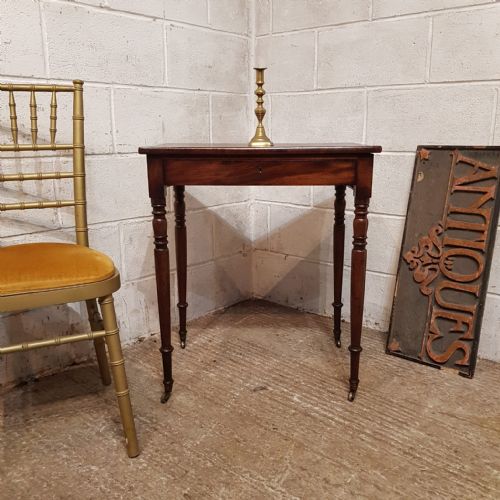
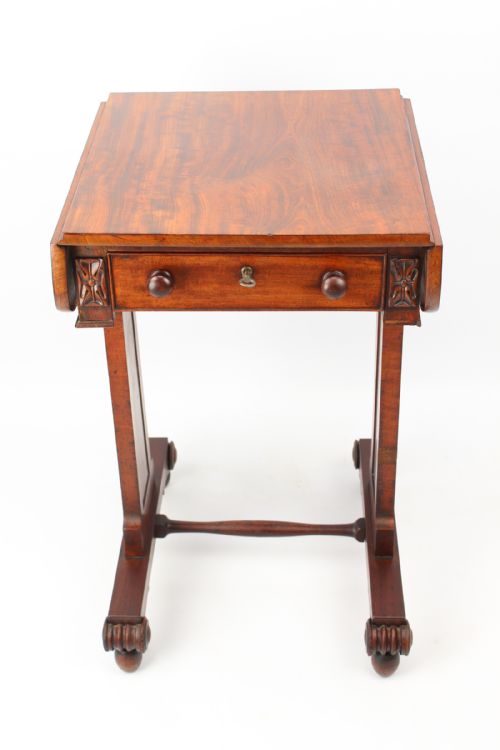
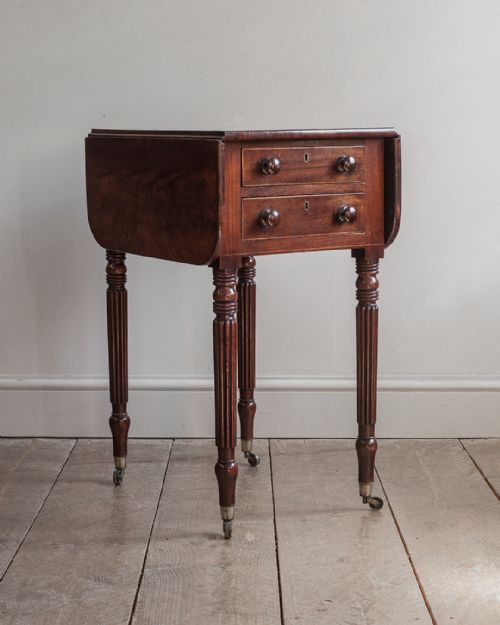
Regency End Table with Drawer
These regency end table with drawer examples bring compact elegance and clever storage to a room, crafted in rich mahogany or rosewood.
Regency End Table with Drawer
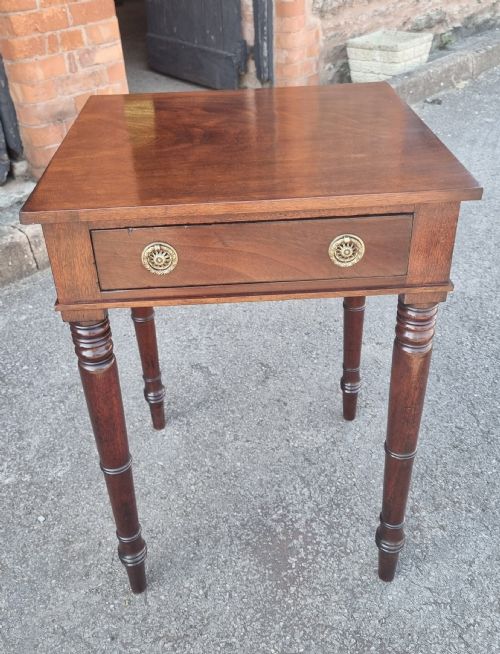
When you search for a regency end table with drawer, you are looking at functional small furniture designed for the home, typically appearing as occasional tables, side tables, and lamp tables. These pieces serve practical needs beside seating while adding period character to a space.
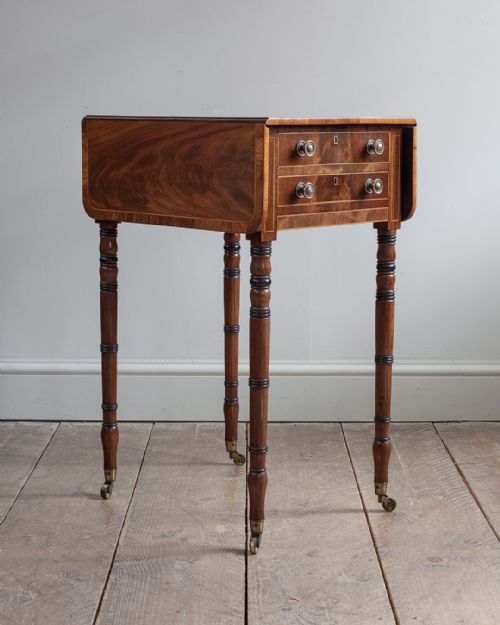
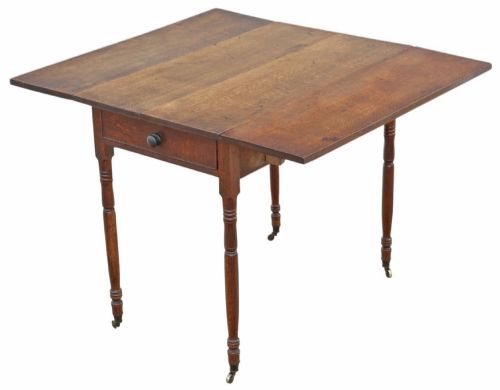
The versions most likely to meet you on this page belong to the Regency, George IV, and William IV periods, alongside later nineteenth-century interpretations. They combine compact footprints with single or double frieze drawers, often featuring drop leaves or pillar supports.
Originating in eras that valued refined domestic convenience, these tables take various forms including Pembroke tables, sofa tables, and bedside tables. Each type brings specific proportions and drawer configurations suited to different rooms in the house.
Materials and construction
Cabinet makers relied heavily on mahogany, flame mahogany, and rosewood to build these tables, exploiting the natural grain patterns for visual impact. Boxwood stringing and brass mounts frequently accent the timber surfaces, adding fine linear detail and contrast.
Construction techniques involve sturdy pillar supports, drop leaves, and fitted frieze drawers that glide smoothly within the frame. Timbers are selected for their figuring, ensuring the top surfaces display rich depth and warmth.
Listings feature tables spanning the Georgian, Regency, and William IV periods, constructed primarily in mahogany, flame mahogany, and rosewood with brass and boxwood details.
Variations in quality
Quality in these tables rests on the choice of timber and the sophistication of its figuring, with flame mahogany and rosewood representing the upper tiers. The crispness of brass mounts and delicate boxwood stringing also distinguish finer examples from plain utilitarian pieces.
Joinery execution and drawer construction reveal the maker's hand, particularly in how smoothly the frieze drawers operate and how neatly the drop leaves align. Proportion and balance in the pillar supports and turnings further separate superior items from standard production.
The Regency End Table with Drawer Glossary
- Pembroke table
- A small occasional table featuring two hinged drop leaves on opposite sides. This design allows the table to expand for use or fold compactly against a wall.
- Frieze drawer
- A drawer integrated directly beneath the tabletop within the structural frame. These compartments provide discreet storage for small household items.
- Flame mahogany
- A highly decorative veneer cut from wood where the branch meets the trunk. It creates a distinctive rippled, flame-like pattern across the tabletop.
- Drop leaf
- A hinged flap on a table edge that can be raised to increase surface area. Brackets or swing legs support the leaf when extended.
- Boxwood stringing
- Thin inlaid lines of pale boxwood set into contrasting darker timber. This technique creates delicate borders around drawer fronts and tabletops.
Regency End Table with Drawer: Frequently Asked Questions
What is a regency end table with drawer used for?
These tables provide a convenient surface for lamps, books, or drinks beside a sofa or chair. The integrated drawer offers hidden storage for small items like writing materials or spectacles.
Their compact size makes them versatile enough to function as bedside tables or occasional pieces in smaller rooms.
How do I identify a Regency period table?
Regency tables typically feature classical proportions, dark timbers like mahogany or rosewood, and restrained decorative elements such as brass mounts or boxwood stringing. Pillar supports and turned legs are also common characteristics of the era.
Later nineteenth-century and twentieth-century pieces often emulate these distinctive stylistic traits while showing different construction details underneath.
What is the difference between a Pembroke table and a side table?
A Pembroke table is defined by its two hinged drop leaves that fold down to save space when not in use. They often include a frieze drawer and supported leaves.
A standard side table has a fixed top without leaves, relying purely on its permanent dimensions and any included drawers for functionality.
How should I care for antique mahogany and rosewood?
Protect the timber by keeping these tables away from direct sunlight and heat sources that can dry out or fade the wood. Regular dusting with a soft, dry cloth maintains the finish without chemical buildup.
Occasional application of appropriate wax nourishes the grain and preserves the historic sheen of the surface.