
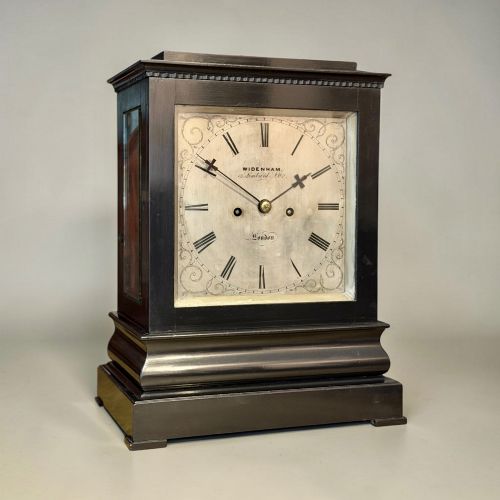
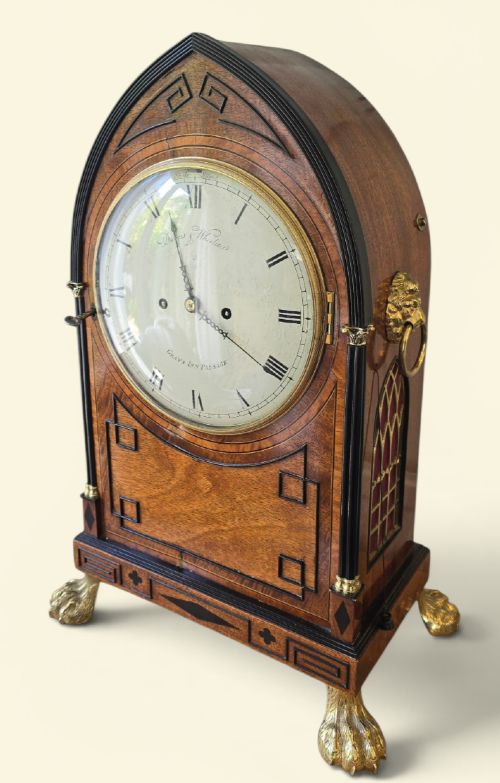


Regency Ebonised Bracket Clock
These regency ebonised bracket clock examples combine dark cases with precise London movements for striking tabletop timekeeping.
Regency Ebonised Bracket Clock
A regency ebonised bracket clock sits upon a table or shelf, bringing architectural form and mechanical movement into a room. These pieces span Georgian, Regency, William IV, and Victorian periods, reflecting shifting tastes in case geometry from lancet tops to balloon shapes.
The objects listed here predominantly feature ebonised wood and mahogany cases housing brass, steel, and silvered metal components. London makers dominate the origins, producing bracket clocks and mantel clocks designed to regulate domestic life.
Makers such as Desbois and Wheeler, John Bull, and Widenham created these timepieces to combine visual severity with complex internal gearing. They represent a period when British horology prioritised both cabinetmaking and mechanical precision.
How they were made
Cabinetmakers constructed the housing using mahogany or other hardwoods treated with an ebonised finish to simulate expensive ebony. Glass panels protected the dial while allowing light across silvered metal faces.
Inside the case, brass plates and steel wheels formed the fusee and timekeeping movements. Gilt brass mounts and fittings added contrast against the dark timber surfaces.
Listings span periods from 1750 through Georgian, Regency, and William IV to Victorian times, using ebonised wood, mahogany, brass, and silvered metal.
What varies in quality
The refinement of the cabinetwork and the reputation of the maker dictate the standing of an individual piece. Clocks signed by established London firms show greater attention to case proportion and dial engraving.
The complexity of the movement, such as twin fusee arrangements, separates standard timepieces from higher grade examples. Sharpness in the ebonised finish and the quality of the cast brass fittings also distinguish superior specimens.
Widenham of London·Desbois and Wheeler·John Bull of Bedford·Des Granges of London·Grimaldi and Johnson·Berguer of the Strand·John Leroux London·William Smith London·Thwaites
The Regency Ebonised Bracket Clock Glossary
- Bracket clock
- A portable timekeeper originally designed to sit on a wall bracket or a table. Many examples include carrying handles on top of the wooden case.
- Fusee
- A conical pulley used in spring-driven clocks to maintain even power as the mainspring unwinds. This mechanism improves timekeeping accuracy across the power reserve.
- Silvered metal
- A brass dial plate treated with a silver compound to create a bright, readable surface for engraved numerals. These faces often feature intricate subsidiary dials.
- Lancet-top
- A case silhouette shaped like a pointed Gothic arch, popular during the Georgian and Regency periods. This form draws the eye upward along the ebonised wood.
- Balloon clock
- A mantel clock featuring a rounded, curved case profile resembling a hot air balloon. These French-influenced shapes appear frequently in eighteenth and nineteenth century listings.
Regency Ebonised Bracket Clock: Frequently Asked Questions
What is a regency ebonised bracket clock?
A portable mechanical timekeeper housed in a dark wood case, produced during the late Georgian and Regency eras. These clocks combine functional brass movements with decorative cabinetry intended for prominent display.
They serve as both accurate timepieces and sculptural objects, often featuring silvered dials and glazed side panels to reveal the internal mechanism.
How were these clocks used originally?
Owners placed them on tables, mantelpieces, or dedicated wall brackets in the principal rooms of large houses. They provided reliable time for the household before the widespread adoption of standardised railway time.
Servants wound the movements regularly using a matching key, ensuring the twin fusee trains maintained their precise rhythm throughout the week.
How do I live with one today?
Position the clock on a stable surface away from direct sunlight, drafts, and sudden temperature fluctuations that can affect the wood and internal oils. Winding and setting the movement requires gentle handling to preserve the historic components.
Allow the tick to become part of the room's atmosphere while appreciating the visual contrast of the dark ebonised case against modern or traditional interiors.
How do I tell periods apart?
Examine the silhouette of the wooden case and the style of the dial engraving, noting how Georgian and Regency makers favoured architectural lines and lancet arches. Later Victorian examples often introduce larger proportions or alternative aesthetic influences.
Signatures on the silvered metal dials often reference London addresses or provincial towns, providing direct evidence of the maker and active decade.