


Regency Dessert Service
A regency dessert service brings the colour and refinement of early nineteenth-century dining rooms directly to the modern table.
Regency Dessert Service
A regency dessert service comprises matching ceramic plates, serving dishes, and occasional custard sets intended for the final course of a formal meal. These ensembles originate primarily from the nineteenth century, spanning the Georgian, Regency, and early Victorian periods.
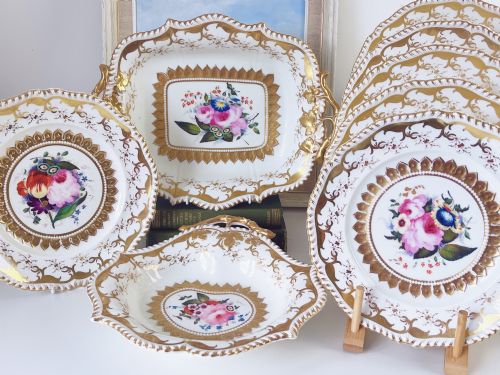
The service is most frequently encountered in porcelain and ironstone, produced by prominent English factories of the era. Buyers will find both complete services and individual serving dishes or plates bearing floral motifs and handpainted details.
How they were made
Potters shaped fine porcelain, ironstone, and earthenware into tableware before applying enamel colours and glaze. Artisans then finished the surfaces with gold leaf and gold gilt highlights, often executing meticulous handpainted flowers and fruit scenes.
Production relied on established English ceramic techniques of the early nineteenth century, combining moulded earthenware shapes with delicate overglaze painting. Kiln firing fixed the enamels and gilding to the porcelain body for lasting display.
Listings for this phrase feature nineteenth-century pieces from the Georgian, Regency, and Victorian periods, executed in porcelain, ironstone, and earthenware.
What varies in quality
Quality rests upon the execution of the handpainted decoration and the crispness of the porcelain moulding. Pieces featuring named artists or intricate botanical studies sit at the higher end of the range.
The preservation of the original gold gilt and enamel surfaces dictates the overall desirability of each piece. Finer examples retain rich gilding and vibrant colours without extensive wear to the glaze.
Grainger Lee & Co·Spode·Derby Porcelain·Minton·Flight Barr & Barr·Wedgwood·Mason's Patent Ironstone
The Regency Dessert Service Glossary
- Ironstone
- A durable type of earthenware patented for its strength and utility in tableware production. It offered a robust alternative to fine porcelain while accepting rich enamel decoration.
- Gold Gilt
- A thin layer of gold applied to the ceramic surface to highlight rims, handles, and painted motifs. This decorative technique defines much of the elegance associated with the period.
- Dessert Service
- A matched collection of plates and serving dishes designed specifically for the fruit and sweet course of a formal dinner. These sets often included specialised vessels such as custard cups.
- Enamel
- Opaque vitreous material fused to pottery to create coloured designs and patterns. Enamel paints provided the bright hues seen on floral and botanical plates.
Regency Dessert Service: Frequently Asked Questions
How were these services used?
A regency dessert service was brought out at the conclusion of a formal dinner for the final course of fruit, sweets, and wine. The plates and serving dishes were arranged on the table to display confectioneries.
Servants would present the custard sets and oval dishes alongside individual dessert plates. The arrangement emphasised visual presentation as much as the food itself.
Can I use them for dining?
Most collectors choose to display these pieces rather than use them for everyday dining due to their age and delicate enamel work. Handpainted surfaces and gold leaf require gentle care.
Gentle hand washing in warm water is necessary if occasional use is preferred. Modern dishwashers and microwaves will damage the historic glaze and gilding.
How do I identify a period piece?
Period pieces display the paste characteristics, factory marks, and handpainted styles typical of the early nineteenth century. Ironstone and porcelain from this era often carry impressed or printed maker marks on the underside.
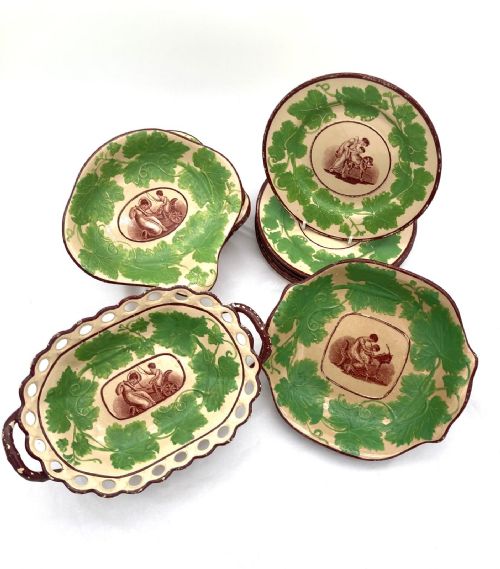
Stylistic cues such as apple green borders, drabware glazes, and botanical painting point directly to the Georgian and Regency eras. Comparing forms with documented factory patterns helps confirm the date.
What is drabware?
Drabware is a stoneware or earthenware body featuring a muted olive, grey, or brownish-beige glaze. Wedgwood and other potteries utilised this understated background to contrast with colourful applied decorations.
This ceramic finish gained popularity during the nineteenth century for its restrained and elegant aesthetic. It offers a distinct visual departure from bright white porcelain.