
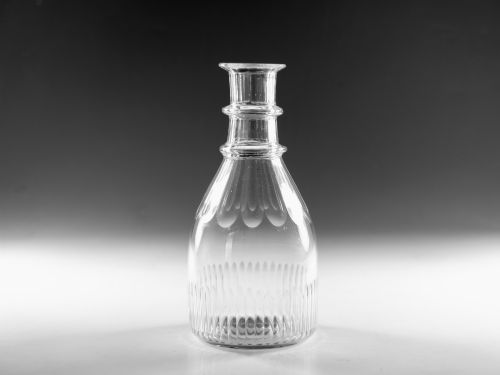
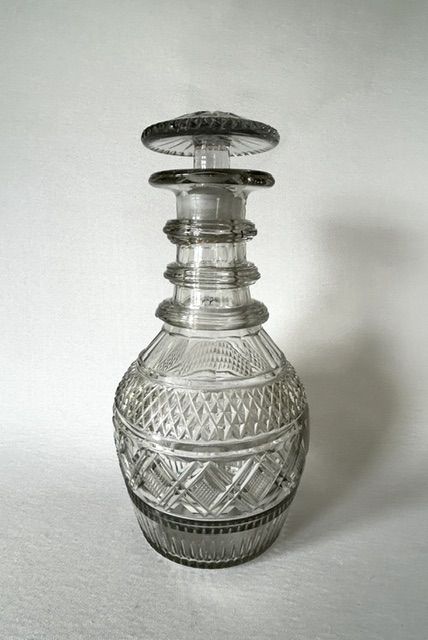


Regency Cut Glass Carafe
A regency cut glass carafe brings heavy brilliance to a sideboard, catching candle-light through deep diamond or pillar cutting.
Regency Cut Glass Carafe
A regency cut glass carafe encompasses heavy glass vessels designed for serving wine, spirits and water during the Georgian and Regency periods. The pieces appearing here span the early nineteenth century, including specific forms such as ship's decanters, three-ring decanters and water jugs.
Buyers will most frequently meet English and Irish examples dated between eighteen hundred and eighteen thirty. These range from single full-size decanters to matched pairs and small sets with associated glassware.
How they were made
Makers utilised heavy lead crystal and glass, blowing the molten material into iron or wooden moulds before finishing the form by hand. The surface was then worked on a wheel to produce deep geometric patterns, flutes and distinctive neck rings.
Cooling and polishing required immense skill to ensure the vessel remained stable while achieving maximum brilliance and weight. Artisans shaped handles and applied rims while the metal was still malleable.
Makers added heavy neck rings so greasy fingers wouldn't drop the port.
What varies in quality
The clarity of the metal and the crispness of the wheel-cut facets define the standard of a vessel. Deeper, sharper cutting catches the light more effectively and indicates superior craftsmanship.
Proportion and weight also dictate worth, with thicker bases providing necessary stability for tall or ship's profiles. Matched pairs and well-defined neck rings demonstrate greater care in the original workshop.
The Regency Cut Glass Carafe Glossary
- Lead crystal
- A type of glass containing lead oxide that increases weight, brilliance and softness for cutting. This material allows the deep faceting characteristic of the period.
- Pillar cut
- A decorative technique featuring vertical flutes or flat-topped columns around the body of the vessel. It creates strong optical lines that refract light clearly.
- Ship's decanter
- A form with a wide, flat base designed to prevent tipping on the rolling tables of a ship at sea. The low centre of gravity made them practical for maritime dining.
- Neck rings
- Horizontal ridges applied or worked onto the narrow upper section of the vessel. They provide a secure grip for the hand when pouring.
Regency Cut Glass Carafe: Frequently Asked Questions
How do I clean a cloudy carafe?
Residue is best removed using warm water with non-abrasive beads or specialised cleaning brushes designed for narrow vessels. Avoid harsh chemical detergents that may damage the old glass surface.
Allow the piece to dry naturally upside down on a soft cloth to prevent water spots forming inside the chamber.
Are these pieces safe for serving wine?
These vessels were originally made for holding wine, spirits and water during the Georgian era. Most historic glass is entirely stable for modern dining use.
Users should check for any internal staining or structural stress before filling them for the table.
How do I tell a Regency decanter apart from a Victorian one?
Regency examples typically feature heavier lead crystal with characteristic three-ring necks and distinct hand-cut geometric patterns. The weight and sharpness of the facet work are key indicators of this earlier period.
Later nineteenth-century pieces often display lighter metal and different moulding techniques as industrial production methods evolved.
Why do some decanters have wide flat bases?
Wide bases belong to ship's decanters, which were specifically shaped to remain stable on unstable surfaces. Their conical profile kept the vessel upright during rough dining conditions.
This practical design has made them enduringly popular for modern homes due to their distinctive silhouette.