

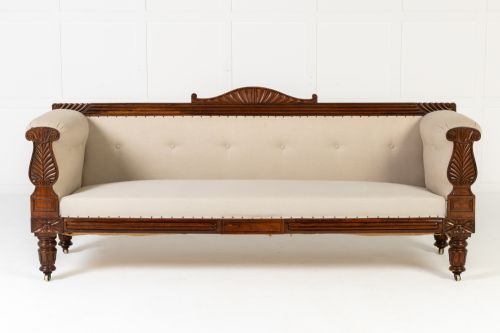


Regency Carved Wood Settee
A regency carved wood settee brings architectural presence and sculptural timber forms into a room, offering a seat designed for both reception and display.
Regency Carved Wood Settee
A regency carved wood settee spans forms ranging from country house sofas to double-ended and scroll-end seating produced during the nineteenth century. These pieces emerge from the Regency period and styles such as William IV, French Empire, and Anglo-Indian, reflecting the sophisticated design vocabulary of the era.
The versions most commonly met on this page include mahogany, rosewood, and simulated rosewood frameworks, alongside giltwood and ebonised examples. Many pieces feature carved frames with herms or scroll ends, while others await upholstery or retain leather and textile coverings.
How they were made
Cabinetmakers constructed these frames using dense timbers like mahogany, rosewood, and ebony, often applying ebonisation or gilding to achieve contrasting surface finishes. Carved elements such as scroll ends, herms, and statuary frames required skilled hand-carving directly into the solid wood.
Upholstered surfaces relied on traditional stuffing techniques, while other variants incorporated cane work into the timber frames. Brass mounts and details frequently complemented the rich dark woods and gilded surfaces.
Listings feature nineteenth-century pieces incorporating mahogany, rosewood, brass, leather, and hessian across Regency and William IV styles.
What varies in quality
The sophistication of the timber carving sets individual examples apart, distinguishing simple turned frames from deeply sculpted scroll-ends and figural herms. Crisp detailing in the woodwork indicates the investment of time by the original maker.
The integrity of the primary wood structure and the ambition of the regional or international design influence - such as Anglo-Indian caning or French Empire proportions - determine the distinction of a piece.
The Regency Carved Wood Settee Glossary
- Scroll-end
- A sofa or settee arm that curls outward in a tight or sweeping scroll formation. This profile defines much of the silhouette in nineteenth-century seating.
- Herm
- A carved bust or figure tapering into a pillar, often integrated into the structural frame of a sofa. These sculptural supports draw directly from classical antiquity.
- Double-ended
- A seating form featuring matching high ends at both sides rather than a conventional back and single arm arrangement. This symmetrical design allows reclining from either direction.
- Simulated rosewood
- A painted or grained surface finish applied to a lighter timber to mimic the rich figuring of genuine rosewood. Cabinetmakers utilised this technique during the Regency era for decorative effect.
- Giltwood
- Timber coated with a thin layer of gold leaf or gilt pigment. This lustrous finish highlights carved mouldings and architectural details.
Regency Carved Wood Settee: Frequently Asked Questions
What is a regency carved wood settee?
A regency carved wood settee is a nineteenth-century upholstered or caned seat featuring architectural timber frames, scroll ends, and decorative carving. These pieces reflect the neoclassical tastes and cabinetmaking standards of the Regency era.
They function both as substantial living room seating and as focal points of period interior design, combining comfort with sculptural presence.
How do I identify a nineteenth century settee?
Identification relies on examining the timber selection, such as rosewood or mahogany, alongside characteristic details like scroll arms, brass mounts, or classical carved herms. The proportions typically adhere to Regency, French Empire, or William IV design idioms.
Looking closely at the construction methods and wood ageing helps confirm the nineteenth-century origin of the frame.
Can I use these settees daily?
Many of these pieces serve as practical seating, provided the internal frame and upholstery foundations are structurally sound and stable. Owners often place them in drawing rooms or large hallways where their decorative lines can be fully appreciated.
Regular care for the exposed timber and leather or fabric surfaces ensures the furniture remains durable for everyday use.
What styles are common in these listings?
The listings encompass English Regency, French Empire, William IV, and Anglo-Indian aesthetic influences. Each style brings distinct decorative elements, from ebonised finishes and giltwood to bleached cane work.
Country house variations also appear alongside formal urban seating, showing a range of regional interpretations.