
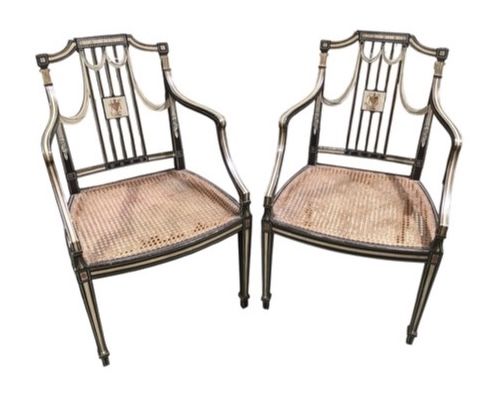
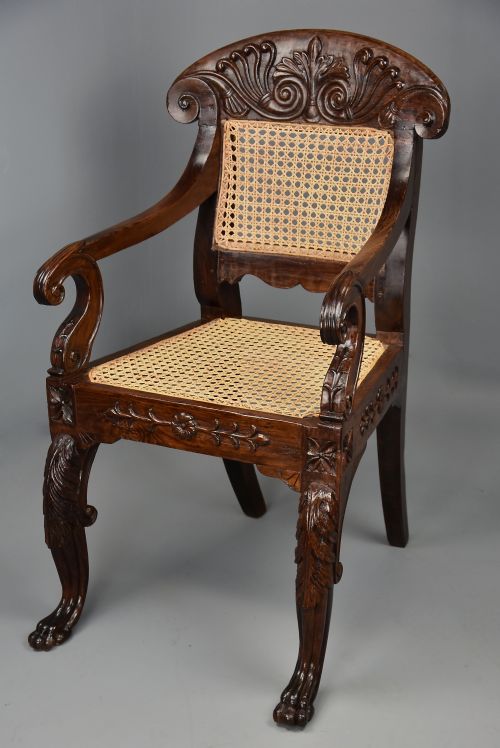


Regency Caned Open Armchair
These regency caned open armchair selections offer classic seating with woven cane seats and open arms, prized for their elegance and historical form.
Regency Caned Open Armchair
The aesthetic bridges British Regency design with Anglo-Indian Colonial and Anglo-Indian Regency influences. Forms incorporate classical silhouettes alongside distinctive variations like faux bamboo and curule style frames.
Materials and construction methods
Frames rely on hardwoods and exotic timbers such as mahogany, padouk, ebony, and simulated rosewood. Ebonised finishes and gold leaf detailing frequently enhance the structured timber surfaces.
Listings feature periods spanning the Regency era, the nineteenth century, eighteen-fifty, and nineteen-twenty.
Distinguishing quality across examples
Quality rests upon the crispness of carved details in timbers like padouk and mahogany, as well as the preservation of original paint and gold leaf decoration. Finer examples display meticulous joinery and balanced proportions across elbow and dining armchair forms.
The integrity of the woven cane seating and the authenticity of period finishes distinguish superior items. Lesser examples may exhibit heavy restoration or simpler secondary woods beneath simulated surfaces.
The Regency Caned Open Armchair Glossary
- Cane
- Woven material made from rattan used to form resilient seat panels. This technique provides lightweight strength and flexibility.
- Elbow chair
- An armchair featuring lower arms designed to support the elbows comfortably. These pieces often serve as dining armchairs or desk seating.
- Padouk
- A dense tropical hardwood favoured for detailed carving and rich colour. It appears frequently in Anglo-Indian furniture.
- Curule
- An ancient chair shape featuring intersecting curved legs resembling an X. This classical style influenced nineteenth-century revival seating.
Regency Caned Open Armchair: Frequently Asked Questions
What defines a regency caned open armchair?
These pieces combine open wooden arms with woven cane seats, echoing early nineteenth-century design principles.
They appear in various timbers and painted finishes, often reflecting British Regency or Anglo-Indian colonial aesthetics.
How were these armchairs used historically?
They served as elegant seating in drawing rooms, libraries, and dining spaces. Sets were often commissioned for formal dining rooms.
The open arms and light cane seats made them practical for warmer climates in colonial contexts as well as formal British interiors.
How do I care for a caned seat?
Cane requires gentle cleaning with a slightly damp cloth to maintain its flexibility. Avoid placing these chairs near direct heat sources.
Weight should be distributed evenly to prevent undue strain on the woven rattan strands.
How can I distinguish period pieces from later revivals?
Examination of construction marks, timber ageing, and hand-woven cane characteristics helps identify the era of production. Evidence points to genuine Regency items alongside nineteenth-century and nineteen-twenty revivals.
Comparing joinery techniques and decorative finishes against known period examples clarifies the date of manufacture.