
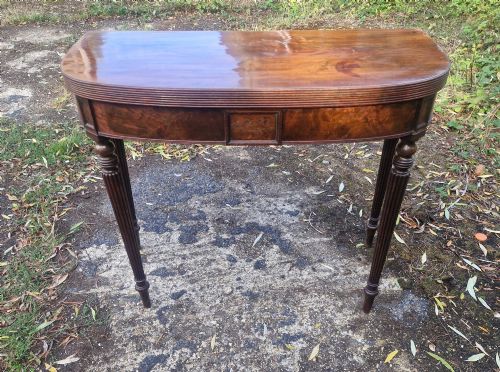


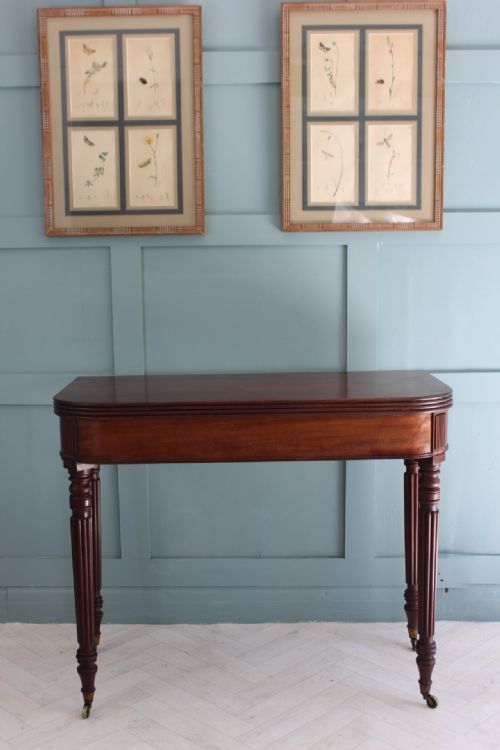


Reeded Leg Games Table
These reeded leg games table examples offer a functional centrepiece for the home, combining period cabinet-making with versatile folding surfaces.
Reeded Leg Games Table
A reeded leg games table is a dual-purpose item designed for card playing or social gatherings, taking the form of a fold-over or turnover top table. Buyers searching for this phrase encounter pieces dating primarily from the Regency, Georgian, and William IV periods, alongside broader nineteenth-century examples.
The objects on this page span several closely related forms, including games tables, card tables, and tea tables, often featuring D-shaped profiles. Mahogany and rosewood dominate the material record, frequently paired with satinwood or boxwood inlay to delineate the surfaces.
How they were made
Cabinet-makers constructed these tables using dense timbers such as mahogany and rosewood, applying contrasting boxwood and satinwood inlay to enrich the folding top and frieze. Turned and carved reeding defines the legs, echoing workshop traditions associated with makers like Gillows.
The structural mechanism relies on a fold-over or turnover top that pivots to reveal a playing surface, supported by a folding rear leg or a swing-frame base.
The listings on this page span the Georgian, Regency, and William IV periods, executed predominantly in mahogany and rosewood.
What varies in quality
The distinction between standard production and superior work rests on the crispness of the reeding carved into the timber and the precision of the boxwood or satinwood inlay. Timber selection plays a major role, with well-figured mahogany and richly grained rosewood commanding greater visual depth.
Proportion and execution of the folding mechanism separate workshop pieces of high regard from ordinary regional alternatives, particularly where attribution to makers such as Gillow is suggested by the handling of the legs.
The Reeded Leg Games Table Glossary
- Reeded
- A decorative moulding consisting of parallel convex strips resembling bundled reeds. This technique adds vertical texture to the legs.
- Fold-over
- A table top hinged to double in surface area when opened. It provides a stable top for cards or tea.
- Crossbanded
- A border veneer applied around the edge of a table top with the grain running perpendicular to the centre. It creates a neat visual frame.
- D-shaped
- A furniture top or frame curved at the front and flat at the back. This profile suits side and console placement.
- Turnover top
- A hinged table leaf that rotates and folds out to rest upon an expanded frame. It conceals a well or playing surface underneath.
Reeded Leg Games Table: Frequently Asked Questions
What is a reeded leg games table used for?
These tables served primarily as dual-purpose furniture for card games, social gatherings, and everyday domestic use. The folding top allowed households to save space when entertainment concluded.
Today, they function well as console or side tables against a wall, opening out when extra surface area is required for hosting.
How do I identify the Regency period?
Regency furniture typically dates from the early nineteenth century and draws inspiration from classical antiquity. Pieces from this era often feature clean structural lines, dark timber, and precise decorative carving.
Details like reeded legs and brass accents help distinguish Regency design from earlier Georgian heavy proportioning.
What timber was used for these tables?
Makers relied heavily on mahogany and rosewood for their durability and rich grain patterns. Lighter woods such as satinwood and boxwood were employed for contrasting inlay work.
These materials were polished to highlight the natural figures within the timber rather than painted over.
Are all these tables attributed to Gillows?
Not all pieces originate from the Gillows workshop, though many share stylistic traits like specific leg turning. Attribution is usually based on structural quality and cabinet-making methods rather than a signature.
Pieces designed in the manner of the firm reflect the high standards of construction prevalent among elite workshops of the era.