




Red Mahogany Pedestal Desk
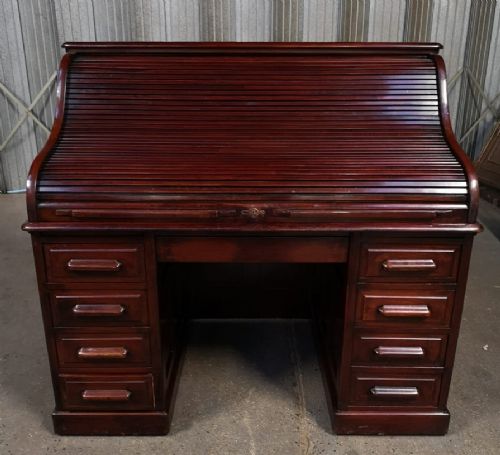
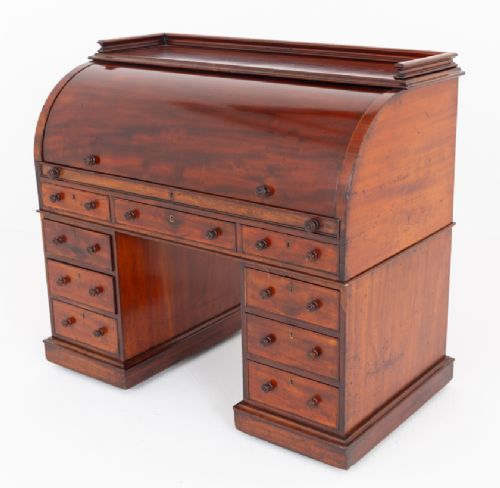
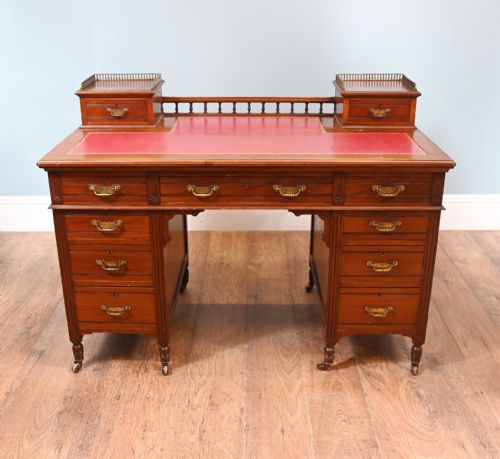
A red mahogany pedestal desk provides a commanding workspace built from rich timber, bringing traditional stature to a study.
Red Mahogany Pedestal Desk
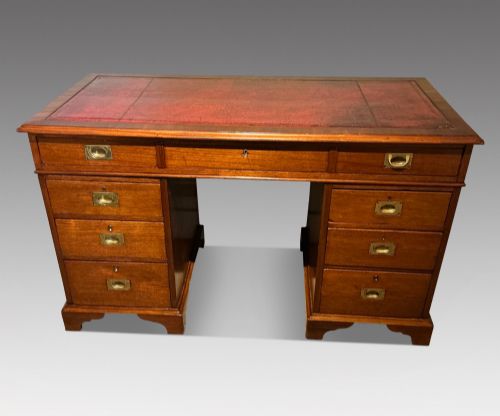
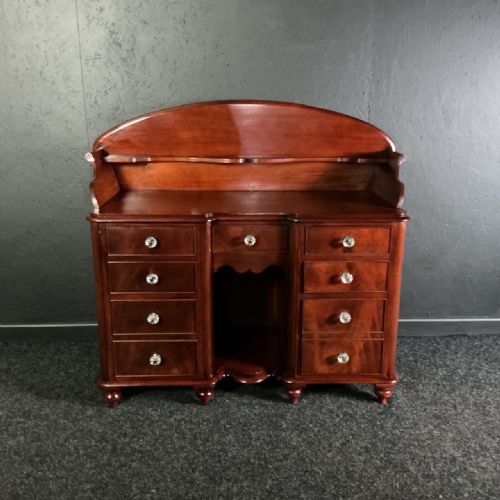
A red mahogany pedestal desk consists of a central writing surface supported by two independent banks of drawers, typically designed for placement in the middle of a room or against a wall. The pieces found here span Georgian origins through Victorian interpretations and Edwardian revivals, with single-sided writing desks and double-sided partners desks both represented in the inventory.
Makers such as James Winter & Sons and Jas Shoolbred & Co contributed marked examples to the record, alongside numerous unmarked pieces produced during the nineteenth and early twentieth centuries. While desks dominate the selection, related forms like kneehole tables and Davenport desks also appear under the broader umbrella of pedestal writing furniture.
Materials and construction methods
Makers utilised solid mahogany and flame mahogany veneers applied over secondary timbers, often framing the writing surfaces with inset leather panels tooled in gold. Brass hardware, including drop handles and drawer pulls, appears regularly alongside glass components and occasional canvas linings in campaign or modular sections.
The construction typically involves a three-part modular format where the two pedestals and the top separate for transportation. Panel work ranges from simple fielded designs to intricate inlaid motifs characteristic of Edwardian revival pieces and Georgian antecedents.
Listings feature pedestal desks spanning the Georgian, Victorian, and Edwardian periods, constructed primarily in mahogany with leather and brass.
Distinguishing quality across the range
The standard of a red mahogany pedestal desk rests on the selection of timber, with highly figured flame mahogany or curl mahogany veneers commanding greater visual depth than plain wood boards. Cabinetmaking finesse shows in the precision of the drawer dovetails, the integrity of the secondary woods, and whether a maker stamped the piece.
Proportion and scale dictate utility, where balanced pedestals and well-considered kneehole clearances separate workshop masterworks from utilitarian office furniture. The survival of original brasses and untouched leather writing surfaces further elevates an example above modified or heavily restored counterparts.
James Winter & Sons·Jas Shoolbred & Co
The Red Mahogany Pedestal Desk Glossary
- Pedestal desk
- A freestanding desk comprising two supporting columns of drawers beneath a rectangular top. These units are frequently built in three modular sections for ease of movement.
- Partners desk
- A large double-sided pedestal desk designed for two people to work opposite one another, featuring drawers and cupboards on both faces.
- Flame mahogany
- A veneer cut from the fork of the mahogany tree where the branch meets the trunk. This timber yields a distinctive undulating flame pattern prized for high-end cabinet work.
- Kneehole desk
- A compact desk featuring a recessed central space for the sitter's legs, flanked by narrow banks of drawers. George II and Victorian variants often use this precise layout.
- Davenport desk
- A small compact writing desk with a sloped, hinged writing surface and drawers opening to the side. These originated in the Georgian period and remained popular through the Victorian era.
Red Mahogany Pedestal Desk: Frequently Asked Questions
What is a partners desk?
A partners desk is a large pedestal desk built with drawers and storage on both opposing sides. This format allowed two people to work facing each other.
Such desks are typically deeper and wider than standard single-sided writing tables. They were frequently used in large libraries and executive offices.
How do I identify a Victorian desk?
Victorian desks are identified by heavier proportions, deep reddish-brown mahogany tones, and robust brass hardware. Drawer construction often utilises hand-cut dovetails.
Many examples from this era also incorporate inset leather writing surfaces with blind-tooled borders. Cabinetmakers during this period frequently drew stylistic inspiration from earlier Georgian and Regency designs.
Are these desks easy to move?
Many pedestal desks are constructed in three separate modular parts. The left pedestal, the right pedestal, and the top lift apart to ease transportation.
Larger partners desks and solid timber variants remain heavy and require multiple people to lift. Removing the drawers beforehand lightens each pedestal significantly.
What is flame mahogany?
Flame mahogany is a figured wood veneer harvested from the junction where a branch joins the main trunk of the tree. The cutting process reveals a swirling, fiery grain pattern.
Cabinetmakers applied these veneers to the primary drawer fronts and top surfaces of fine desks. This decorative technique creates a striking visual contrast against simpler solid mahogany frames.