
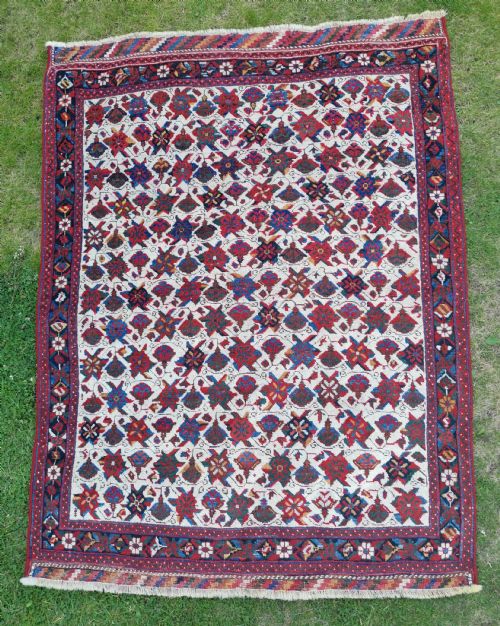


Red Ground Rug
When you search for a red ground rug, you seek a floor covering defined by a rich crimson foundation that anchors tribal and classical designs alike.
Red Ground Rug
A red ground rug displays a distinct crimson, madder, or scarlet field that serves as the visual anchor for geometric medallions, floral lattices, and tribal motifs. These textiles span Persian, Anatolian, Caucasian, and Central Asian traditions, reflecting centuries of regional weaving heritage.
The pieces encountered on this page encompass various formats, including smaller tribal rugs, larger carpets, wall hangings, and specific nomadic face pieces such as torbas and chuvals. Many examples date from the late nineteenth century through the early decades of the twentieth century, capturing a period of traditional craftsmanship.
While many specimens feature the characteristic red field, the inventory also encompasses alternative ground colours such as ivory, camel hair, and blue. Collectors and decorators gravitate toward these works for their ability to bring warmth and historical depth to an interior space.
Materials and construction methods
Weavers constructed these rugs predominantly using wool foundation and pile, frequently complemented by cotton warps and occasional highlights of silk. Certain Central Asian and Persian textiles also utilise wool felt, adras silk-cotton blends, and camel hair to achieve varied surface textures.
Natural dyes provided the rich chromatic palette characteristic of these works, yielding deep reds from madder root alongside contrasting tones in indigo, ivory, and yellow. Artisans knotted the wool by hand onto upright looms, employing symmetrical or asymmetrical knot densities depending on the regional workshop or tribal tradition.
Listings feature works spanning the late nineteenth century through the 1930s, utilising wool, cotton, silk, and natural dyes.
Evaluating quality and execution
The standard of a red ground rug depends heavily on the purity and depth of its natural dyework, which develops subtle abrash and tonal variations over time. Finer knots per square inch and tightly beaten foundations indicate superior structural integrity and longevity.
Design precision and artistic expression separate standard production from exceptional examples, particularly in the rendering of complex medallions, lattice work, and tribal symbols. The condition of the original selvedges and ends further influences the desirability of a piece among collectors.
The Red Ground Rug Glossary
- Abrash
- Variation in colour depth caused by differences in dye batches or hand-spun wool lots. This tonal gradation is a hallmark of natural dyeing techniques.
- Madder
- A natural dye derived from the root of the Rubia plant, producing the characteristic warm reds seen in traditional oriental carpets.
- Soumak
- A flat-weave technique utilising a wrapping stitch over the warp threads, creating a sturdy structure with a textured, brocaded face.
- Torba
- A small tent bag or utilitarian wall hanging produced by Turkmen tribes, often featuring distinct gul motifs and secondary panels.
- Warp
- The vertical foundation threads stretched lengthwise on a loom, onto which the pile knots are tied and secured by horizontal wefts.
Red Ground Rug: Frequently Asked Questions
How do I identify a tribal rug?
Tribal rugs typically display geometric memory patterns, hooked polygons, and asymmetrical motifs rather than formal court designs. They are woven by nomadic or village groups using locally sourced materials and hand-spun wool.
The colour palettes often rely on saturated natural dyes, and the overall construction tends to show charming irregularities reflecting the weaver's individual hand.
How should I care for an antique rug?
Antique textiles require gentle maintenance, starting with regular vacuuming using low suction without a rotating beater bar. Professional cleaning by a specialist in historical oriental carpets ensures the wool and natural dyes remain protected.
Keeping the piece out of direct sunlight prevents the crimson and secondary hues from fading over the years.
How do I distinguish regional weaving styles?
Regional styles reveal themselves through specific structural traits, knotting techniques, and signature motifs unique to areas like the Caucasus, Anatolia, or Persia. Caucasian pieces often favour sharp geometric polygons, whereas Persian workshops tend toward curvilinear floral medallions.
Examining the selvedges, fringe construction, and palette helps narrow down the probable origin of an anonymous piece.