
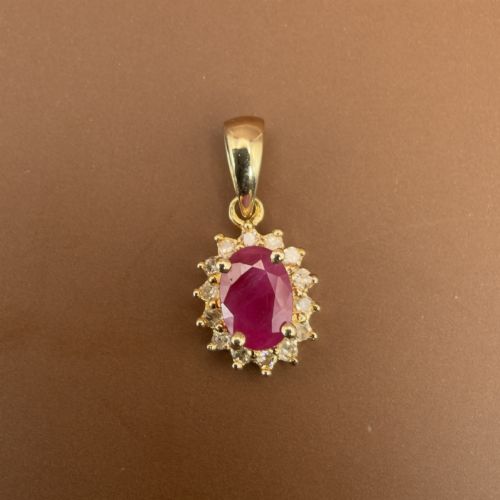


Red Gemstone Necklace
A red gemstone necklace brings together rich colour and precious metal, offering the enduring appeal of garnets, rubies, and tourmalines set for the neck.
Red Gemstone Necklace
A red gemstone necklace centres on distinctive stones such as ruby, garnet, and tourmaline, mounted in yellow gold, white gold, rose gold, silver, or gilt metal. These pieces take the form of pendants, fringe drop necklaces, cluster designs, and two-strand pearl pairings with decorative clasps.
The selections span distinct historical periods including the Victorian and Edwardian eras, alongside mid-century and later twentieth-century styles. Buyers encounter both delicate floral or cluster motifs and striking fringe drops that reflect the aesthetic of their period of origin.
Pieces range from simple nine-carat gold garnet pendants to elaborate eighteen-carat gold ruby and diamond clusters. Each example demonstrates how makers utilised different red stones to create varied focal points for the wearer.
Materials and construction
Materials comprise precious metals including nine-carat gold, fourteen-carat yellow gold, eighteen-carat yellow and white gold, silver, and gold gilt metal. These form the structure for settings that secure rubies, garnets, diamonds, sapphires, tourmalines, and pearls.
Techniques involve cluster settings, fringe drops, and pendant mountings designed to display the natural colour and cut of the stones. Goldsmiths combined stones like rubies and garnets with supporting diamonds or white sapphires to enhance visual contrast.
Design forms encompass simple pendant necklaces, multi-stone clusters, fringe drops, and clasps on pearl strands.
Factors of quality
Quality rests upon the selection and matching of the gemstones, such as Burma rubies or imperial garnets, paired with supporting diamonds and precious metals like eighteen-carat gold. Superior examples display harmonious proportions between the central stones and the surrounding gold or silver work.
The execution of period-specific designs, whether Art Nouveau, Art Deco, or Victorian, dictates the refinement of the piece. Masterful setting techniques ensure that stones like garnets and rubies are securely held while maximising their brilliance.
The Red Gemstone Necklace Glossary
- Cluster pendant
- A jewellery piece featuring a central gemstone surrounded by a border of smaller stones, typically diamonds or contrasting gems. This setting maximises the visual impact of the primary stone.
- Fringe drop necklace
- A necklace style incorporating hanging gemstone elements suspended along the chain. This construction creates movement and showcases multiple matched stones.
- Garnet
- A silicate mineral utilised in antique jewellery for its deep red hue, frequently seen in Bohemian settings. It provides a rich, dark alternative to the brighter red of ruby.
- Ruby
- A pink to blood-red coloured gemstone of the mineral corundum, prized in fine jewellery. It often appears alongside diamonds in cluster and pendant configurations.
- Tourmaline
- A crystalline silicate mineral that displays various colours, including distinctive red and pink varieties seen in mid-century pieces. Its vibrant tones offer a unique aesthetic within vintage designs.
Red Gemstone Necklace: Frequently Asked Questions
What periods do these necklaces come from?
The pieces span the Victorian and Edwardian eras, through the Art Deco period, up to mid-century and later twentieth-century examples. Each era brings distinct metalwork and setting characteristics.
Victorian and Edwardian items often feature rich gold and garnet combinations, while later decades introduce diverse carat weights and cluster formations.
Which metals are used in these settings?
Makers utilised nine-carat gold, fourteen-carat yellow gold, eighteen-carat yellow and white gold, rose gold, silver, and gold gilt metal. These metals provided the durable framework necessary for securing stones.
Gold purity varies across the decades, with higher carat values generally appearing in finer gemstone clusters and pendant designs.
How do garnet and ruby necklaces differ?
Garnet necklaces frequently showcase deep, dark red tones, often associated with Victorian Bohemian styles and antique fringe drops. Rubies present a brighter, highly prized red often enhanced by surrounding diamonds.
Both stones occupy a central place in these designs, yet they offer distinctly different visual weights and historical associations.
What styles can be found?
Styles range from traditional and classic fine jewellery to specific movements like Art Nouveau and Art Deco. Mid-century vintage pieces also feature prominently among the selections.
Each style dictates the arrangement of the stones, moving from organic floral lines to geometric cluster formations.