
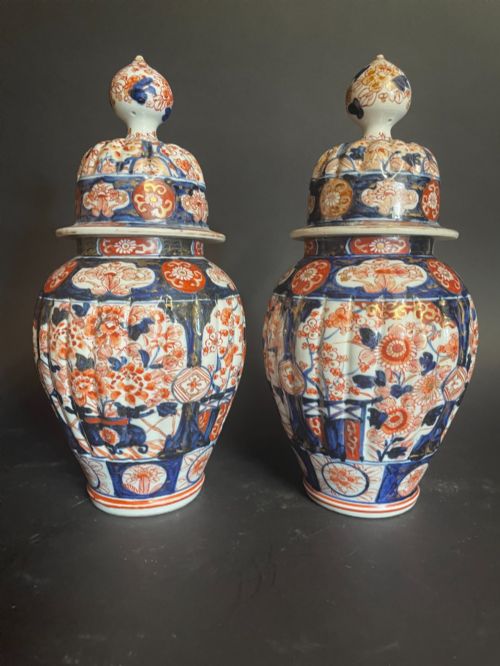


Red Ceramic Covered Jar
These red ceramic covered jar pieces bring striking colour and traditional form into a room, offering both decorative presence and practical lidded storage.
Red Ceramic Covered Jar
A red ceramic covered jar encompasses lidded vessels and ginger jars created across the eighteenth, nineteenth, and early twentieth centuries. These pieces frequently draw upon Japanese Imari and Kutani traditions, alongside European interpretations in earthenware and porcelain.
Buyers seeking a red ceramic covered jar most often encounter nineteenth-century Japanese Imari examples, characterised by distinctive iron-red glazes combined with blue and gilt detailing. Continental potteries also produced substantial lidded vases and pot pourri jars in this broader stylistic family.
Forms range from compact ginger jars to large decorative urns designed for prominent display on mantelpieces or cabinets. The inclusion of the original matching cover remains a defining feature across these diverse periods and origins.
Materials and construction
Potters shaped these vessels primarily from hard-paste porcelain, ironstone, and earthenware, applying foundational glazes before secondary surface decoration. Iron-red enamel pigment formed the cornerstone of the palette, often contrasted with cobalt blue and enriched with gold leaf or gilding.
Firing techniques varied between European kilns and Eastern workshops, where high-temperature kilns set the ceramic body and subsequent lower-temperature firings fixed the polychrome enamels and gold leaf details.
These lidded vessels have spent centuries hiding ginger, spices, and dried petals while looking impossibly grand.
Assessing quality and execution
Quality rests in the crispness of the hand-painted brushwork and the depth of the iron-red enamel against the white ceramic ground. Superior examples display precise control in their gilding and complex pattern work without cluttering the form.
The harmonious fit of the cover to the jar body and the balance of the overall silhouette distinguish finer workshop output from more utilitarian production. Age and preservation of the enamel surface further elevate an individual piece.
The Red Ceramic Covered Jar Glossary
- Imari
- A style of Japanese porcelain originating from Arita, traditionally featuring a palette of iron-red, cobalt blue, and gold. This aesthetic heavily influenced European potters during the nineteenth century.
- Kutani
- A distinct style of Japanese coloured porcelain and earthenware noted for bold pictorial designs and rich red overglaze enamels. These pieces frequently depict natural scenes and figurative subjects.
- Pot pourri
- A decorative lidded jar or vase featuring pierced or openwork sections in the cover to allow scented dried plant materials to fragrance a room. They appear in various ceramic bodies from the Georgian period onward.
- Ironstone
- A heavy, durable type of earthenware patented in the nineteenth century that offered an affordable alternative to porcelain. It readily accepted rich enamels and gilding.
- Gilding
- The application of gold leaf or powdered gold paint to the surface of ceramics. It highlights rims, handles, and specific decorative motifs.
Red Ceramic Covered Jar: Frequently Asked Questions
How do I date a red ceramic covered jar?
Dating relies on examining the ceramic body, glaze characteristics, and the style of the hand-painted decoration. Nineteenth-century pieces often display specific iron-red and gilt palettes associated with Imari or Kutani traditions.
Examining the base for kiln marks, crazing in the glaze, and wear patterns helps narrow down whether a piece originates from the Georgian, Victorian, or Edwardian eras.
Are the covers usually original to the jars?
Most listed examples retain their matching original covers, which is essential for historical integrity and visual balance. Potters designed the lid and jar as a unified composition.
Careful inspection of the rim and interior glaze helps confirm that the cover belongs to the base vessel rather than being a later replacement.
How were these lidded jars used historically?
These vessels served multiple functions ranging from practical storage for spices and ginger to pure ornamental display on furniture. Large lidded jars often anchored mantelpiece garnitures.
Pot pourri variants were specifically utilised to hold dried scented mixtures that freshened the air in period reception rooms.
How should I display these in a modern home?
Their strong red and gilt palette makes them natural focal points on sideboards, open shelving, or tables where the colour can anchor a room's scheme. Pairing ginger jars in matching pairs creates formal symmetry.
Placing them away from direct heat sources and heavy foot traffic protects the delicate overglaze enamels and gold leaf details over time.