
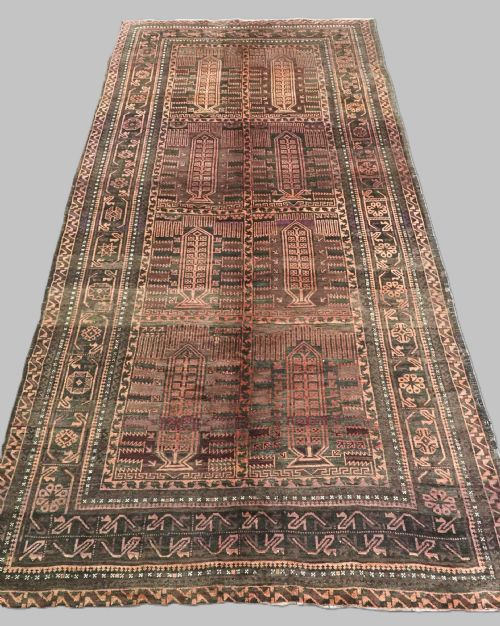


Red Brown Woven Rug
A red brown woven rug brings the rich, earthy tones of tribal craftsmanship into a room.
Red Brown Woven Rug
When you search for a red brown woven rug, you are looking at tribal and nomadic textiles originating primarily from Central Asia, Persia, and the Caucasus. The pieces gathered here span from the late nineteenth century into the early decades of the twentieth century, reflecting traditional weaving cultures.
You will most frequently encounter tribal formats such as Baluch rugs, Yomut Turkmen torbas, and Kurdish long rugs. These range from small prayer rugs and saddle bags to larger main carpets, all defined by their characteristic wool foundations and deep crimson or brown palettes.
Materials and construction
The construction relies heavily on hand-spun wool for the pile, paired frequently with cotton for structural elements or specific design contrasts, and occasionally goat hair or leather for durability. Artisans utilised natural dyes to achieve the deep red and brown tones that dominate the palette.
Weaving techniques include pile knotting for carpets and rugs alongside flatweave methods used for kilims, torbas, and mafrash storage bags. Many pieces are structured in distinct strips or bands, reflecting the practical requirements of nomadic life on the steppes.
Several storage bags still retain their original woven faces designed to hold nomadic pillows and blankets inside traditional tents.
Distinctions in quality
Quality rests upon the fineness of the knotting and the crispness of traditional tribal motifs such as guls, lattice patterns, and prayer designs. Tighter structures and more precise geometric execution signal superior craftsmanship within regional weaving traditions.
The depth and stability of the natural dyes further separate standard examples from finer pieces. Rich, saturated red and brown hues that maintain their complexity across the textile indicate skilled dye preparation and superior wool selection.
The Red Brown Woven Rug Glossary
- Torba
- A small Turkmen storage bag traditionally used inside a yurt. These pieces typically feature banded flatweave designs or characteristic tribal guls.
- Gul
- A medallion pattern used repeatedly across Turkmen and Central Asian carpets. The motif acts as a primary identifier for specific tribal groups.
- Kilim
- A flatweave textile produced without a pile. These pieces are constructed by tightly interweaving warp and weft strands to create flat geometric patterns.
- Mafrash
- A rectangular storage container or face bag utilised by nomadic tribes for bedding and household goods. They often appear as woven panels or complete flatweave pouches.
- Ensi
- A tribal door rug hung at the entrance of a yurt. They usually display a four-part partitioning design with specialised elem panels at the base.
Red Brown Woven Rug: Frequently Asked Questions
How were these rugs used originally?
Nomadic and tribal communities utilised these textiles as floor coverings, tent decorations, and functional storage containers for bedding and household possessions.
Smaller formats often served as prayer rugs or saddle bags for travel across Central Asian steppes.
How do I care for an old rug?
Protect the wool pile by keeping the textile out of direct, prolonged sunlight to prevent natural dye fading.
Vacuum gently without a rotating brush roll and consult a specialist in antique textiles for professional cleaning.
How can I identify tribal origins?
Look closely at the repeating motifs, border structures, and specific structural materials like white cotton details or goat hair edges.
Distinct tribal groups such as the Yomut, Baluch, and Ersari employed specific design vocabularies and colour proportions.
What dates are common here?
The pieces available predominantly date from the late nineteenth century through to the early decades of the twentieth century.
Examples from the eighteen-eighties and eighteen-nineties sit alongside pieces woven around nineteen-hundred and slightly beyond.