

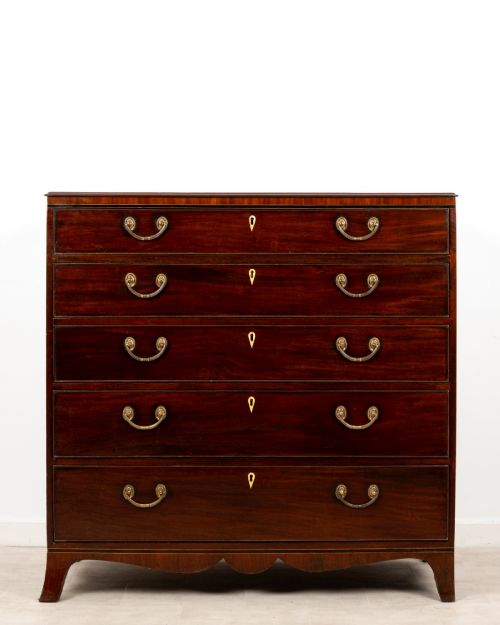
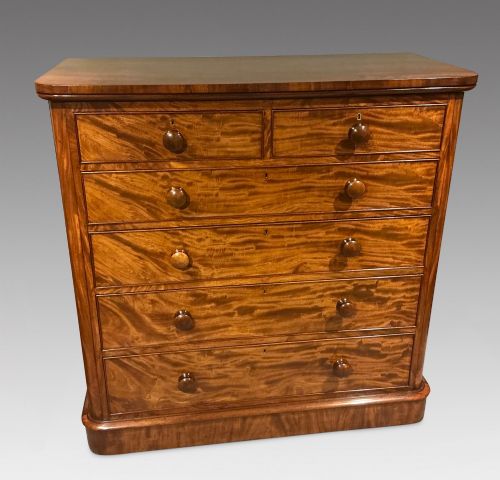


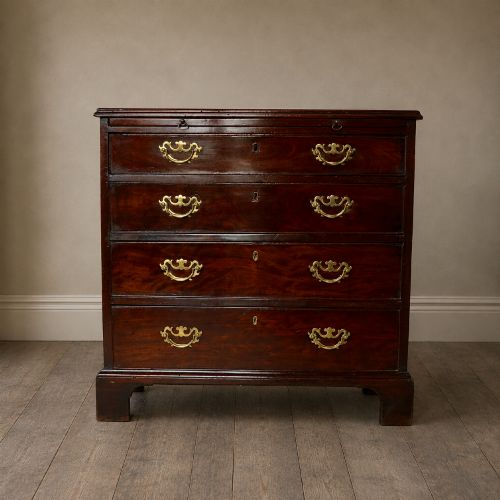
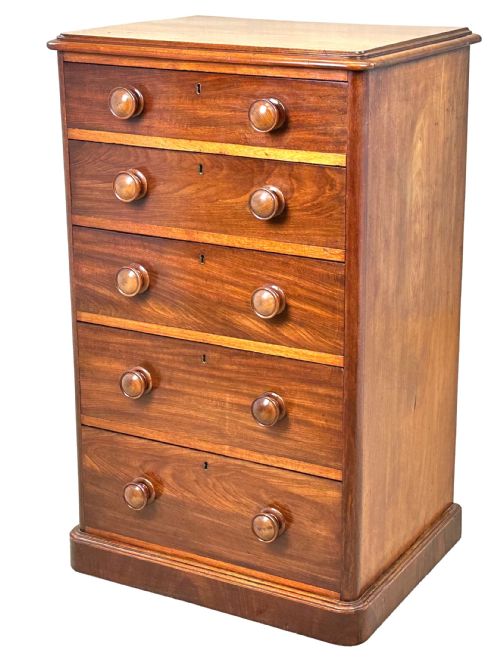
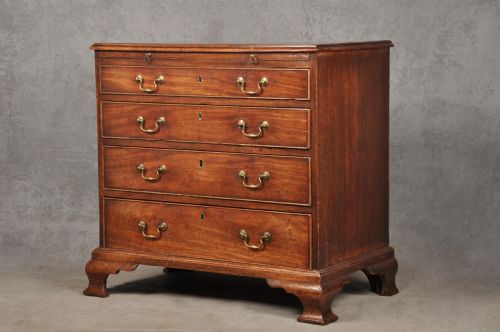


Red Brown Mahogany Commode
A red brown mahogany commode offers deep timber tones and traditional drawer storage, making it a functional centrepiece for a period bedroom.
Red Brown Mahogany Commode
A red brown mahogany commode covers the chests of drawers and washstands found across Georgian, Victorian, and nineteenth-century eras. These forms range from compact bowfront designs and bachelor pieces with slides to serpentine fronts and washstand cupboards.
How they were made
Cabinet makers utilised solid mahogany alongside flame mahogany veneers to achieve rich red brown surfaces across drawer fronts and tops. Secondary timbers such as oak and pine provide structural framing for the internal drawer boxes and carcases.
Fine decorative details rely on brass hardware for handles and escutcheons, occasionally complemented by bone inlay or subtle stringing. Joinery techniques from the Georgian and Victorian periods ensure robust construction suited to generations of daily use.
Red Brown Mahogany Commode Retail Price Guide 2026
Typical asking prices for red brown mahogany commode among the pieces listed under this phrase on Sellingantiques today, from the lower quarter to the upper quarter. They describe what is for sale here now, not the wider market.
Listings span the Georgian, George III, Victorian, and nineteenth-century periods, showcasing mahogany, flame mahogany veneer, oak, pine, brass, and bone.
What varies in quality
The visual depth of the timber sets the baseline, with striking flame mahogany grain patterns commanding attention above plain surfaces. Superior examples display careful book-matching on drawer fronts and consistent colour saturation across the red brown finish.
Construction choices separate standard utilitarian items from elite cabinet work, visible in secondary woods like oak versus pine and the inclusion of functional additions like brushing slides. Period hardware integrity and balanced proportions further distinguish the finer pieces.
The Red Brown Mahogany Commode Glossary
- Commode
- A term historically used for a chest of drawers or fitted cabinet. These pieces provide substantial storage capacity through multiple stacked drawers.
- Bowfront
- A furniture front that curves outward in a convex shape. This style softens the profile of a chest of drawers.
- Serpentine
- A shaped furniture front featuring a central convex curve flanked by two concave curves. This sophisticated outline requires advanced woodworking skill.
- Bachelor's chest
- A small chest of drawers equipped with a pull-out sliding shelf above the main drawers. It served as a compact writing surface or dressing ledge.
Red Brown Mahogany Commode: Frequently Asked Questions
What is a red brown mahogany commode used for?
These pieces function primarily as chests of drawers, providing practical bedroom storage for clothing and linens. Some variations include washstand cupboards or pull-out slides designed for dressing tasks.
Their robust timber construction and traditional drawer configurations allow them to integrate easily into modern living spaces as decorative side storage.
How do I date a mahogany chest of drawers?
Dating relies on observing construction methods, hardware types, and prevailing furniture styles like George III Sheraton or Victorian designs. Secondary timbers inside the drawers also offer clues to the period of manufacture.
Earlier eighteenth-century pieces often feature finer proportions and specific design traits like sliding shelves, whereas nineteenth-century examples tend toward sturdier Victorian forms.
What is flame mahogany?
Flame mahogany is a highly figured veneer sliced from where branches join the main trunk of the tree. This creates a dramatic, shimmering grain pattern that catches the light.
Cabinet makers reserved this striking timber for the most prominent surfaces on high-end chests of drawers and commodes.
Are these pieces made of solid mahogany?
Many surfaces utilise mahogany veneers laid over secondary structural timbers such as oak or pine. Solid mahogany typically appears on structural framing, columns, and solid top boards.
Using veneers allowed makers to display dramatic grain figures like flame mahogany across large drawer fronts without risking the warping common in wide solid boards.