

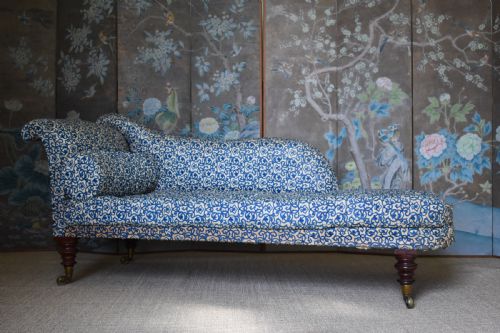


Recamier Lounge Chair
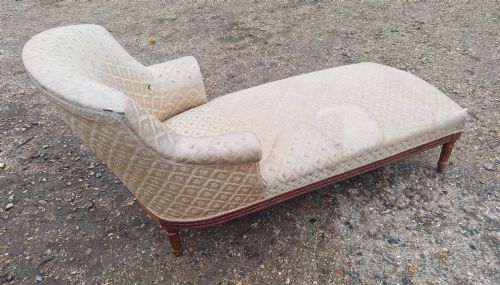
A recamier lounge chair offers an elongated seat for reclining in the manner of neoclassical portraits, built for drawing rooms and boudoirs.
Recamier Lounge Chair
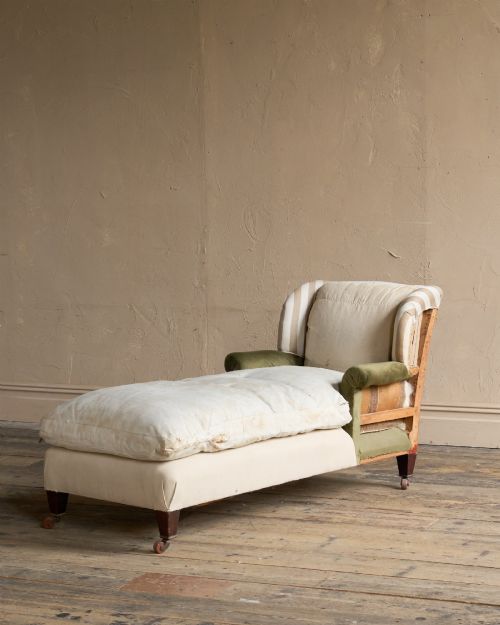
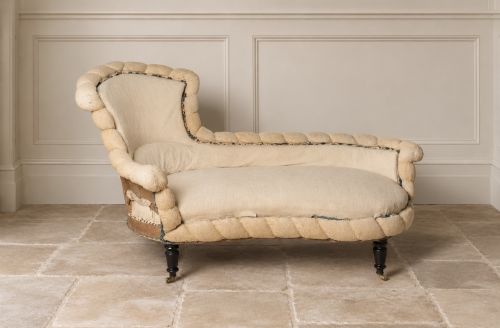
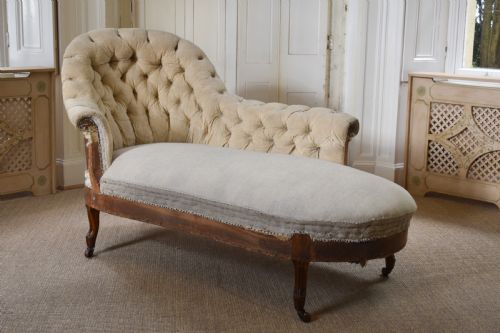
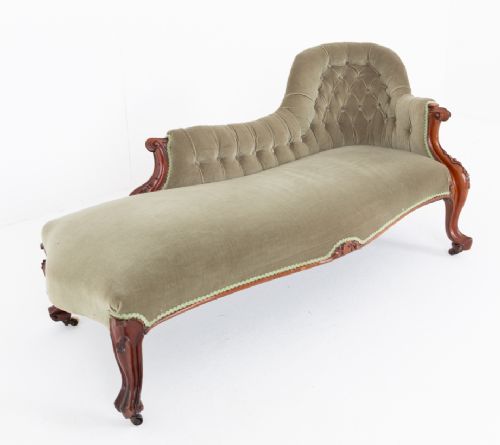
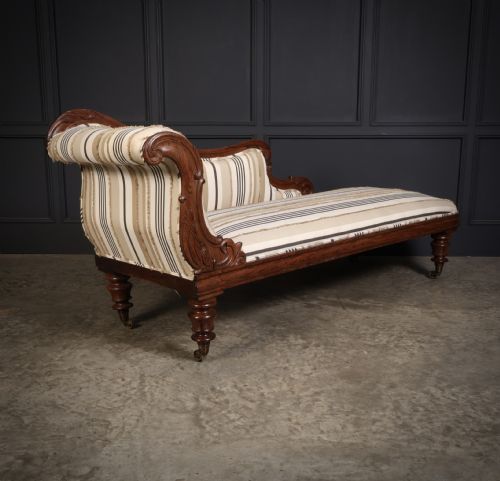
A recamier lounge chair appears across this selection as a chaise longue or day bed, designed with a raised headrest and an open side for reclining. These pieces emerge primarily from the nineteenth century, spanning Regency, William IV, and Victorian periods alongside later Edwardian and Surrealist interpretations.
The dominant forms are upholstered day beds and chaise longues sharing a lineage of graceful, asymmetrical seating. Makers of the nineteenth century interpreted the French recamier shape in mahogany, walnut, and rosewood, creating low-slung seating suited to formal reception rooms.
Materials and construction
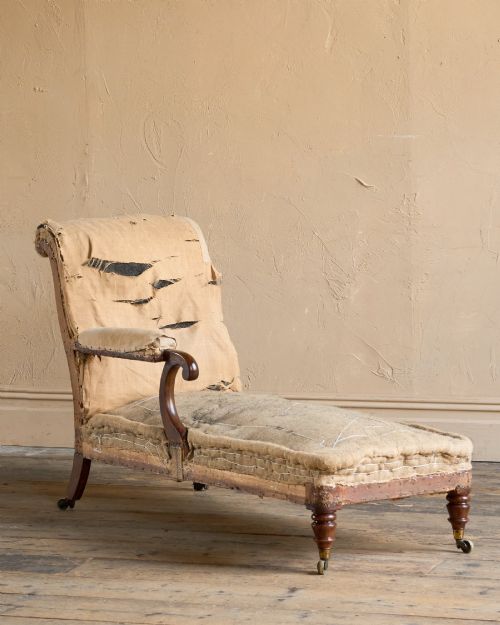
The structural frames rely on dense timbers such as mahogany, walnut, and rosewood, which provide the necessary strength to support curved headrests and scrolled rails. Wood carvers shaped these hardwoods into fluted legs, scrolling ends, and moulded frames.
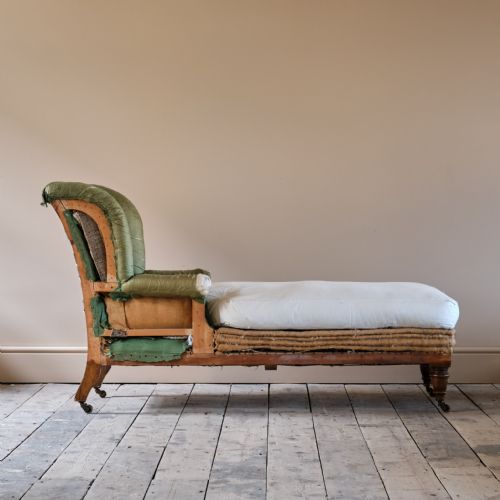
Upholstery defines the surface character, utilising deep-buttoning techniques, blue damask, velvet, and hessian over supportive stuffing. Brass castors frequently finish the feet, allowing these heavy day beds to move across carpets.
Recamier Lounge Chair Retail Price Guide 2026
Typical asking prices for recamier lounge chair among the pieces listed under this phrase on Sellingantiques today, from the lower quarter to the upper quarter. They describe what is for sale here now, not the wider market.
Early twentieth-century makers even translated the classical day bed into surrealist forms, proving that even a quiet lounge enjoys a dream.
Judging quality and craftsmanship
Quality rests in the precision of the timber frame and the integrity of the joinery beneath the upholstery. Finer examples display crisp hand-carving along the show wood and robust internal construction that prevents movement in the scrolled back.
The execution of the upholstery work also dictates the standard of the piece, where traditional springing and deep buttoning hold their form without sagging. The choice of original textiles, from damask to velvet, reflects the ambition of the original commission.
Miles and Edwards·William Birch·Holland and Sons·Syrie Maugham·Gillows
The Recamier Lounge Chair Glossary
- Chaise longue
- An upholstered sofa in the form of a chair with a long seat for reclining. It combines the functions of a chair and a day bed.
- Deep-buttoned
- An upholstery technique where stitches pull the fabric tight into recessed buttons. This creates a pattern of tufted diamonds across the backrest.
- Show wood
- The exposed timber portions of a piece of upholstered furniture. It highlights the grain and carving of mahogany or walnut frames.
- Castor
- A small wheel fitted to the base of furniture legs. Brass versions are common on nineteenth-century day beds to ease movement.
Recamier Lounge Chair: Frequently Asked Questions
How do I use a recamier in a modern room?
Place the piece against a long wall or floating in an open space where the scrolled backrest remains visible from multiple angles. It functions well as a reading seat or a resting spot in a living room or large bedroom.
Pair the lounge with low-profile surrounding furniture to let the elongated silhouette stand out. Keep the floor space around the curved end clear so the historic form commands attention.
Were these chairs meant for sleeping?
These day beds and chaise longues were designed primarily for daytime resting, reading, or receiving visitors in a semi-reclined posture. They offered a comfortable place to stretch out without retiring to a bedchamber.
While comfortable for an afternoon nap, they lack the full dimensions and mattress support of a proper bed. Their main purpose remained decorative and social within nineteenth-century domestic life.
How do I distinguish Regency from Victorian models?
Regency and William IV pieces lean towards classical restraint, featuring cleaner lines, rosewood or mahogany grains, and restrained scrolling. They often show direct inspiration from French Empire or neoclassical design.
Victorian examples tend to be heavier in proportion, frequently utilising walnut with deep buttoning and more elaborate carved ornamentation. The woodwork becomes darker and the upholstery softer as the century progresses.
What maintenance do antique upholstered day beds need?
Protect the exposed wood frames with appropriate furniture wax and keep the pieces away from direct sunlight to prevent the textiles from fading. Vacuum the fabric gently using a brush attachment to remove dust from deep buttons.
Check the stability of the legs and castors periodically, as the weight of the timber frame places stress on the joints. Avoid placing heavy loads on the unsupported cantilevered headrests.