


Queen Anne Style Dining Table
A queen anne style dining table brings classic proportions and figured timbers to the modern interior.
Queen Anne Style Dining Table
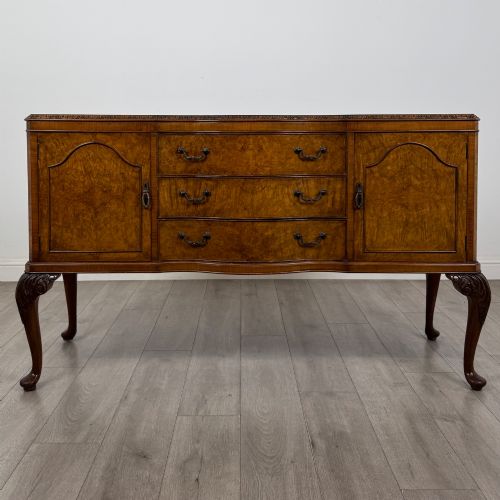
A queen anne style dining table draws upon eighteenth-century design traditions, though the examples met most often on this page date from the Edwardian era through to the 1930s. These pieces embrace revival periods, including George II influences, offering formal dining surfaces suited to traditional and contemporary rooms alike. The selection encompasses extending models with wind-out mechanisms alongside fixed tops, frequently accompanied by matching dining chairs or sideboards.
Makers working in walnut and mahogany utilised distinct revival forms, producing everything from intimate six-seater configurations to large eight-foot dining suites. Gate-legged variants also appear, demonstrating the domestic flexibility prized by earlier generations. Buyers encounter both compact tables and comprehensive dining room suites designed to coordinate across a single interior.
Materials and construction
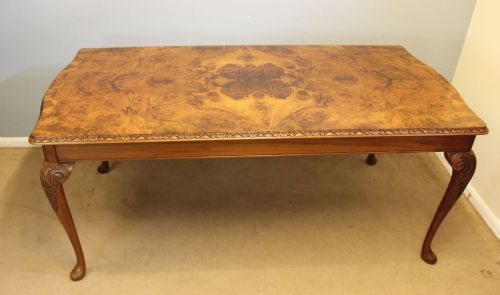
Timbers dictate the character of these tables, with walnut, burr walnut veneer, and solid mahogany appearing consistently across the records. Cabinet makers applied figured veneers to tabletops to create striking grain patterns, supported by sturdy secondary woods for structural frames.
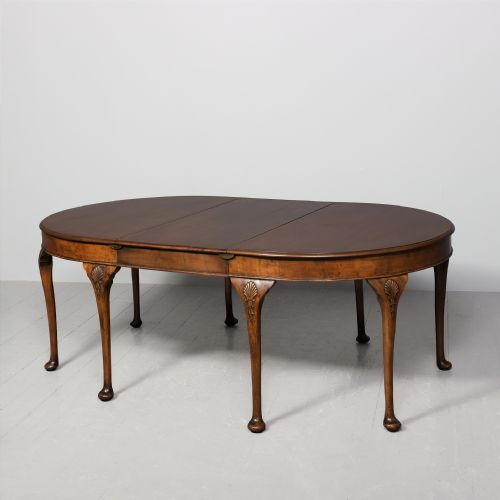
Extending versions rely upon internal wind-out mechanisms to accommodate additional leaves smoothly. Finish and joinery reflect the period of manufacture, balancing decorative surface treatments with functional durability for daily dining.
Listings feature walnut, burr walnut veneer, and mahogany, spanning the 18th century, Edwardian period, and the 1910s to 1930s.
Assessing quality in revival dining furniture
Quality rests upon the selection of timber and the precision of the veneer work across the top. Burr walnut demands expert application to maintain a smooth, continuous surface, whereas lesser examples show uneven grain matching or poor adhesion.
The sophistication of the extending mechanism and the stability of the frame differentiate standard production from finer workshop outputs. Tables paired with original matching chairs or suites display a greater cohesion of design and finish.
Hille of London·Whytock & Reid of Edinburgh·Epstein
The Queen Anne Style Dining Table Glossary
- Burr walnut
- A prized timber harvested from walnut tree growths, yielding intricate, swirling grain patterns. It is frequently applied as a veneer on tabletop surfaces to create a decorative focal point.
- Wind out
- A mechanical system utilising a handle and internal screw threads to part the table halves for insertion leaves. This mechanism allows a dining table to extend smoothly.
- Gate-legged table
- A drop-leaf table featuring hinged legs that swing outward to support the raised flaps. This design offers space-saving versatility.
- Mahogany
- A dense, durable hardwood utilised extensively in traditional dining furniture. It provides a stable base for rich polishing and carving.
- George II style
- An architectural and furniture aesthetic following the Queen Anne period, known for heavier proportions and robust ornamentation. It heavily influences many twentieth-century revival dining tables.
Queen Anne Style Dining Table: Frequently Asked Questions
How do I extend the table?
Many tables utilise a mechanical wind-out system. Insert the handle into the aperture beneath the rim and turn it to separate the halves.
Once the gap opens, drop the extra leaves into place and wind the mechanism back to secure the surface.
Are chairs usually included?
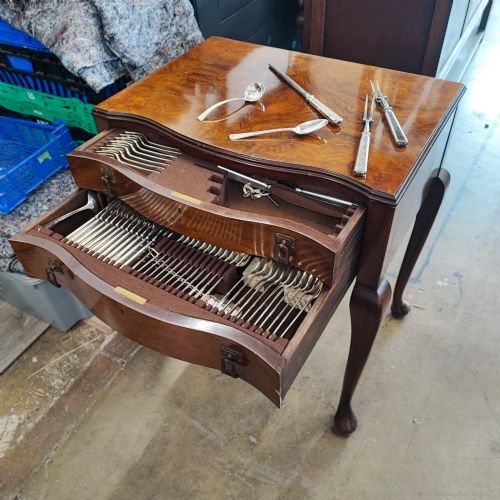
Some listings offer complete dining suites comprising the table alongside a matched set of chairs and a sideboard. Other entries present the dining table independently.
Check the individual description to confirm whether seating forms part of the purchase.
How do I care for burr walnut?
Burr walnut surfaces require protection from direct sunlight and excessive heat to prevent veneer cracking. Maintain the finish by dusting with a soft, dry cloth.
Avoid silicone polishes, opting instead for traditional beeswax occasionally to nourish the timber.
What periods do these tables span?
The majority of pieces date from the early twentieth century, specifically the Edwardian era through the 1920s and 1930s. These items represent revival movements rather than original eighteenth-century manufacture.
Infrequent examples from the 18th century and nineteenth-century wind-out models also appear in the record.