


Carved Knee Walnut Table
A carved knee walnut table brings rich figure and period presence to a room, offering both practical surface space and enduring craftsmanship.
Carved Knee Walnut Table
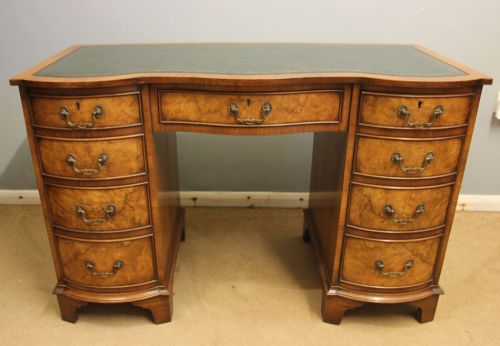
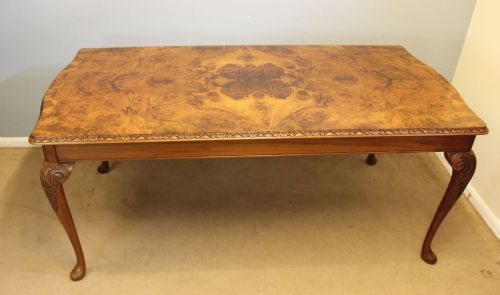
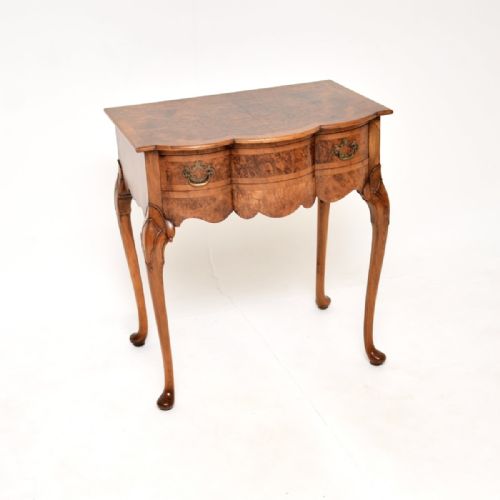
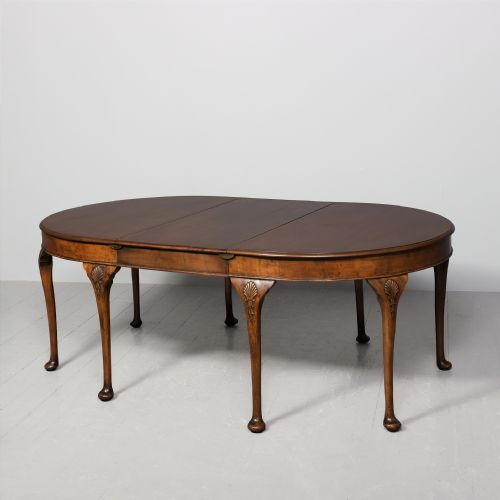
Buyers encountering this group will frequently find items executed in Queen Anne Revival and George II styles, alongside Victorian examples. These forms often incorporate characteristic cabriole legs with carved knees, reflecting historical design idioms from the eighteenth to the early twentieth century.
The assortment balances workspace solutions with decorative occasional furniture, utilising timbers like oak and mahogany alongside the primary walnut. Every piece demonstrates how traditional cabinet-making traditions persisted across successive revivals and distinct decades.
Materials and construction
Cabinet-makers relied heavily on walnut and burr walnut veneer to cover primary structures, creating striking figuration across large flat surfaces like desk tops and console boards. Secondary timbers such as oak and mahogany provided robust internal framing and drawer linings for structural stability.
Carved ornament on knees and legs was executed directly into solid timber components, particularly on cabriole supports inspired by Georgian and Queen Anne precedents. Workshops also integrated brass handles, escutcheons, and occasional leather writing surfaces to complete the functional hardware of desks and games tables.
The listings span from the 18th century through Victorian times up to 1930, utilising walnut, burr walnut, oak, mahogany, and brass.
Distinctions in quality
The refinement of the carving on the knee section establishes a primary visual distinction, separating mechanically repetitive work from fluid, hand-chiselled detailing. Timber selection also dictates grade, with richly figured burr walnut veneers commanding greater visual presence than plain walnut planks.
Structural integrity and the retention of original brass hardware and secondary woods influence overall execution. Pieces that maintain harmonious proportions between the carved cabriole legs and the primary carcase demonstrate superior workshop design.
Epstein and Co
The Carved Knee Walnut Table Glossary
- Cabriole leg
- A furniture leg that curves out and then in, resembling the leg of an animal. This form became central to Queen Anne and George II furniture design.
- Burr walnut
- A specialised timber cut from walnut tree growths, yielding highly intricate and swirling grain patterns. It is typically applied as a veneer on prominent surfaces.
- Kneehole desk
- A compact writing table featuring a central recess for the user's legs, flanked by pedestals of small drawers. This form became prevalent during the Georgian period.
- Pie crust table
- A small circular table with a raised, carved, and scalloped edge resembling pastry work. Examples from the early twentieth century echo earlier Georgian prototypes.
- Serpentine
- A curved line that is convex in the middle and concave at the sides, often seen on the front edges of desks and cabinets.
Carved Knee Walnut Table: Frequently Asked Questions
What is a kneehole desk?
A kneehole desk is a pedestal writing table designed with a central recessed space for sitting.
These pieces typically provide banks of small drawers on either side of the opening.
How do I date a walnut table?
Dating relies on examining the secondary timbers, construction methods, and stylistic revival cues.
Cabinet-makers in different eras utilised distinct joinery techniques and hardware styles that help pinpoint their origin.
Where were these tables used?
These tables served primarily as domestic writing desks, dressing tables, and occasional furniture in reception rooms.
Their compact scale allowed them to fit comfortably into private studies and bedrooms.
What is burr walnut?
Burr walnut is a veneer derived from the knotted growth of a walnut tree.
It produces complex, swirling grain patterns prized for decorative table tops and drawer fronts.
Are these tables solid walnut?
Most examples combine solid walnut or structural timbers like oak with decorative walnut veneers.
Veneering allowed workshops to display striking wood figures across large surfaces without risking the warping common in solid boards.