
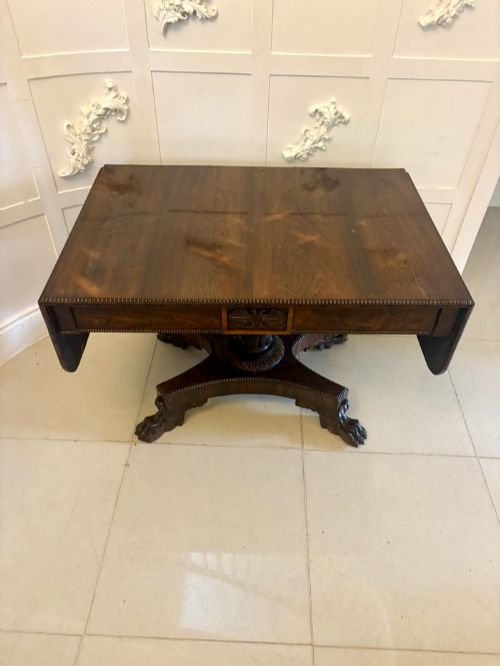
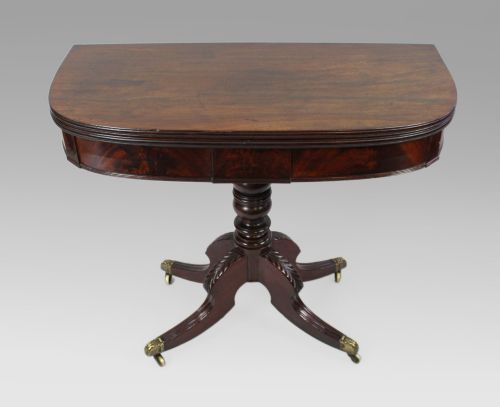


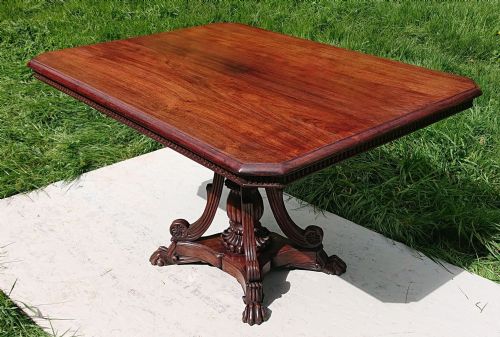


Quadripartite Pedestal Table
These quadripartite pedestal table pieces are sturdy four-part base furnishings that bring classic 19th Century and Regency character to any room.
What a quadripartite pedestal table is
A quadripartite pedestal table is a distinctive form resting on a four-part base, appearing frequently across the 19th Century, Regency, and Georgian periods. These furnishings take several domestic shapes, including card tables, tea tables, coffee tables, sewing tables, and sofa tables.
The versions most likely to be met on this page span the Regency and George IV styles, often featuring fold-over tops designed for games or tea. These pieces combine practical surfaces with architectural pedestal supports that anchor the design firmly.
Makers of the period utilised rich timber choices such as mahogany and rosewood to construct these tables, adapting them for versatile use in parlours and drawing rooms. Each form balances utility with the formal elegance characteristic of early 19th Century British cabinet making.
How they were made
Makers constructed these tables from dense timbers such as mahogany and rosewood, frequently incorporating boxwood stringing and brass details like castors or mounts. These durable materials provided the structural strength needed for pedestal supports and fold-over mechanisms.
Cabinet makers shaped the timber using traditional joinery and hand-finishing techniques suited to the Regency and George IV periods. Inlaid elements and careful grain selection required skilled hand labour to achieve the finished surface.
Retail Price Guide 2026
Typical UK retail prices for quadripartite pedestal table, calculated from the Sellingantiques database of over a million retail prices indexed since 2003. This retail price guide relies exclusively on Sellingantiques data; no external sources or auction records are used, so the figures do not describe the wider market.
Secret compartments in sewing tables often still smell faintly of lavender and old beeswax after two hundred years.
What varies in quality
Quality in a quadripartite pedestal table rests primarily on the choice of timber and the precision of its construction. Rich, well-figured rosewood or finely grained mahogany distinguishes the superior examples from more plain utilitarian items.
The refinement of brass mounts, inlay work such as boxwood stringing, and the stability of the four-part base dictate the upper tier of the range. Finer pieces display harmonious proportions and careful attention to structural detailing.
The Quadripartite Pedestal Table Glossary
- Quadripartite
- Having four distinct parts or divisions, referring specifically to the four-way base of the pedestal support.
- Pedestal table
- A table supported by a central pillar or column rather than four corner legs.
- Fold-over
- A table top hinged to open out and double the surface area, common on card and tea tables.
- Boxwood
- A hard, pale yellow timber frequently utilised for fine stringing and decorative inlay work.
Frequently Asked Questions
What is a quadripartite pedestal table?
A quadripartite pedestal table is a furnishing supported by a central pillar rising from a four-part base. These pieces date from the 19th Century and Regency periods.
They appear in various functional forms, including card tables, tea tables, and sewing tables, designed for domestic use in formal rooms.
How were these tables used?
These tables served multiple domestic purposes depending on their specific form, such as holding tea or providing a surface for card games.
Fold-over tops allowed households to expand the surface area when entertaining guests and fold it closed to save space when not in use.
What woods were used?
Cabinet makers built these tables primarily using dense hardwoods like mahogany and rosewood. These timbers offered the necessary strength and decorative grain patterns.
Inlayers also incorporated lighter woods such as boxwood to create contrasting stringing and geometric details.
How do I spot a Regency table?
Regency tables typically feature architectural pedestal bases, classical proportions, and dark timbers like rosewood or mahogany. They often include brass castors and subtle inlay.
Cabinet makers of this era focused on clean lines and structural symmetry, drawing inspiration from classical antiquity.