







Pottery Lion Ornament
These pottery lion ornament examples range from Staffordshire spill vases to Chinese Buddhist figures, bringing robust historic character into any room.
Pottery Lion Ornament
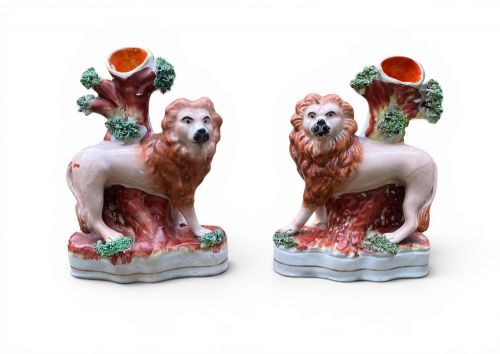
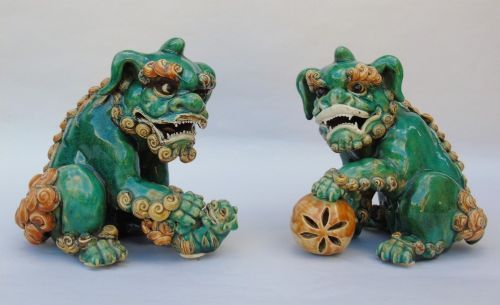
A pottery lion ornament takes many forms, stretching from traditional Staffordshire mantel figures and spill vases to Chinese Buddhist lions and German fayence pieces. You will frequently encounter Victorian Staffordshire pairs, modelled either standing or recumbent, often designed to flank a fireplace or sit upon a bookshelf.
Beyond domestic Staffordshire figures, the selections encompass specialised variations including bookends, garden figures on bases, and sculptural representations featuring copper or metallic lustre glazes. The scope spans multiple centuries, reaching back to eighteenth-century examples alongside works from the nineteenth and early twentieth centuries.
Materials and methods
Pottery lion ornament pieces rely fundamentally on earthenware, ceramic, and pearlware bodies shaped by hand or cast in moulds. Makers applied various surface treatments, utilising lead glazes, treacle glaze, tin glaze, and metallic lustre finishes to achieve distinct sheen and colouration.
Firing techniques and glaze applications define the physical structure of these figures, from the deep brown treacle surfaces of nineteenth-century English works to the sancai glazes on Chinese examples. Salt glazing appears on heavy garden figures, whilst finer decorative objects utilise smooth ceramic bases.
Pottery Lion Ornament Retail Price Guide 2026
Typical asking prices for pottery lion ornament among the pieces listed under this phrase on Sellingantiques today, from the lower quarter to the upper quarter. They describe what is for sale here now, not the wider market.
Listings feature earthenware, pearlware, and ceramic bodies decorated with lead glaze, tin glaze, and metallic lustre finishes across multiple centuries.
Distinguishing quality across pieces
The richness and depth of the glaze application further separate standard items from finer works, particularly where metallic lustre, tin glaze, or treacle finishes catch the light evenly. Intact pairs and large-scale sculptures generally demonstrate higher ambition from the pottery or workshop.
Lancaster and Sons of Hanley·Rockingham Pottery
The Pottery Lion Ornament Glossary
- Pearlware
- A fine earthenware developed in the eighteenth century, featuring a thin glaze with a faint bluish tint caused by cobalt. It serves as a common body for early Staffordshire figures.
- Treacle Glaze
- A dark, rich brown lead glaze that produces a glossy, treacle-like appearance on nineteenth-century pottery. This finish is frequently found on Staffordshire lions.
- Spill Vase
- A hollow ceramic cylinder attached to a figure, designed to hold wooden spills for lighting candles or fires. Pairs of lion spill vases were popular mantelpiece ornaments in the Victorian era.
- Sancai
- A traditional Chinese three-colour glaze technique, commonly yellow, green, and white or amber, used on ceramic figures and Dogs of Fo.
- Medici Lion
- A classic sculptural form modelled after the ancient marble lions in Florence, often replicated in ceramic figures and bookends.
Pottery Lion Ornament: Frequently Asked Questions
What periods do these pottery lions come from?
The available selection spans from the eighteenth century through the nineteenth century and into the early twentieth century. Victorian examples from around eighteen-fifties to eighteen-eighties are particularly common.
Earlier pieces include eighteenth-century German and Chinese examples, showing how diverse the tradition of ceramic lion figures remains across different regions.
How were lion spill vases used?
Spill vases incorporated a small cylindrical holder alongside the figure to store thin wooden spills. These spills were used to transfer flames from a fireplace to candles or lamps.
Placed on mantelpieces, they combined practical household utility with decorative display.
Are these lions sold in pairs?
Many of the listed pieces appear as matched pairs, particularly the Staffordshire mantel ornaments and garden figures. Pairs were traditionally manufactured to sit symmetrically on either side of a fireplace or shelf.
Single figures and bookends also feature within the selection for alternative placement.