



Post War Landscape Painting
Post war landscape painting captures mid-century views on board and canvas, offering buyers a direct window into twentieth-century artistic responses to changing rural and industrial scenes.
Post War Landscape Painting
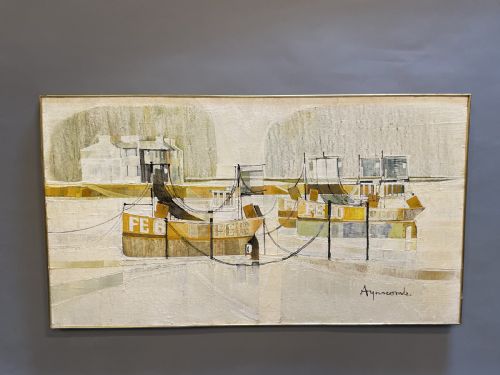
A post war landscape painting represents rural, industrial or maritime scenes created during the mid-twentieth century, predominantly spanning the nineteen-forties, fifties and sixties. These works capture everything from Norfolk river sailing views and Lake District parkland to industrial constructivist factory scenes and old barges on the Tees.
Buyers encountering this group will frequently find oil paint applied directly to board or canvas, framed in wood or gilded timber. Styles range across mid-century modern, post-war British, post-impressionism and impressionism, alongside occasional watercolour works on paper.
The subjects shift between tranquil countryside, coastal harbours such as Folkestone, and wartime or reconstruction themes, including Normandy scenes and northern English waterways. Each piece records how artists of the period interpreted familiar topography through varied modernist and impressionist lenses.
Materials and methods
Painters of this era relied heavily on oil paint applied to prepared canvas or rigid board panels, building rich textures and visible brushwork. Watercolours also appear on paper supports, offering a lighter handling of mid-century subjects.
Framing typically involves wood or gilded timber surrounds that complement the aesthetic of the period, protecting the edges of the board or canvas. These straightforward material combinations reflect the standard studio practices of mid-century artists working across Britain and continental Europe.
Materials recorded across these listings include board, canvas, oil paint, metal, gilded wood, and timber.
Assessing quality and execution
Quality in these works rests upon the confidence of the brushwork and the strength of the composition, distinguishing spirited handling from mechanical reproduction. A successful piece demonstrates deliberate control over light, colour harmony and spatial depth within the landscape.
The integration of the painted surface with its period frame also influences the overall cohesion of the object. Works that retain their original character and display distinct stylistic allegiance to mid-century modern or post-war British movements command greater interest.
Kenneth Cozens·Paul-Jean Anderbouhr·John Ward Knowles
The Post War Landscape Painting Glossary
- Board
- A rigid flat support made from wood pulp or compressed material used instead of stretched canvas. Artists favoured it during the mid-century for its stability and smooth working surface.
- Canvas
- A heavy woven fabric stretched across a wooden frame to form a foundation for oil paint. It remains one of the primary supports found in post-war fine art.
- Constructivism
- An artistic style originating in the early twentieth century that emphasises abstract structures, industrial forms and geometric arrangement. In landscape work, it translates factories and urban elements into stark, ordered compositions.
- Impressionism
- A painting approach focused on capturing light and atmospheric effects through visible brushstrokes rather than meticulous detail. Post-war variations apply these principles to contemporary British and European scenery.
- Oil paint
- A slow-drying medium consisting of pigment suspended in drying oil, typically linseed. It allows for rich blending, impasto texture and deep tonal variation.
Post War Landscape Painting: Frequently Asked Questions
What periods do these paintings cover?
The works primarily date from the nineteen-forties through to the nineteen-sixties, capturing the post-war decades. Occasional pieces extend back to the aftermath of the First World War in nineteen-nineteen.
This broad temporal span reflects both reconstruction eras and the mid-century modern artistic developments that followed.
What subjects appear most often?
Common subjects include rural countryside views, coastal harbours, northern rivers and industrial factory scenes. Artists also recorded specific locations such as Windermere, Rouen and the Norfolk Broads.
These varied motifs demonstrate how painters balanced traditional topography with emerging modernist and constructivist viewpoints.
How should I hang these paintings?
These works suit traditional domestic interiors as well as contemporary spaces, particularly when paired with simple wall art displays. Ensure they are placed away from direct sunlight and damp conditions to protect the oil paint and board supports.
Their mid-century character allows them to anchor a room or complement existing collections of twentieth-century fine art.
How do I identify the medium?
Examine the surface under good light to see whether the pigment sits on a woven fabric canvas or a rigid wooden board. Oil paint exhibits a characteristic richness and slight sheen, whereas watercolours appear flat on paper beneath glass.
Signatures, framing styles and backing materials often provide further clues regarding the date and origin of the piece.