
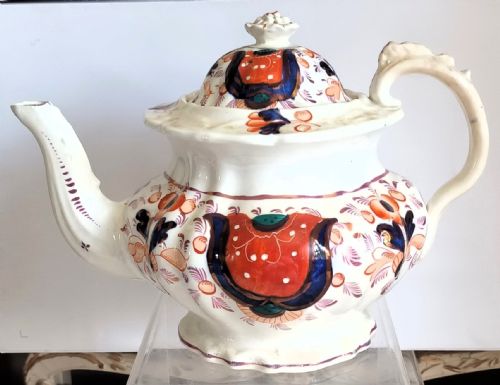


Porcelain Tea Vessel
A porcelain tea vessel is a fragile ceramic container made for holding or serving tea, prized for its delicate form and historical glaze work.
Porcelain Tea Vessel
A porcelain tea vessel brings centuries of ceramic tradition to the table, taking the form of teapots, tea caddies, sugar bowls, and teacups. When searching for a porcelain tea vessel, buyers encounter pieces spanning from early Chinese dynasties to Georgian and Victorian European interpretations.
The selections on this page draw heavily from Chinese export wares, Japanese Satsuma and Kutani production, and English factories like Spode and Royal Crown Derby. Forms range from utilitarian teapots with covers to decorative bowls and ginger jars.
Earlier examples reflect Song and Qing dynasty aesthetics, whilst later items demonstrate 19th-century tastes including Imari patterns and Gaudy Welsh designs. Each vessel represents a specific moment in the global exchange of tea culture and ceramic manufacturing.
How they were made
Makers shaped these porcelain tea vessels using refined clay bodies fired at high temperatures, often applying cobalt underglaze before the final glaze firing. Many pieces incorporate hand-painted enamel decoration executed over the glaze.
Surface enrichment frequently involves the application of gold leaf and intricate lustre glazes to accentuate moulded or incised motifs. Chinese export pieces often utilise a translucent white paste finished with vibrant famille rose or blue and white pigments.
Japanese workshops employed specialised crackle or tea dust glazes, whilst European makers developed felspar porcelain formulations to achieve durable yet translucent bodies.
Some vessels required absolute silence in the kiln room so the glaze would settle without hearing the potter sigh.
What varies in quality
Quality in a porcelain tea vessel rests on the fineness of the potting, the control of the kiln temperature during firing, and the precision of the hand-painted decoration. Thinner walls and consistent glaze application without warping distinguish superior vessels from heavier, coarser production.
The clarity of underglaze blue pigments and the richness of overglaze enamels and gilding indicate the skill level of the decorator. Well-executed incised motifs and balanced proportions reflect higher standards of workshop execution across both Asian and European pieces.
Spode·Royal Crown Derby·Tokyo Taizan·Herend
The Porcelain Tea Vessel Glossary
- Porcelain
- A hard, fine-grained ceramic fired at high temperatures until vitrified and translucent. It provides the smooth, non-porous body essential for holding hot liquids.
- Cobalt underglaze
- A blue pigment applied to the raw clay body before glazing and firing. This technique protects the design beneath a glossy vitreous layer.
- Famille rose
- A palette of opaque enamel colours dominated by pink, introduced to Chinese porcelain in the 18th century. It allowed for nuanced shading and botanical detail.
- Celadon
- A transparent pale green glaze over a high-fired body, often crackled. It mimics the appearance of jade and originated in ancient Chinese kilns.
- Sucrier
- A small covered vessel designed to hold sugar for tea service. French in origin, the term appears frequently in European porcelain inventories.
Porcelain Tea Vessel: Frequently Asked Questions
Can I still use these teapots for brewing tea?
Many antique teapots remain structurally sound, but thermal shock from boiling water can crack aged ceramic bodies.
It is generally safer to treat these vessels as display items or use them solely for serving pre-brewed tea rather than direct boiling.
How do I distinguish Chinese export porcelain from European copies?
Examine the foot ring and body paste, as Chinese export wares typically feature a fine, resonant porcelain body with specific potting characteristics.
European factories often utilised different clay recipes, such as felspar porcelain, and exhibited distinct foot rim treatments.
What does Imari mean on a tea vessel?
Imari refers to a decorative style originating in Japan featuring a distinct palette of underglaze blue, iron red, and gold.
European potteries later copied these vibrant Japanese export designs extensively during the 19th century.