

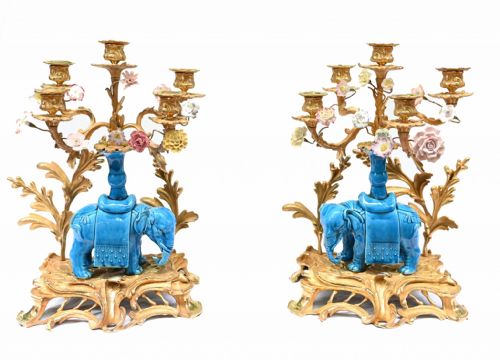


Porcelain Table Candelabra
Porcelain table candelabra bring elaborate Victorian design and intricate figurine work directly to the dining table or mantelpiece.
Porcelain Table Candelabra
Porcelain table candelabra combine multi-branch candleholders with glazed ceramic bodies, often taking the form of figural groups or animal subjects. The pieces appearing here span the Victorian era, particularly the late nineteenth century around eighteen eighty to nineteen hundred.
Buyers encounter distinct regional traditions within this group, including German factories such as Meissen, Sitzendorf, Saxony, and Dresden, alongside French Sevres style pieces and English Royal Worcester Hadley works. Many survive as matched pairs, though individual examples and clock garniture sets also occur.
The decorative vocabulary draws heavily on Rococo Revival styles, incorporating scrolled mounts and naturalistic motifs alongside birds, elephants, and human figures. These objects served as centrepieces for formal dining settings as well as decorative garnitures flanking mantel clocks.
Materials and Construction
The ceramic components integrate with metalwork mounts, specifically ormolu and gilt bronze, which form the structural arms and ornate bases supporting the candle sockets. This combination required skilled assembly to join fragile fired porcelain securely to heavy cast metal frames.
Porcelain Table Candelabra Retail Price Guide 2026
Typical asking prices for porcelain table candelabra among the pieces listed under this phrase on Sellingantiques today, from the lower quarter to the upper quarter. They describe what is for sale here now, not the wider market.
Victorian dining tables once glowed beside porcelain elephants and exotic birds holding up the evening light.
Assessing Quality and Execution
The refinement of the modelling separates standard production from superior examples, visible in the hand-painted expressions of figures and the crispness of moulded feathers or drapery. Finer pieces demonstrate careful attention to detail in every leaf and petal of the floral ornamentation.
The quality of the metal mounts similarly defines the tier of the piece, with heavily chased ormolu and gilt bronze providing a richer contrast to the white or painted porcelain bodies than simpler gilt metal alternatives.
Sitzendorf·Meissen·Royal Worcester Hadley·Dresden
The Porcelain Table Candelabra Glossary
- Ormolu
- Gilt bronze mounted on decorative objects, created by applying a mercury and gold amalgam to cast bronze before heating. This technique produced a durable golden finish characteristic of nineteenth-century decorative arts.
- Clock Garniture
- A set comprising a mantel clock accompanied by matching side pieces such as candelabra or urns. These matched groupings created a cohesive decorative scheme for formal nineteenth-century interiors.
- Rococo Revival
- A nineteenth-century design movement emulating the asymmetrical scrolls, C-curves, and naturalistic shell motifs of the eighteenth-century French Rococo period. This style dominates the ornamentation found on Victorian table candelabra.
- Figural Candelabra
- Candleholders incorporating human figures, animals, or mythological subjects as the primary structural and decorative elements of the stem. These sculptures often depict pastoral scenes or exotic animals.
Porcelain Table Candelabra: Frequently Asked Questions
What are porcelain table candelabra?
These decorative objects combine branch candleholders with ceramic bodies, frequently decorated with hand-painted enamels and gilt highlights. They were produced by major European factories during the nineteenth century.
Most examples incorporate figural or animal subjects modelled in the Rococo Revival style, mounted onto metal bases or paired with ormolu arms.
How were these candelabra used?
Victorian households placed them on dining tables as formal centrepieces or arranged them on mantelpieces alongside matching clocks as garniture sets. They provided both ambient lighting and high-status interior decoration.
When fitted with multiple arms, they held several candles to illuminate evening gatherings and social events.
How do I care for porcelain candelabra?
Clean the porcelain surfaces gently using a soft, dry brush or a lightly dampened cloth without harsh chemical detergents. Avoid touching painted enamel and gilt areas aggressively to preserve the finish.
Take care when handling the metal mounts and delicate porcelain arms, as the joins between ceramic and metal represent vulnerable points.
How do I identify nineteenth-century pieces?
Examine the style of the modelling, the palette of the enamel paint, and the nature of the metal mounts, which typically reflect Victorian taste or Rococo Revival design. Factory marks on the underside of the porcelain often provide specific attribution.
The weight and colour of the gilt bronze or ormolu further help distinguish period production from later reproductions.