

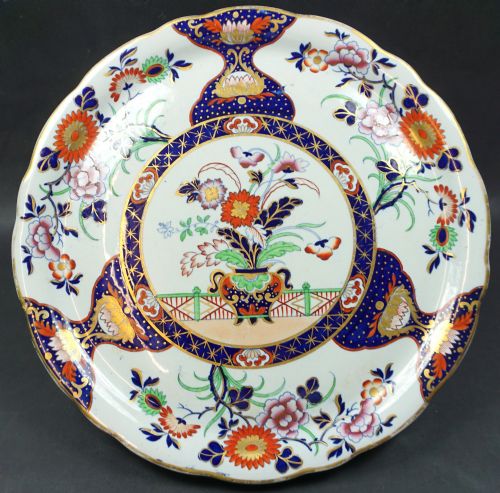
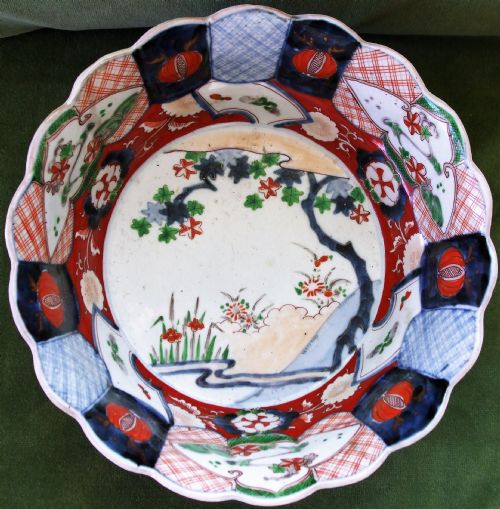
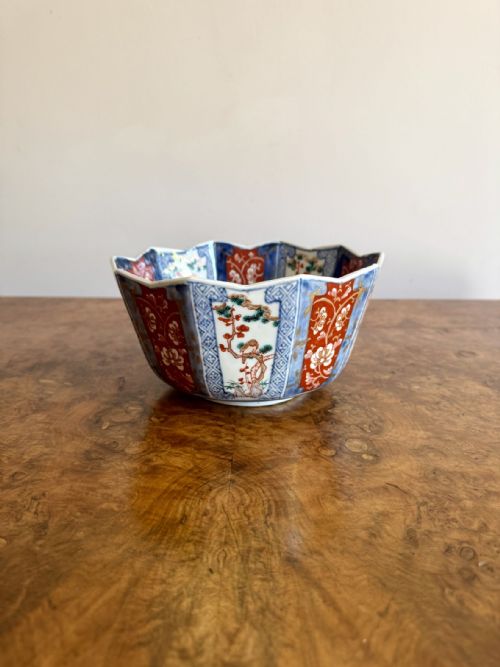


Polychrome Imari Dish
A polychrome imari dish brings together rich iron-red and cobalt blue pigments on porcelain, offering a decorative surface that collectors prize for its depth.
Polychrome Imari Dish
A polychrome imari dish is a ceramic piece defined by its vibrant palette, typically combining underglaze blue with overglaze iron red, gold, and secondary enamel colours. These items span various periods, including the Edo and Meiji eras, alongside nineteenth-century English interpretations of the aesthetic.
The objects appearing on this page take the form of chargers, plates, bowls, and serving platters, originating from both Japanese kilns and English potteries influenced by eastern designs. Buyers encounter circular chargers, scalloped edge bowls, and square plates that demonstrate distinct regional traditions.
Japanese examples present characteristic motifs such as koi carp and dragon patterns, while English counterparts from makers such as Mason's employ ironstone ceramic bodies with chinoiserie and Japan basket decorations. Each variant reflects the cross-cultural exchange of ceramic styles over successive centuries.
Materials and Construction
Potters constructed these pieces using porcelain, ironstone, and stoneware bodies, shaped by hand or moulded into plates, chargers, tureens, and bowls. The ceramic base received an initial firing before artisans applied underglaze cobalt blue pigment.
Overglaze enamel decoration followed the primary firing, incorporating iron red, glaze, and gold leaf highlights to build complex motifs. Subsequent low-temperature firings fixed the polychrome enamels and gilding securely to the vitreous surface.
Materials recorded across the inventory include porcelain, ironstone, enamel, gold leaf, and glaze.
Distinctions in Quality
Quality rests in the crispness of the underglaze blue cobalt and the precise placement of overglaze enamel and gilding across the porcelain surface. Superior examples maintain intact gilding and vivid enamel colours without heavy rubbing or loss.
The fineness of the potting, the symmetry of moulded edges such as scallop shapes, and the clarity of painted details like koi carp or floral motifs separate standard utility wares from exhibition-grade chargers and decorative plates.
Hicks & Meigh·Mason's·Flight Barr & Barr·John Ridgway·Minton·Chamberlain Worcester·Coalbrookdale·Derby
The Polychrome Imari Dish Glossary
- Imari
- A style of Japanese porcelain originally exported from the port of Imari, distinguished by a palette of cobalt blue, iron red, and gold. This decorative scheme was later copied by European factories.
- Ironstone
- A patented ceramic body developed in nineteenth-century England to provide a durable, dense alternative to porcelain. It frequently received transfer-printed and hand-painted polychrome decoration.
- Charger
- A large decorative plate or platter intended primarily for display on a wall, sideboard, or table rather than standard dining use. These pieces often feature complex central motifs.
- Overglaze
- Enamel decoration applied on top of the fired glaze, requiring an additional low-temperature firing to adhere. It allows for a wider range of bright colours such as iron red and gold leaf.
- Meiji Period
- A span of Japanese history lasting from 1868 to 1912, known for intense artistic production and increased export of decorative arts to Western markets.
Polychrome Imari Dish: Frequently Asked Questions
How do I identify a Japanese imari piece from an English copy?
Japanese examples utilise a true porcelain body with characteristic spur marks and hand-painted iron-red and cobalt pigments applied directly to the biscuit or glaze. English versions frequently employ heavy ironstone ceramics marked by domestic potteries.
Examination of the foot ring and the weight of the ceramic helps determine the origin, as English ironstone tends to be denser and thicker than traditional Japanese porcelain.
Were these chargers used for dining or display?
Large chargers and decorative plates were primarily produced for display on sideboards or walls, functioning as ornamental objects in country houses and parlours. Smaller plates and dishes saw use in dessert and dining services.
The presence of heavy gilding and intricate overglaze enamels on larger chargers indicates they were not meant for heavy daily culinary service.
What does the term black ship imari mean?
Black ship imari refers to wares associated with the arrival of Western trade vessels in Japan, reflecting the historical contact between nations during the nineteenth century. These pieces often incorporate specific historical motifs related to maritime trade.
Collectors look for these items as documentation of the economic and cultural exchange of the Meiji period.