


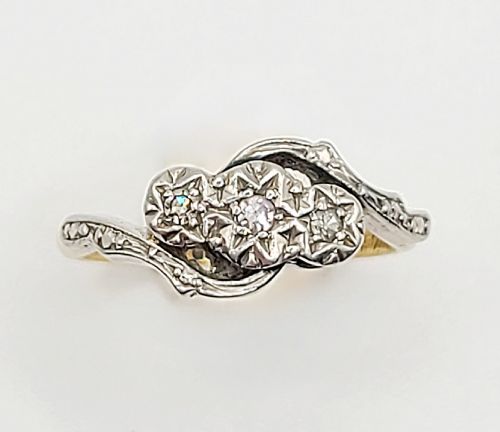


Platinum Illusion Set Ring
These platinum illusion set ring pieces combine precious metals with clever setting work to make smaller stones look substantial on the hand.
Platinum Illusion Set Ring
The pieces on this page lean heavily towards the Art Deco period, alongside Edwardian and 1950s or 1960s examples. Most combine a platinum setting or head with an 18ct gold or yellow gold band, creating the classic two-tone look of the era.
Materials and construction
Craftsmen built these rings using solid platinum alongside 18ct gold, white gold, yellow gold, and occasionally 9ct gold bands. The defining characteristic is the illusion setting itself, where metal facets surround the diamond to trick the eye into seeing a larger stone.
Diamonds used in these rings include brilliant cuts, transitional cuts, and princess cuts, held securely within meticulously worked metal collars. The combination of durable platinum for the head and gold for the shank provided both structural strength and visual contrast.
Materials documented across the pieces include platinum, diamond, 18ct gold, yellow gold, white gold, and 9ct gold.
Quality factors
Quality in a platinum illusion set ring rests on the crispness of the metalwork surrounding the stone and the proportion of the setting to the band. Finer examples show sharp geometric lines in the illusion plates and seamless integration between the platinum head and the gold shank.
The choice of diamond cut and the weight of the precious metals also shift pieces across the spectrum. Better specimens maintain substantial shank thickness and secure, well-finished setting work that has survived decades of daily wear.
The Platinum Illusion Set Ring Glossary
- Illusion setting
- A metal mounting technique that surrounds a diamond with faceted platinum to magnify its apparent size and brilliance.
- Solitaire
- A ring featuring a single prominent gemstone, commonly found among the Art Deco and vintage pieces here.
- Trilogy ring
- A ring set with three stones, often representing past, present and future in engagement and anniversary jewellery.
- Transitional cut
- A diamond cutting style bridging the old European cut and the modern brilliant cut, seen in mid-century pieces.
- Art Deco
- A design style spanning the 1920s and 1930s characterised by geometric symmetry, clean lines and platinum-topped gold.
Platinum Illusion Set Ring: Frequently Asked Questions
What is an illusion setting?
An illusion setting uses a specially faceted metal plate around a diamond to make the stone appear much larger than it actually is.
This technique became popular in earlier twentieth-century jewellery as a way to maximise visual impact.
Are these rings suitable for daily wear?
Most of these pieces are sturdy enough for everyday wear, particularly those combining platinum heads with gold bands.
Platinum is exceptionally durable and holds small stones securely within these specialised mountings.
How do I date a platinum illusion ring?
Dating relies on stylistic clues such as geometric Art Deco motifs, Edwardian filigree work, or later mid-century proportions.
Materials also help, as combinations of platinum and 18ct yellow gold appear frequently in 1920s and 1930s pieces.
What gold purities are used?
These rings typically use 18ct gold for the band, often in yellow gold paired with a platinum setting.
Some examples also incorporate white gold or 9ct gold alongside the platinum components.