







Pirot Carpet Flatweave
These pirot carpet flatweave textiles offer striking Balkan traditional design, bringing geometric presence and rich cultural history to any interior.
Pirot Carpet Flatweave
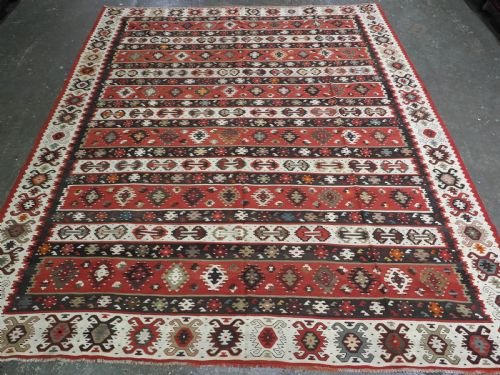
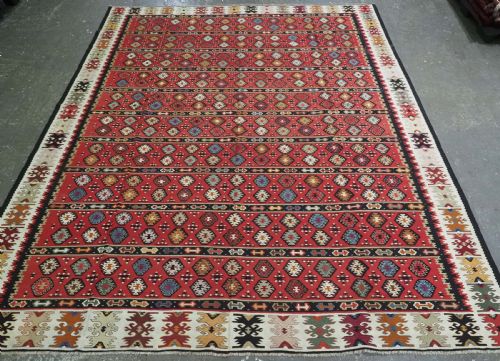
A pirot carpet flatweave brings together traditional Balkan folk art and Ottoman design influences, forming distinctive flat-faced tapestries without a pile. The examples seen here belong primarily to the early twentieth century, spanning from nineteen hundred through nineteen thirty.
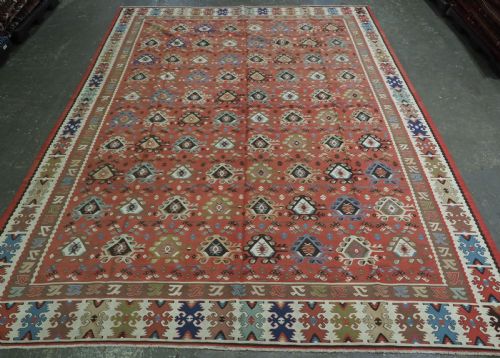
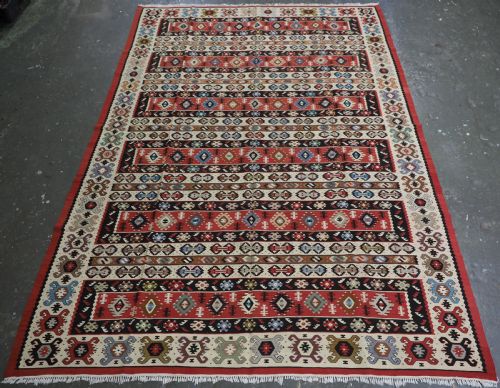
Buyers encounter regional weaving styles often attributed to Pirot and Sarkoy, manifesting in large room sizes as well as smaller area rugs. The decorative vocabulary relies heavily on classic repeats, banded layouts, flowering trees, and lattice patterns.
Materials and Construction
These textiles utilise wool and cotton foundations, woven as kilim rugs to create reversible surfaces with sharp, geometric pattern definitions. The structural integrity relies on tightly packed weft yarns concealing the warp completely.
Natural dye palettes create the soft, warm colours observed across the inventory, lending deep tonality to the repeat medallions and banded borders.
These rugs are so precisely woven that even the sheep occasionally check their work for symmetry.
Evaluating Quality and Design
Quality rests in the precision of the geometric repeat and the crispness of the lattice or flowering tree motifs. Stronger examples display deliberate balance across large room dimensions.
The visual appeal depends heavily on the preservation of warm soft colours and the complexity of the original design layout, distinguishing standard repeating patterns from scarcer compositional variants.
The Pirot Carpet Flatweave Glossary
- Kilim
- A flatweave textile produced by tightly interweaving warp and weft strands without creating a pile. This technique produces a lightweight, reversible rug suitable for both floor placement and wall hanging.
- Pirot
- A regional weaving centre known for producing distinctive flatweave carpets with traditional Balkan and Ottoman motifs. These textiles are celebrated for their intricate geometric precision.
- Sarkoy
- A regional designation frequently associated alongside Pirot for flatweaves sharing similar Balkan traditional design characteristics. Pieces carrying this attribution show comparable aesthetic qualities.
- Balkan Folk Art
- The cultural decorative tradition informing the motifs, colour choices, and geometric structures found in these flatweaves. It reflects local heritage and regional craftsmanship.
- Flatweave
- A textile construction method where no pile is knotted into the warp, resulting in a smooth, flat surface. These pieces rely entirely on the interaction of coloured weft threads for their design.
Pirot Carpet Flatweave: Frequently Asked Questions
How do I clean a flatweave rug?
Gentle surface cleaning and regular light vacuuming without a rotating brush help maintain wool and cotton flatweaves.
Professional specialist cleaning is recommended for heavier maintenance to protect the natural dyes and weave structure.
Can I place these rugs on the floor?
These flatweaves function well as area rugs in rooms with moderate foot traffic when paired with a quality underlay.
The lack of a pile makes them particularly suitable for spaces where door clearance is limited.
How are different production periods identified?
Dating relies on stylistic markers, wool characteristics, and traditional dye analysis typical of the early twentieth century.
Comparison with documented regional examples helps narrow the production window between nineteen hundred and nineteen thirty.
What defines the Pirot and Sarkoy style?
The style combines Balkan folk traditions with Ottoman influences, showcasing banded layouts, repeat medallions, and flowering trees.
Sharp geometric transitions characterise the visual language of these woven pieces.