

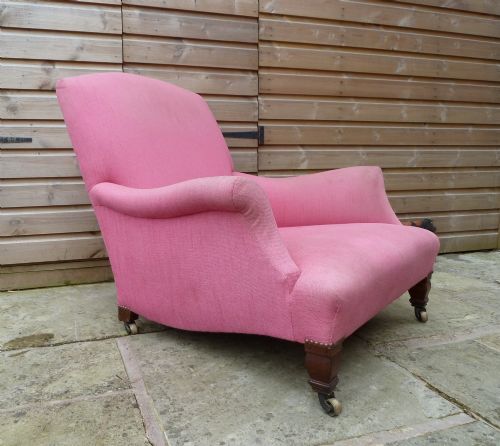
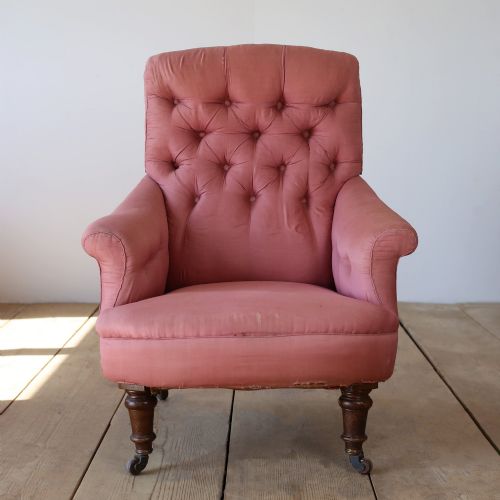
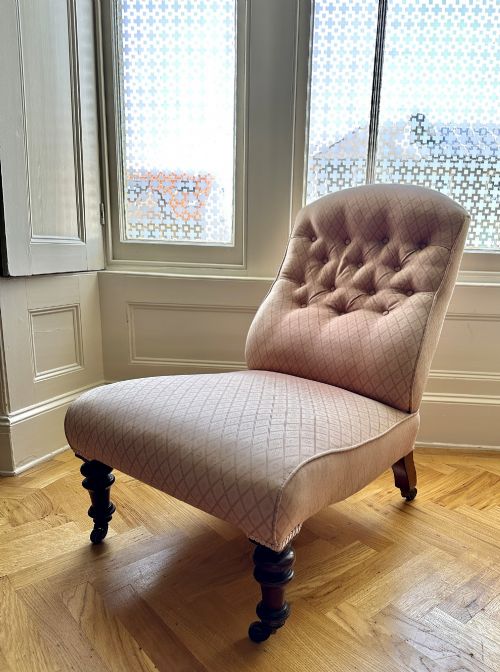


Pink Fabric Armchair
A pink fabric armchair brings warmth and character into a room, offering deep comfort alongside period charm.
Pink Fabric Armchair
A pink fabric armchair encompasses low slipper chairs, button-backed drawing room seats, and deep-seated loungers built across the nineteenth and early twentieth centuries. These upholstered forms range from compact bedroom chairs to substantial library seats standing on timber frames.
Victorian and Edwardian workshops produced the majority of these pieces, often adopting earlier Georgian or Howard styles. Buyers will frequently encounter button upholstery, mahogany or walnut frames, and low profiles designed for intimate sitting rooms.
The seating includes matching footstools and occasional pairs upholstered in velvet, cotton, or damask. Each piece combines structural timber work with soft textiles to create a distinctive focal point for modern or traditional interiors.
How they were made
Frames rely on sturdy timbers such as mahogany, walnut, and hardwood to provide a rigid structural skeleton. Makers shaped these woods into cabriole or ball and claw feet, supporting the heavy internal stuffing required for deep seats.
Upholstery techniques combined traditional coil springing with hand-stitched horsehair or stuffing, secured beneath top covers of velvet, damask, cotton, or fabric. Brass castors frequently assisted movement on heavy carpeted floors.
Pink Fabric Armchair Retail Price Guide 2026
Typical asking prices for pink fabric armchair among the pieces listed under this phrase on Sellingantiques today, from the lower quarter to the upper quarter. They describe what is for sale here now, not the wider market.
Low slipper chairs were originally built close to the floor so ladies could fasten their footwear without tumbling over.
What varies in quality
Quality rests in the integrity of the timber frame and the refinement of the carved details, from simple turned legs to intricate ball and claw feet. A well-constructed mahogany or walnut base holds its joints firmly without movement.
The execution of the upholstery work, particularly the precision of button-backed tufting and the selection of the top cover material, distinguishes standard production from exceptional workshop output.
Howard and Sons·James Shoolbred
The Pink Fabric Armchair Glossary
- Button back
- A traditional upholstery method where deep buttons are pulled through the padding to create a distinctive diamond-patterned indentation. This technique provides both structural tension and decorative depth.
- Slipper chair
- A low-set bedroom armchair designed originally to assist ladies with their shoes without obstruction. These pieces sit close to the floor and usually feature high backs.
- Damask
- A reversible figured fabric traditionally woven on a jacquard loom with patterns formed by contrasting warps and wefts. It adds a subtle sheen and texture to formal seating.
- Cabriole leg
- A furniture leg that curves outward in a convex arc and tapers inward in a concave arc, ending in a pad or foot. It derives from classical forms popularised during the eighteenth century.
- Ball and claw
- A furniture foot carved to resemble a bird's talon gripping a spherical ball. This decorative feature appears frequently on substantial Edwardian and revival seating.
Pink Fabric Armchair: Frequently Asked Questions
What periods do these armchairs come from?
The available pieces originate primarily from the nineteenth century, the Victorian era, and the early twentieth century up to nineteen twenty. Makers also produced later pieces drawing upon earlier Georgian design motifs.
These dates reflect the manufacturing eras represented in the current selection, encompassing both original period items and faithful revival pieces.
Which woods form the frames?
Makers constructed the internal and visible frames using mahogany, walnut, and general hardwood. These dense timbers provided the necessary strength to support deep springing and heavy daily use.
Exposed woodwork often received polishing to highlight the natural grain of the mahogany or walnut beneath the upholstery.
What fabrics cover the seats?
Upholstery options span velvet, damask, cotton, and standard woven fabric. These materials were chosen for their durability as well as their tactile and visual appeal in drawing rooms and libraries.
Some pieces retain earlier top covers while others feature later renewal work suited to contemporary interiors.
How do I identify a slipper chair?
Slipper chairs stand noticeably lower to the ground than standard armchairs and lack cumbersome armrests. Their compact proportions were originally intended for dressing rooms and bedrooms.
They often feature button-backed upholstery and upright backs designed to support the sitter in an upright posture.