
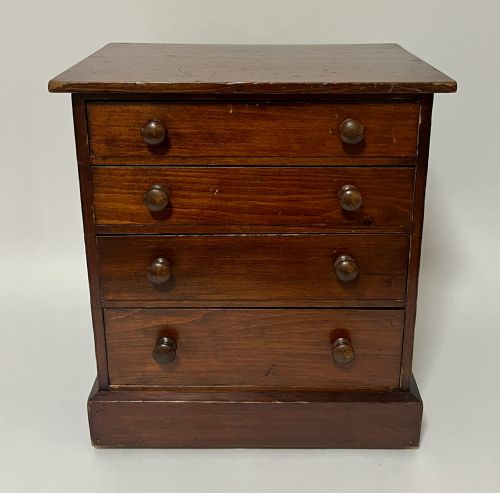
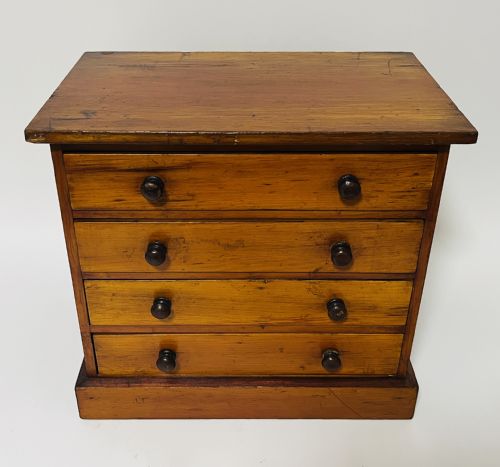


Pine Apprentice Chest
These small pine apprentice chests are charming scaled-down pieces of cabinet work that offer practical storage and timeless appeal.
Pine Apprentice Chest
A pine apprentice chest is a miniature set of drawers or a small cabinet created to demonstrate a woodworker's skill or to serve as a salesman's sample. These charming objects mirror the full-sized furniture of their era, executed in miniature scale.
You will most commonly meet pieces from the Victorian period, along with examples spanning the Georgian era up to the 1930s. They appear in styles ranging from rustic country to more formal Victorian and Georgian designs.
The forms vary from simple miniature chests of drawers to spice boxes, specimen cabinets and tool trunks with fitted interiors. Most examples are constructed primarily from pine or pitch pine, sometimes combined with oak.
How they were made
Construction relies heavily on pine and pitch pine, occasionally enhanced with oak, ebonised wood or decorative paint finishes. Cabinet makers utilised traditional joinery techniques suited to small-scale work.
Fittings such as brass handles, pulls and glass panels appear on specific specimen and collector cabinets. Surfaces are often finished with stain, paint or natural patination developed over decades of handling.
Forms include spice boxes, specimen cabinets, miniature chests of drawers and wall-hanging storage units.
What varies in quality
Quality rests in the precision of the miniature joinery and the proportionality of the drawers and mouldings. Finer pieces display careful attention to detail, such as ebonised moulding or well-fitted interiors.
The choice of secondary woods and the quality of the timber grain also separate standard utility items from more accomplished cabinet maker work. Original surfaces and patination heavily influence the desirability of a piece.
The Pine Apprentice Chest Glossary
- Apprentice piece
- A small-scale item made by a trainee woodworker to prove their proficiency to a guild or master. These objects demonstrate the full range of cabinet making skills on a reduced scale.
- Pitch pine
- A durable resinous softwood frequently utilised in 19th-century furniture making. It provides a distinct grain pattern and robust structure.
- Ebonised wood
- Timber treated with a dark finish to imitate expensive ebony. This technique creates high-contrast decorative mouldings and details.
- Specimen cabinet
- A small piece of furniture designed for holding natural history collections or small objects. They often feature multiple shallow drawers or glass doors.
- Spice box
- A small wall-hanging or tabletop cabinet containing miniature drawers for storing culinary spices. These functional boxes frequently date to the Georgian and 19th-century periods.
Pine Apprentice Chest: Frequently Asked Questions
What were apprentice chests actually used for?
These small chests served primarily as test pieces where a woodworker demonstrated mastery of dovetailing, drawer construction and finishing to a guild or master.
Some also functioned as salesman samples or personal tabletop storage for precious items in the home.
How do I date a pine apprentice chest?
Dating relies on observing construction methods, timber types and overall stylistic details that match documented periods like the Georgian or Victorian eras.
Nail types, drawer construction and the presence of specific secondary woods like oak help narrow down the decade of manufacture.
Where should I place one at home?
Their compact scale makes these chests versatile for placement on top of larger sideboards, desks or chest of drawers.
They also sit comfortably on bookshelves or dedicated display tables where their miniature details can be easily appreciated.
Are painted finishes original?
Many pieces retain historic paint or stained finishes that reflect the decorative tastes of the country and folk art traditions.
Careful inspection of the underlying timber helps determine whether a painted surface was applied during the period of manufacture.