
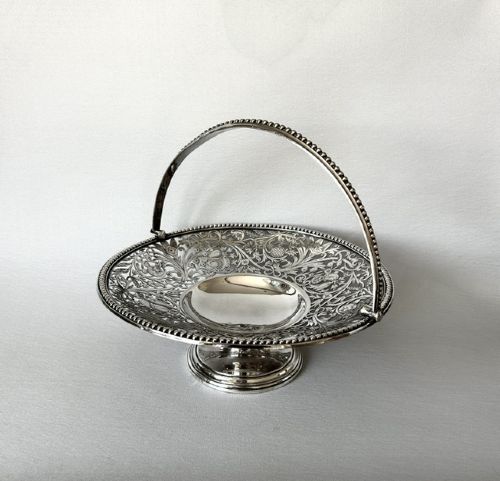
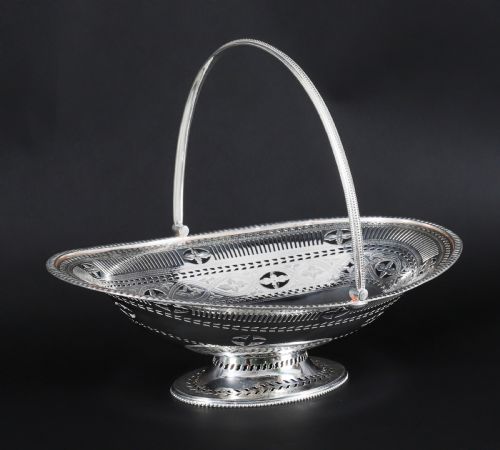


Pierced Pedestal Bowl
These pierced pedestal bowl examples elevate a table through openwork metal and porcelain supported on raised feet.
Pierced Pedestal Bowl
A pierced pedestal bowl serves as a decorative centrepiece or fruit basket, raised on a foot to command attention in a room. When you search for a pierced pedestal bowl, you encounter forms ranging from Edwardian silver baskets to Victorian neoclassical dishes and French porcelain vessels.
The selection here encompasses centrepieces, fruit baskets, sugar baskets, and tazzas dating across the nineteenth and twentieth centuries. These objects frequently exhibit lattice work, fretwork, or wirework alongside cobalt blue glass liners and porcelain bodies.
Originating from English, German, French, and Chinese traditions, the inventory spans diverse styles such as Rococo Revival, Art Deco, and French Empire. You are most likely to meet Edwardian sterling silver examples alongside nineteenth-century porcelain and silver-plated fruit baskets.
How they were made
Silversmiths utilised sterling silver and silver plate, employing piercing, fretwork, and lattice techniques to create intricate openwork patterns in metal bowls and baskets. German and English makers often combined pierced silver frames with blown cobalt blue glass liners.
Object forms span centrepieces, fruit baskets, tazzas, sugar baskets, and comports from English and continental workshops.
What varies in quality
The quality of a pierced pedestal bowl rests upon the crispness of the openwork piercing and the substantial weight of the silver or bronze structure. Superior pieces display finely hand-pierced lattice or wirework rather than simpler stamped patterns.
Makers such as Joseph Rodgers, Walker & Hall, and James Dixon & Sons delivered rigorous silversmithing, reflected in clear hallmarks and balanced proportions. In porcelain and glass, the refinement of the glaze, the delicacy of applied figures, and the intact survival of removable liners dictate the tier of the piece.
Joseph Rodgers·Viners·Walker & Hall·Hammond, Creake & Co·James Dixon & Sons·James Deakin And Sons
The Pierced Pedestal Bowl Glossary
- Pierced
- Work decorated with holes or openwork patterns cut through the material. This technique lightened the visual weight of silver baskets and fruit dishes.
- Pedestal
- A base or foot that elevates a vessel above the table surface. Pedestal feet give bowls and comports greater vertical presence.
- Comport
- An ornamental dish or bowl raised on a stand, used for serving fruit or sweets. These pieces typically sit centrally on dining tables.
- Fretwork
- An ornamental design in metal or wood produced by piercing. It creates an intricate geometric or floral lattice effect.
- Tazza
- A small, broad saucer-shaped vessel mounted on a stem and foot. French Empire examples often utilise gilt bronze.
Pierced Pedestal Bowl: Frequently Asked Questions
What is a pierced pedestal bowl used for?
These elevated vessels served primarily as centrepieces, fruit baskets, and sugar containers on formal dining tables. Their openwork design allowed air to circulate around fruit or functioned as decorative display objects.
Over time, collectors repurposed them for pot pourri, floral arrangements, or standalone table decoration. Their raised form ensures they draw the eye wherever placed in a room.
How do I identify an Edwardian pierced bowl?
Edwardian pieces often feature crisp lattice or fretwork executed in sterling silver, dating from the early twentieth century. Makers such as Joseph Rodgers and Walker & Hall dominated this era with substantial silver table bowls.
Look for clear hallmarks indicating Birmingham or Sheffield assay offices alongside dates around 1900 to 1910. The styling leans towards refined Edwardian elegance rather than heavy Victorian ornamentation.
Are glass liners original to these bowls?
Many silver baskets and centrepiece bowls were manufactured with fitted cobalt blue glass liners to hold fruit or moisture safely. Surviving original liners add significant completeness to silver-plated and solid silver openwork frames.
When inspecting pieces from makers like those in late Victorian and Edwardian periods, check whether the glass matches the interior contours of the pierced metal.
How do I care for silver-plated and sterling silver bowls?
Sterling silver and silver-plated items require gentle cleaning with a soft cloth and specialist silver polish to maintain their finish. Avoid abrasive materials that can wear down delicate fretwork and piercing.
Store them in stable environments away from extreme humidity to protect both the metal and any accompanying glass or porcelain elements.