





Persian Ziegler Carpet
A persian ziegler carpet brings room-anchoring scale and muted, Western-adapted palettes directly from late nineteenth-century looms into domestic spaces.
Persian Ziegler Carpet
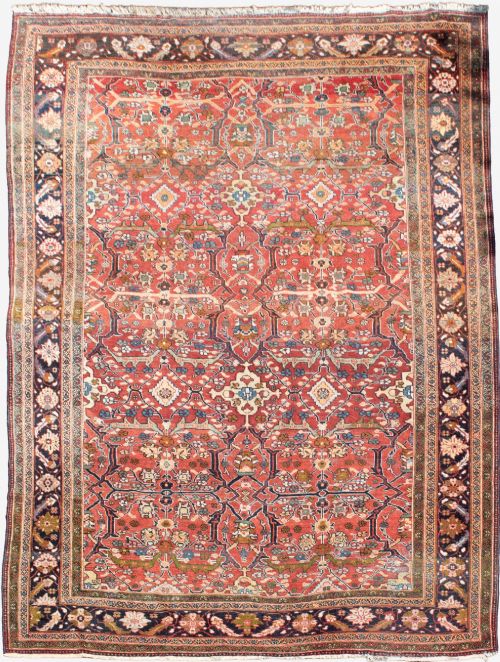
A persian ziegler carpet represents a specific nineteenth-century commercial evolution, designed by European firms like Ziegler and Co in Manchester and produced in Western Persia. These floor coverings bridge traditional Persian floral design with Western decorative tastes, using subdued colours and expansive open fields suited to Victorian drawing rooms.
The inventory on this page consists predominantly of nineteenth-century pieces bearing styles such as Sultanabad, Mahal, and Fereghan Ziegler, dated chiefly around the 1880s and 1890s. Buyers will encounter both room-size formats and palace dimensions, all originating from the same West Persian weaving regions.
Materials and Construction
Makers constructed these carpets using wool pile knotted onto cotton foundations, a combination that provided both soft underfoot comfort and structural stability. The quality of the wool determines how the pile ages and how deeply the natural dyes take.
Weavers employed regional dyeing techniques to achieve the characteristic softer tones associated with the style, distinguishing them from more saturated contemporary Persian production. The resulting fabrics combine resilience with a pliable drape.
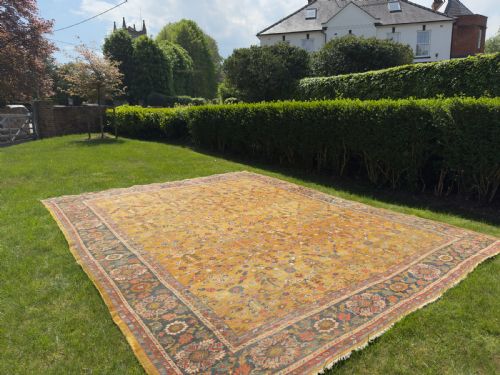
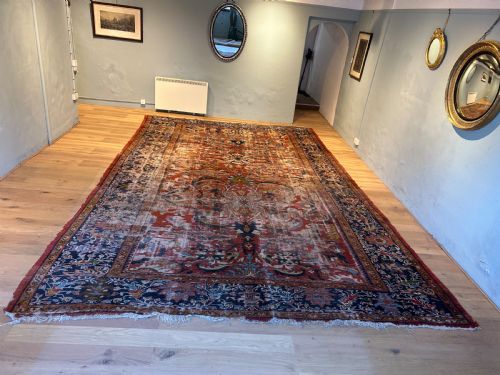
Several examples exceed five metres in length, designed originally to anchor sprawling Victorian country-house drawing rooms with generous floral expanses.
Factors That Separate Examples
The hierarchy among these pieces rests primarily on the handling of the wool and the precision of the large-scale floral drawing. Superior examples maintain crisp botanical lines across expansive fields without visual crowding or dye bleeding.
Proportion and scale also dictate worth, particularly in palace-size or country-house formats where maintaining balanced borders across large dimensions requires master planning by the workshop.
Ziegler and Co
The Persian Ziegler Carpet Glossary
- Sultanabad
- A West Persian weaving centre known for large-scale, open floral patterns. Carpets from this region often share aesthetic ground with Ziegler productions.
- Mahal
- A designation for rugs and carpets originating from the same general district as Sultanabad, typically featuring slightly simpler or more rustic village-level interpretations of workshop designs.
- Fereghan
- A geographical style marker associated with finer knot density and intricate Herati or palmette motifs found in specific nineteenth-century West Persian carpets.
- Wool
- The animal fibre used for the pile of these carpets, harvested and spun locally before being dyed with natural colourants.
- Cotton
- The vegetable fibre utilised for the warp and weft threads, creating the grid structure that holds the wool knots in place.
Persian Ziegler Carpet: Frequently Asked Questions
What is a persian ziegler carpet?
A persian ziegler carpet is a nineteenth-century floor covering produced in Western Persia for a European firm, tailored to Western interior design tastes.
These pieces typically feature large-scale floral motifs set against softened, muted backgrounds rather than the saturated hues of traditional Persian weaving.
How do I date a persian ziegler carpet?
Dating relies on stylistic markers, structural analysis of the cotton foundation, and the specific chemical or natural dye palette used during production.
Most surviving examples date from the 1880s and 1890s, reflecting the peak period of commercial workshop activity in the Sultanabad region.
Where were these carpets woven?
They were woven in Western Persia, specifically in and around the town of Sultanabad, which served as a major hub for commercial carpet production.
European supervision in these workshops ensured the designs matched the specific scale and colour preferences demanded by Western export markets.
How do I care for an antique carpet?
Maintenance requires gentle vacuuming without rotating brush heads to protect the wool pile, alongside professional cleaning when necessary.
Keeping the carpet out of direct, harsh sunlight preserves the muted natural dyes characteristic of these nineteenth-century floor coverings.