


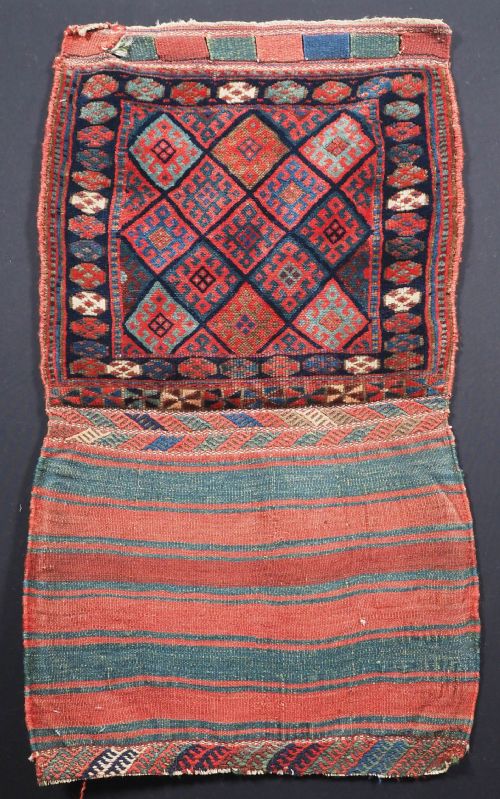


Persian Saddle Bag Face
A persian saddle bag face is a woven tribal textile fragment, prized for dense geometric patterns and portable folk artistry.
Persian Saddle Bag Face
When you search for a persian saddle bag face, you are looking at the decorative front panel of a utilitarian nomadic container, often detached from its plain weave back. These textiles originate from tribal groups including the Qashqa'i, Afshar, Khamseh, Luri, Shahsavan, Baluch, Kurdish, and Jaf confederations across Persia.
You are most likely to meet single bag faces woven in wool during the latter half of the nineteenth century and around nineteen hundred. They served practical nomadic functions for transport before surviving as collector pieces.
What Varies in Quality
The quality rests upon the handle of the wool and the clarity of the natural dye palette. Finer spinning and tighter knotting distinguish the more accomplished nomadic examples.
Design execution and completeness also separate the pieces, as surviving backs or intact structural edges elevate the historical context of the textile.
Persian Saddle Bag Face Retail Price Guide 2026
Typical asking prices for persian saddle bag face among the pieces listed under this phrase on Sellingantiques today, from the lower quarter to the upper quarter. They describe what is for sale here now, not the wider market.
Listings span from eighteen fifty to nineteen hundred, featuring wool, cotton, and natural dyes across various tribal regions.
The Persian Saddle Bag Face Glossary
- Khorjin
- The Persian term for a double saddlebag used by nomads for transport. These were balanced across pack animals during seasonal migrations.
- Soumak
- A flatweave technique employing wrap-threads to create a textured, durable surface without pile. This method produces crisp geometric patterning.
- Boteh
- A traditional almond-shaped motif representing a floral spray or cypress tree. It appears frequently in Afshar and tribal compositions.
- Pile
- The upright yarn surface of a rug formed by individual knots tied to the warp. It provides depth and softness to the textile face.
Persian Saddle Bag Face: Frequently Asked Questions
What is a saddle bag face?
A saddle bag face is the decorative front panel of a nomadic storage bag, separated from its plain weave back over time.
These panels survive independently as miniature tribal rugs, valued for their concentrated designs and portable scale.
How did nomads use them?
Nomadic tribes utilised these bags to transport possessions across rough terrain during seasonal migrations.
They hung in pairs across the flanks of horses, camels or donkeys, holding personal items and household goods.
How do I display a bag face?
Many collectors mount these textile fragments on fabric backings for wall hanging or display them on flat surfaces.
Their compact dimensions make them adaptable for interior spaces where a large carpet would not fit.
How are tribal groups identified?
Tribal attribution relies on specific design vocabulary, colour combinations, and structural weaving characteristics.
Groups like the Qashqa'i, Afshar, and Shahsavan each maintained distinct artistic traditions and knotting methods.