
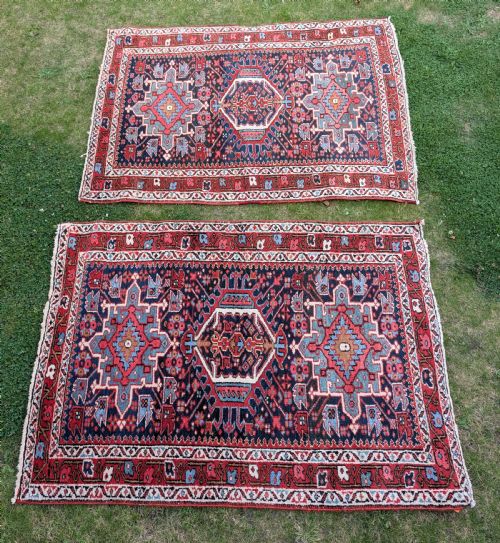
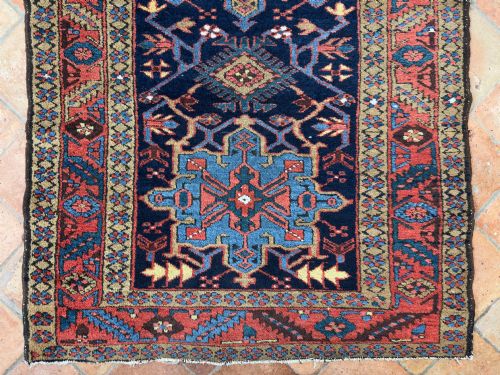
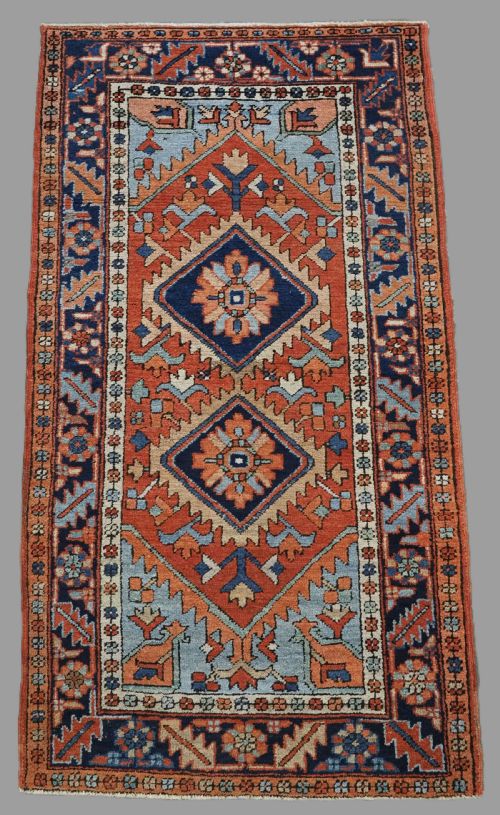


Persian Karaja Carpet
A persian karaja carpet brings heavy geometric structure and deep earthy tones into a room from nineteenth and early twentieth century North-West Persia.
Persian Karaja Carpet
A persian karaja carpet represents the robust weaving tradition of the Heriz region in North-West Persia. These pieces emerge from village workshops and nomadic camps, displaying bold medallion formats and geometric repeats.
Most examples found on this page take the form of small rugs, larger carpets, or elongated runners suited for hallways. The dates span from the late nineteenth century through to the 1930s.
Makers in these districts relied on traditional regional patterns passed down through generations. The resulting floor coverings combine utility with striking village aesthetics.
How a persian karaja carpet was made
The construction of a persian karaja carpet relies on hand-knotted wool pile secured on cotton foundations. Weavers tied dense knots by hand, creating a heavy and resilient fabric designed to endure heavy daily use.
Natural dyestuffs provided the rich palette seen across these rugs, yielding saturated blues, reds, and contrasting ivories. Artisans sourced local wool, spinning the yarn by hand before setting the dye.
Listings feature hand-knotted wool and cotton pieces spanning from the 1870s to the 1930s.
What varies in quality
Quality in a persian karaja carpet depends on the fineness of the knotting and the clarity of the geometric design. Tighter knots allow sharper definition in the central medallions and border details.
The choice of wool and the depth of the dye saturation also distinguish superior pieces. Even wear across an older rug indicates balanced materials, whilst well-preserved wool retains a characteristic crisp handle.
The Persian Karaja Carpet Glossary
- Karaja
- A village weaving tradition originating in North-West Persia near the Heriz district. These rugs are known for bold geometric medallions and sturdy construction.
- Runner
- An elongated narrow carpet format designed specifically for corridors, hallways, and staircases. They repeat central motifs along a linear axis.
- Medallion
- A central ornamental design motif placed in the middle of the carpet field. In this region, these motifs typically adopt angular, geometric polygon shapes.
- Pile
- The upright yarn loops forming the soft upper surface of the carpet. Hand-knotted wool pile provides both warmth and durability underfoot.
- Heriz
- A neighbouring carpet-weaving region sharing stylistic traits with Karaja production. Pieces from this district often exhibit large-scale geometric schemes.
Persian Karaja Carpet: Frequently Asked Questions
Where were these rugs made?
A persian karaja carpet comes from the North-West region of Persia, specifically originating in villages surrounding the town of Karaja near Heriz.
Weavers in this mountainous district produced distinctive tribal and village rugs that utilised durable wool and sturdy cotton foundations.
How do I place a runner?
Narrow formats such as a persian karaja carpet runner suit hallways, corridors, and narrow gallery spaces. Their elongated proportions guide movement through a home.
Ensure the floor beneath is level and use an appropriate underlay to prevent slipping and reduce friction on the wool pile.
How do I date these rugs?
Dating relies on examining the wool texture, natural dye palettes, and structural characteristics. Pieces on this page primarily date from the late nineteenth century to the early decades of the twentieth century.
Earlier examples often display a greater depth of saturated colour and hand-spun wool irregularities not found in later village production.
Are these rugs durable?
Hand-knotted wool construction makes a persian karaja carpet exceptionally resilient for everyday domestic use. The dense pile absorbs heavy foot traffic while maintaining its structural integrity.
Routine care involving gentle vacuuming without rotating brushes helps preserve the wool fibres across decades of placement.