
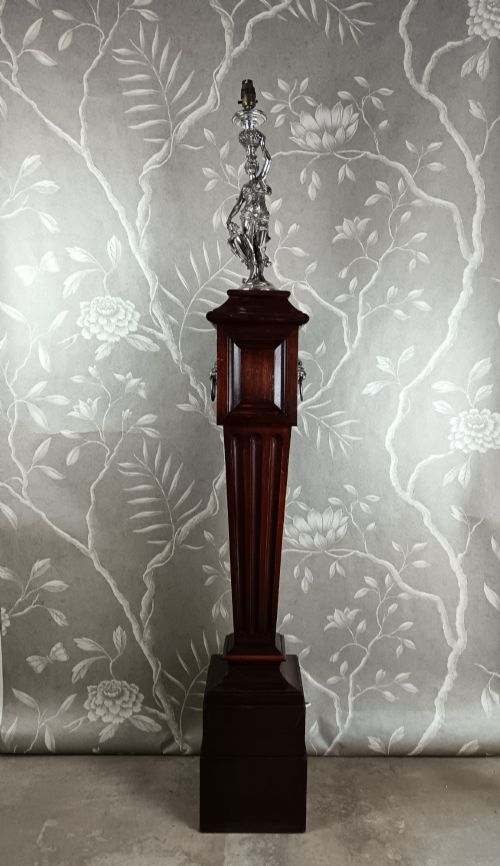


Pedestal Floor Light
A pedestal floor light brings height and drama to a room, rising from a solid base to cast upward illumination or hold a striking figure.
Pedestal Floor Light
When you search for a pedestal floor light, you encounter tall upright fixtures designed to stand directly on the floor and elevate a light source or decorative standard. The forms range from classical columns and carved figures to streamlined metal shafts and geometric pillars.
The selections span the nineteenth century up through the nineteen-thirties, covering periods such as Victorian, Edwardian, and Art Deco. Materials vary from heavy carved wood and mahogany to polished brass, bronze, marble, and chrome.
You meet various configurations, including standard oil lamps converted for electricity, grand figural torcheres, and upright alabaster bowls. Neoclassical revival designs and Venetian figures on stands appear frequently among the listings.
How pedestal floor lights were made
Metal components such as brass, bronze, and chrome utilise casting and openwork techniques to create ornate bases and structural shafts. Makers also employed silver-plating and gilt patination to enrich the metallic surfaces.
Woodworking traditions are visible in carved timber, padouk, teak, and mahogany pedestals shaped with classical proportions or intricate detailing. Stone elements incorporate solid marble and carved alabaster columns to support the heavier lighting hardware.
Materials span carved mahogany, heavy bronze, marble columns, and delicate Venetian gilt polychrome figures.
What varies in quality in pedestal floor lights
The sophistication of the casting and carving sets the standard for these tall upright pieces. Fine figural work and crisp botanical openwork display superior artisan skill compared to simpler, repetitive casting.
Materials dictate much of the structural integrity, with dense marbles, heavy bronzes, and solid hardwoods holding greater weight and permanence than lighter plated metals or composite builds. Original gilding and polychrome paint finishes preserve the intended visual impact far better than later over-painting.
The architectural harmony between the pedestal shaft, the base, and the upper lighting fitting determines the overall success of the design. Integrated components designed as a single unit outrank mismatched assembled parts.
WMF·F. De Luca·François-Christophe-Armand Toussaint
The Pedestal Floor Light Glossary
- Standard lamp
- A traditional British term for a freestanding vertical floor lamp. It usually incorporates a weighted base and a tall central column.
- Polychrome
- Painted in several colours. This finish appears frequently on carved wooden figures and stands from Venetian workshops.
- Openwork
- Metalwork or woodwork pierced with patterns to let light through. This technique creates delicate floral or geometric screens on lamp bases.
- Uplighter
- A lighting fixture that projects illumination straight up. These pieces gained popularity during the Art Deco era using chrome and glass.
Pedestal Floor Light: Frequently Asked Questions
How do I wire an old pedestal floor light?
Older tall lamps often require rewiring to meet modern electrical safety standards while preserving their original brass or bronze fittings.
A qualified electrician can thread modern flex through the internal channels without altering the exterior finish or structural integrity of the antique column.
Where should I place a heavy marble floor lamp?
Heavy stone and marble columns demand a stable, level spot on solid flooring to support their considerable weight safely.
Positioning them away from high-traffic pathways prevents accidental knocks while allowing the upward illumination to bounce effectively off nearby walls and ceilings.
How do I distinguish an oil lamp conversion?
Converted standard oil lamps usually retain a visible fuel reservoir, burner mechanism, or gallery space at the top of the wooden or brass column.
These functional elements were adapted for electrical wiring during the twentieth century, often keeping their original switches and screw fittings intact.
What is the difference between a torchere and a standard lamp?
A torchere specifically directs its light upward to illuminate a room via the ceiling, frequently mounted on a figural or classical pedestal.
A standard lamp generally carries a downward-facing shade supported by a simpler vertical column for localized task or ambient seating light.