
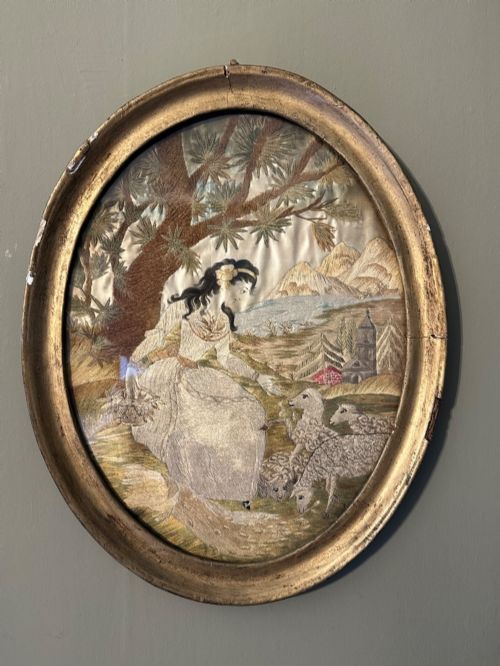


Pastoral Needlepoint Picture
These pastoral needlepoint picture examples capture quiet country scenes in silk and wool, bringing centuries-old rustic charm straight to your walls.
Pastoral Needlepoint Picture
A pastoral needlepoint picture brings rural life indoors through detailed threadwork depicting figures, gardens, and farming scenes. These textile works span the eighteenth and nineteenth centuries, including Georgian and Regency creations alongside Victorian pieces.
Most examples appear as framed wall art utilising linen grounds stitched with wool and silk. Buyers frequently encounter oval woolwork panels, rectangular silk embroideries, and framed tapestry pieces from British and continental makers.
The aesthetic shifts from restrained eighteenth-century compositions to ornate Victorian interpretations. Frames range from simple rosewood to elaborate giltwood and verre églomisé glass borders.
How They Were Made
Maker execution relies on fine stitches worked onto woven linen foundations using dyed silk and wool yarns. Gros point and petit point techniques allow artisans to achieve intricate facial details and textured foliage.
Framing forms an integral part of the construction, utilising giltwood, rosewood, and specialised mezzotint black glass. Gold leaf accents often enhance the surrounding wooden moulding to complement the textile within.
Object forms include framed tapestry, oval woolwork panels, and detailed crewel embroidery across various European origins.
What Varies in Quality
The refinement of the stitchwork dictates visual depth, separating master needlework from simpler domestic efforts. Finer silk threads allow for nuanced shading in figures and landscape backgrounds.
Original frames play a significant role in overall integrity, particularly scarce verre églomisé glass surrounds and untouched giltwood mouldings. The harmony between the textile art and its period frame defines the upper tier.
The Pastoral Needlepoint Picture Glossary
- Needlepoint
- A form of counted or freehand embroidery stitched onto a canvas or linen ground. It creates a dense, durable surface that covers the underlying fabric entirely.
- Verre Églomisé
- A cold decoration technique involving the application of gold leaf and painting onto the reverse side of glass. It produces a reflective, dark border often seen on Regency frames.
- Gros Point
- A coarser needlepoint stitch worked over two or more threads. It provides a robust texture frequently utilised for foliage and foreground elements.
- Mezzotint glass
- Dark glass panels used in period framing to create a tonal, reflective border around the artwork. It frames the textile without distracting from the central design.
Pastoral Needlepoint Picture: Frequently Asked Questions
How old are these needlework pictures?
These textile pieces primarily date from the eighteenth and nineteenth centuries, spanning Georgian, Regency, and Victorian eras.
Specific examples reach back as far as seventeen hundred, showing the longevity of traditional embroidery techniques.
What materials were used to make them?
Artisans stitched wool and silk threads onto linen foundations to build up the pastoral scenes.
Finished works were then housed in timber enclosures featuring giltwood, rosewood, gold leaf, and specialised glass.
Are the frames original to the pieces?
Many surviving examples retain their period frames, such as giltwood mouldings and mezzotint black glass surrounds.
Original framing helps preserve the textile by maintaining proper tension and sealing against environmental dust.
How should I hang textile art?
Needlework pictures require positioning away from direct sunlight to prevent the silk and wool threads from fading.
Stable indoor humidity levels protect both the underlying linen ground and the wooden or gilded frames.
What is the difference between silkwork and woolwork?
Silkwork utilises fine, lustrous threads that allow for delicate shading and a subtle sheen on figures and garments.
Woolwork employs heavier, matte yarns that provide rich textures and robust coverage for landscape elements.