



Parquetry Bombe Commode
A parquetry bombe commode brings together curved woodwork, geometric veneers and stone tops for a striking French storage piece.
Parquetry Bombe Commode
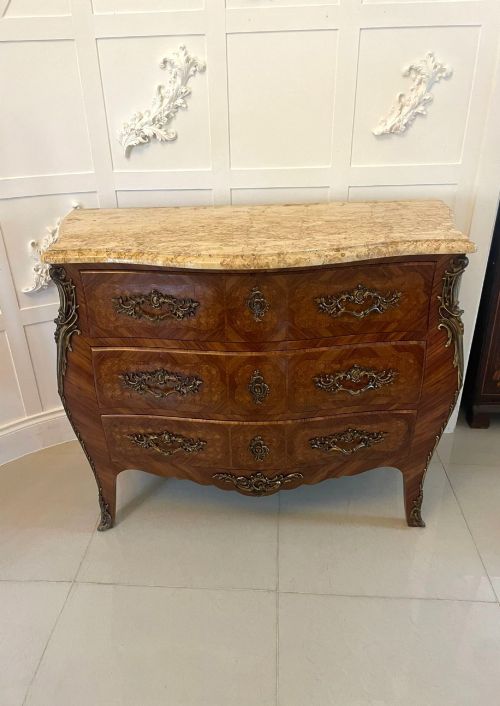
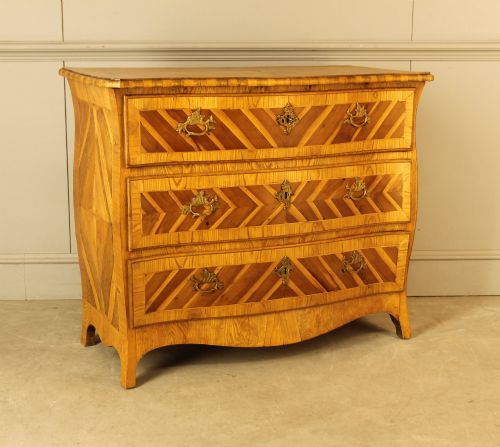
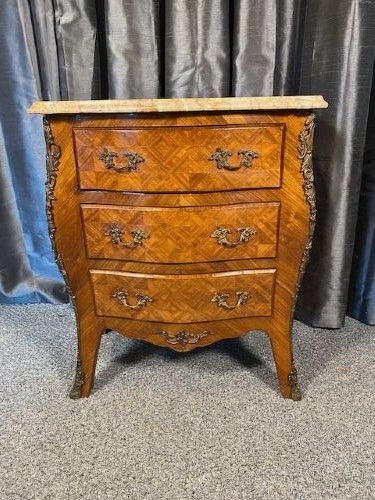
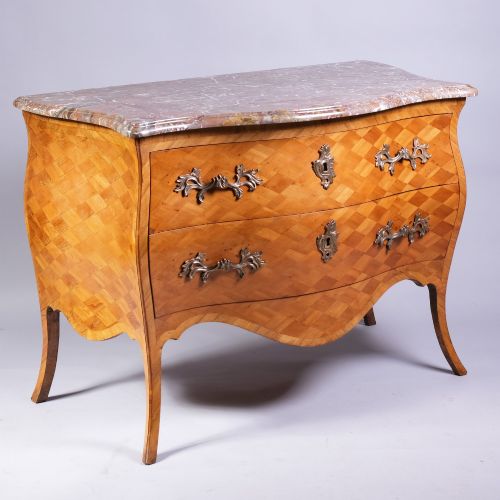
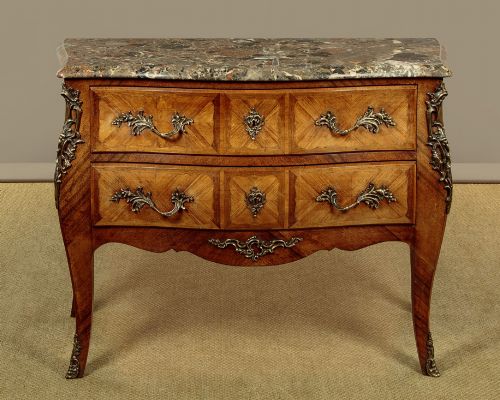
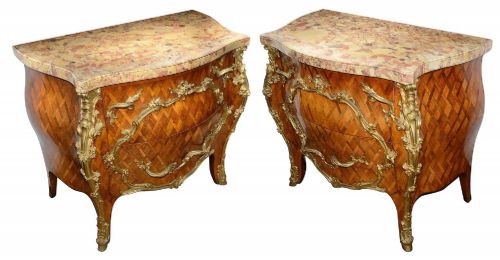
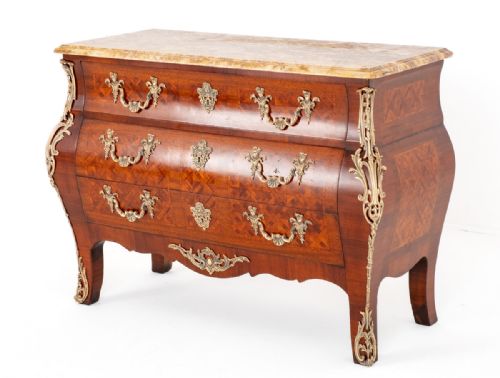
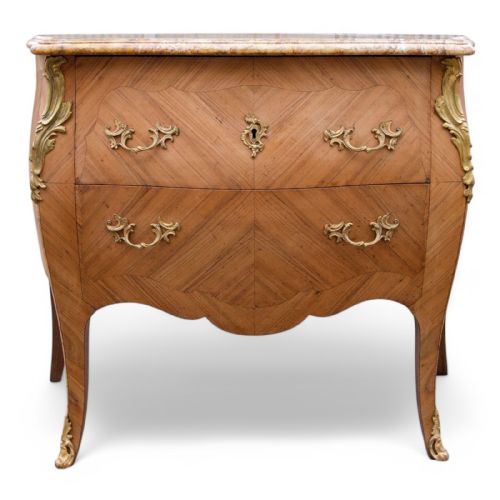
A parquetry bombe commode is a distinct form of chest of drawers defined by its swelling, outward-curving sides and front. When buyers search this phrase, they encounter pieces originating from eighteenth-century workshops alongside later revivals from the nineteenth and early twentieth centuries. The surviving examples include full-sized chests, bedside cabinets and smaller miniature pieces.
The style draws heavily on French Rococo and Louis design traditions, appearing frequently in walnut, kingwood, fruitwood and mahogany veneers. Continental pieces, particularly from Swedish and French makers, display the characteristic serpentine lines and sweeping profiles. These items function as grand decorative focal points while providing practical drawer storage.
How they were made
Craftsmen shaped these pieces by applying thin wood veneers, including kingwood, tulipwood, walnut and plum, onto a secondary timber carcase. The geometric parquetry patterns required precise cutting and fitting of individual wooden tesserae to follow the complex curves of the swelling frame.
Metal ornamentation played an essential structural and decorative role, with cast ormolu, gilt bronze and brass mounts fixed to the corners, feet and handles. Heavy marble slabs, cut to follow the serpentine contours, were then fitted as the top surface of the commode.
Miniature versions exist alongside full-sized chests, proving that even eighteenth-century cabinetmakers enjoyed building tiny, perfectly curved storage for doll-sized châteaux.
What varies in quality
The standard of execution depends heavily on the precision of the veneer work and the complexity of the wood grain chosen for the parquetry. Finer examples display seamless alignment across the curved drawer fronts, where the grain flows naturally despite the swollen contours.
The weight and crispness of the ormolu mounts also distinguish the better pieces from standard production. Higher quality items feature finely chiselled bronze mounts that integrate smoothly with the timber carcase rather than appearing stiff or heavily cast.
The Parquetry Bombe Commode Glossary
- Bombe
- A swelling, bulging contour found on the front and sides of furniture chests and cabinets. This curved shape requires specialised carpentry to veneer successfully.
- Parquetry
- A geometric mosaic of wood veneers arranged in repeating patterns such as cubes or chequers. It differs from marquetry by using strictly geometric shapes rather than pictorial designs.
- Ormolu
- Gilt bronze mounts applied to furniture edges, corners and feet for decoration and protection. The technique involves applying a gold amalgam to heated bronze.
- Kingwood
- A dense, dark exotic timber with rich brown and violet figuring used extensively for fine cabinet veneers. It became a favourite material in eighteenth-century French workshops.
- Serpentine
- A line or surface curving in a continuous wave, typically convex in the centre and concave at the sides. This contour softens the profile of large chests of drawers.
Parquetry Bombe Commode: Frequently Asked Questions
How do I date a bombe commode?
Dating relies on examining the construction methods of the carcase, the timber species used for the secondary woods, and the style of the ormolu mounts. Eighteenth-century examples typically show hand-cut dovetails and native European hardwoods beneath the veneers.
Later nineteenth and twentieth-century revivals often incorporate machine-cut elements and distinct hardware styling associated with historical copy work. Comparing the veneer types and decorative motifs against known historical periods helps narrow down the decade of manufacture.
Were these commodes used in bedrooms?
These pieces served primarily in principal reception rooms, salons and grand bedchambers rather than private dressing quarters. Their decorative parquetry and substantial marble tops were designed to display porcelain, clocks and candelabra.
Smaller variants, such as bedside cabinets and miniature chests, were built for more intimate spaces while maintaining the same curved profile as the larger storage commodes.
How do I care for a marble top?
Marble surfaces require simple cleaning with a damp cloth and mild, neutral soap to avoid damaging the stone polish. Acidic substances like wine, vinegar or citrus juice will etch the surface if left to sit.
Using coasters and protective pads prevents staining and scratching on the polished stone. Periodically applying a specialised stone wax helps maintain the lustre of the marble.
What is the difference between parquetry and marquetry?
Parquetry builds geometric patterns using angular pieces of wood veneer, such as cubes, diamonds or squares. This technique focuses on the grain contrast and mathematical arrangement of the timber.
Marquetry creates pictorial scenes, flowers or scrolls using various tinted woods, shells or metals to form organic pictures. Both methods appear on eighteenth-century and revival furniture surfaces.