


Paper Hunting Pictures
Paper hunting pictures capture the traditional pageantry of the chase through delicate works on paper.
Paper Hunting Pictures
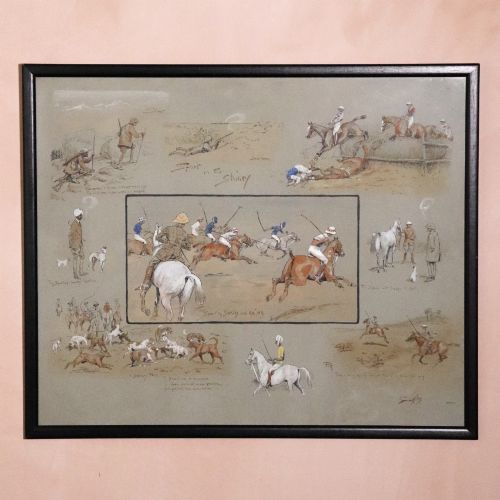
Paper hunting pictures encompass a variety of works on paper depicting rural equestrian pursuits, hounds, and country sports. When exploring paper hunting pictures, buyers encounter hand-coloured engravings, original prints, and detailed watercolours dating from the nineteenth and twentieth centuries.
The selection spans from mid-nineteenth-century hand-coloured engravings to early twentieth-century framed prints and mid-century drawings. Pieces range from intimate pencil and chalk sketches to exhibition-sized watercolours and bodycolour compositions.
Originating predominantly within British sporting art traditions, these works frequently document famous packs like the Quorn, Belvoir, and Cottesmore. Collectors acquire them to celebrate historic country house aesthetics and the heritage of equestrian sport.
Materials and techniques
Artists and printmakers utilised paper as the primary support, applying media such as watercolour, ink, bodycolour, pencil, and chalk. Many nineteenth-century plates began as monochrome engravings before receiving hand-applied colour washes.
Framed prints and original works often incorporated wood and glass to protect the delicate paper surfaces from moisture and atmospheric degradation. Draughtsmen relied on precise pencil and chalk lines to establish form before washing in tones of watercolour.
Materials documented across the collection include paper, wood, glass, watercolour, ink, bodycolour, pencil, and chalk.
Evaluating quality
Superior examples display confident brushwork, accurate anatomical rendering of horses and hounds, and well-preserved paper without excessive foxing or fading. Signed works by noted sporting artists generally command stronger visual presence and historical authority.
The sophistication of the hand-colouring distinguishes finer engravings from standard production pieces. Original watercolours and drawings demonstrate the direct hand of the artist, offering unique tonal depth compared to mass-produced prints.
George Sydney Shepherd·Snaffles·Michael Lyne·John Sanderson Wells·William J Hodgson·George Goodwin Kilburne·Frank Dadd·Edward Aubrey Hunt
The Paper Hunting Pictures Glossary
- Bodycolour
- Watercolour paint mixed with a white pigment to render it opaque. This technique adds solid highlights and dense colour to hunting scenes.
- Foxing
- Brown spots and discolouration that appear on old paper due to chemical reactions over time. Proper conservation helps stabilise these age marks.
- Engraving
- A printmaking method where an image is incised onto a metal plate. The resulting lines hold ink to produce sharp, detailed impressions on paper.
- Hand-coloured
- A monochrome print enhanced by hand using watercolours or tints. This method was common for nineteenth-century sporting prints before colour lithography.
Paper Hunting Pictures: Frequently Asked Questions
What periods do these pieces date from?
The selection spans from the nineteenth century through the mid-twentieth century, capturing various eras of British sporting art.
Dates range from mid-Victorian engravings to modernist-era prints and watercolours from the 1950s and 1960s.
How should I frame and display them?
Paper works require archival mounting and UV-filtering glass to prevent fading and deterioration from direct sunlight.
Keep them away from damp environments like unheated hallways to protect the fragile paper support.
Are these works original or printed?
The category includes both original one-off pieces like watercolours and pencil drawings, alongside period printed editions.
Engravings and lithographs were often published in sets, while watercolours represent unique hand-painted compositions.
How do I identify different print types?
Engravings show fine, indented lines under magnification where the metal plate pressed into the damp paper.
Original watercolours reveal brush texture and pigment layering that sits directly on top of the sheet.