



Pale Wood Console Table
These pale wood console table options bring light, grain-focused character to a hallway, drawing on centuries of European and British craftsmanship.
Pale Wood Console Table
A pale wood console table encompasses narrow serving tables, side tables, and trestle formats designed to sit flush against a wall in domestic spaces. When buyers search for this phrase, they meet practical furniture items shaped from lighter timbers across the nineteenth century.
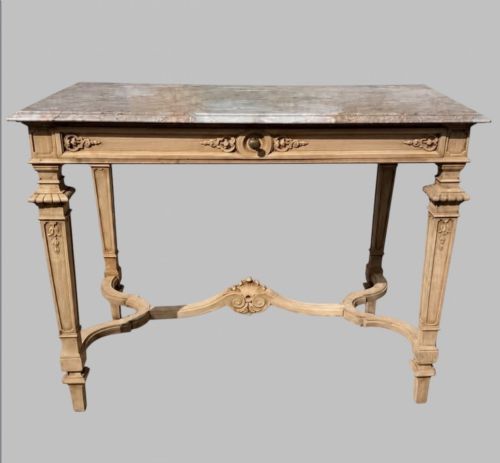
The selection on this page leans heavily toward French provincial and Scandinavian country traditions, with styles such as Gustavian, rustic farmhouse, and Louis XVI revival appearing regularly. Forms range from narrow painted pieces and demi-lune pairs to scrubbed laundry and drapers tables.
Origins stretch across France, Sweden, Spain, China, and England, capturing both formal architectural influences and simpler vernacular workshops. Buyers find pieces suited to narrow corridors, living rooms, and dining spaces where depth is restricted.
How they were made
Construction relies upon a mixture of native hardwoods and softwoods, including pine, oak, elm, poplar, sycamore, and ash, supplemented by marble tops on select French models. Timbers were often scrubbed down to their pale raw grain or finished with light paint layers.
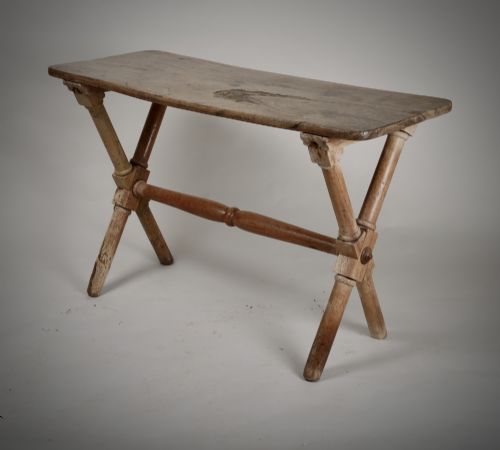
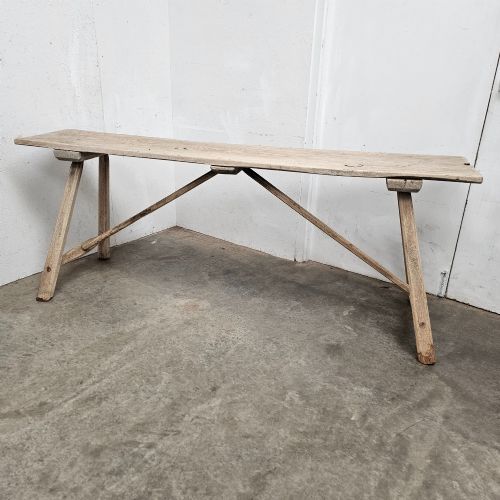
Joinery techniques reflect traditional workshop practices of the nineteenth and early twentieth centuries, joining substantial timber tops to trestle supports, tapering legs, or server bases. Surfaces show the honest marks of hand planing and daily utilitarian use.
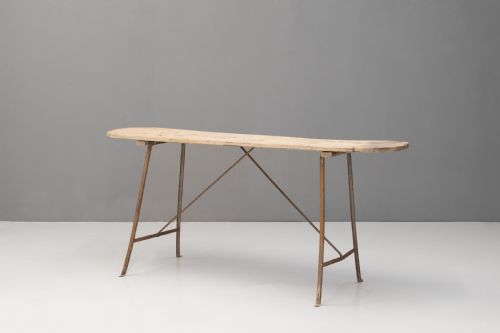
Several tables spent past lives as laundry or drapery sorters before retiring to polite hallways.
What varies in quality
Quality rests upon the choice of timber and the harmony of the proportions, particularly in how cleanly a console table sits against a wall. Heavier woods like bleached oak and sycamore command attention for their dense grain structures and robust framing.
The subtlety of the surface finish dictates distinction, separating straightforward utility pieces from refined painted or scrubbed examples. Surviving pairs and marble-topped variants introduce greater decorative presence to a room.
The Pale Wood Console Table Glossary
- Demi-lune
- A half-moon shaped console table designed to stand flat against a wall. These tables often appear in pairs within Swedish and French interiors.
- Trestle table
- A long surface supported by two or more trestles or framework legs rather than four corner posts. This form serves multiple domestic functions in rustic contexts.
- Scrubbed
- A finish achieved by vigorously washing and scouring wooden boards to remove old polish and reveal the pale, raw grain beneath. It is common on nineteenth-century utility furniture.
- Gustavian
- The Swedish interpretation of neoclassical style, characterised by restrained carving, pale painted finishes, and light proportions. It provides a bright aesthetic for domestic spaces.
- Drapers table
- A long, narrow utilitarian table originally utilised in cloth merchandising. These formats offer generous surface area with minimal depth for narrow hallways.
Pale Wood Console Table: Frequently Asked Questions
Where should I place a console table?
These narrow tables suit hallways, entryways, and narrow living room perimeters where floor space is limited. Their shallow depth allows them to sit against walls without obstructing pathways.
They also function effectively behind sofas or as serving surfaces in dining areas, holding lamps, books, and decorative objects.
How do I clean pale wood surfaces?
Unfinished or scrubbed timbers respond well to gentle dusting with a dry, soft cloth to remove everyday particles. Avoid harsh chemical cleaners that can strip or discolour the natural grain.
For stubborn marks, a damp cloth with mild soap can be used sparingly, followed immediately by drying with a clean towel.
What is the difference between oak and pine?
Oak is a dense hardwood offering distinct grain patterns and heavy structural durability suitable for formal and provincial serving tables. It holds up well to sustained use over generations.
Pine and poplar are softer woods that provide lighter weights and smoother painted surfaces, frequently seen in Scandinavian and French country furniture.
Are these tables from the nineteenth century?
The majority of pieces originate from the nineteenth century, spanning Victorian Britain and continental European periods up around nineteen hundred. Construction methods and material choices reflect the hand tools and workshop traditions of that era.
Some examples extend into the early twentieth century, maintaining traditional forms like trestles and side tables.