

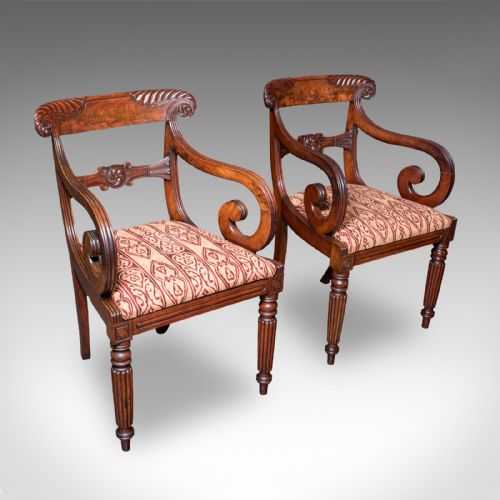
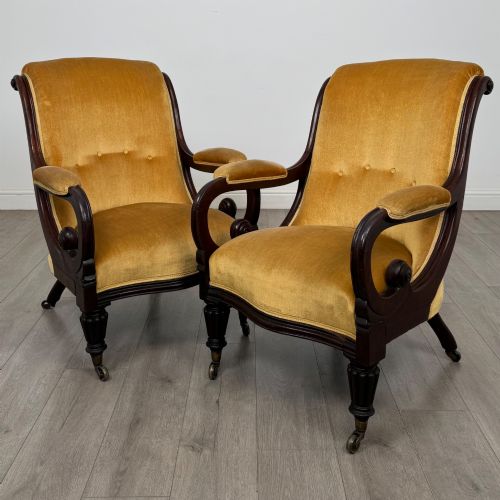
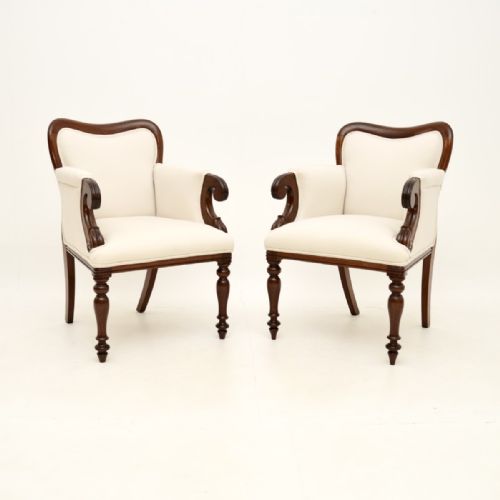
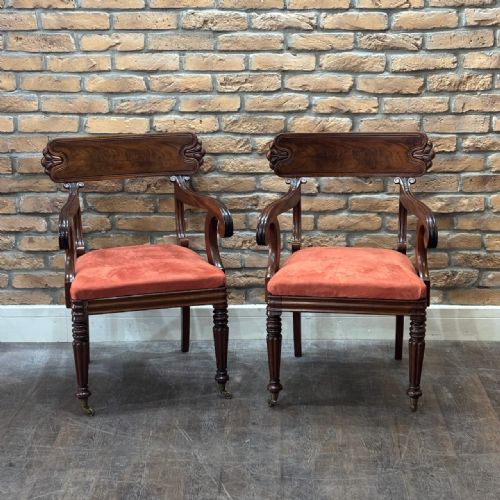


Pair William IV Armchairs
These pair william iv armchairs bring substantial timber and generous proportions to a room, offering both presence and comfort.
Pair William IV Armchairs
When you search for pair william iv armchairs, you find seating designed for nineteenth-century libraries, morning rooms and reception spaces. These pieces span the 19th Century, Regency, Victorian and Georgian periods, though the core of the selection sits firmly in the William IV era.
The forms you meet most often on this page are mahogany carver chairs, library armchairs and desk chairs. They typically arrive as matched pairs, engineered for placement by a fireside or flanking a desk.
Makers and workshops of the period drew on preceding Regency lines while introducing heavier scrolling and robust timber frames. The resulting armchairs balance architectural weight with deeply welcoming proportions.
How they were made
Cabinetmakers constructed these frames primarily in solid mahogany and rosewood, selecting dense timbers capable of holding deep carved details. Scroll arms, swan neck supports and bobbin turnings required skilled hand-tooling to achieve smooth curves and crisp junctions.
Upholstery involved traditional stuffing techniques applied over webbing and springs, finished with leather, velvet, fabric, or tapestry upholstery. Brass details such as castors and studwork frequently completed the assembly.
Pair William IV Armchairs Retail Price Guide 2026
Typical asking prices for pair william iv armchairs among the pieces listed under this phrase on Sellingantiques today, from the lower quarter to the upper quarter. They describe what is for sale here now, not the wider market.
Listings on this site span eight distinct periods, from Georgian origins through Victorian revivals and Edwardian examples.
What varies in quality
The distinction between standard seating and superior examples lies in the crispness of the timber carving and the architectural ambition of the frame. Heavy scroll arms and well-figured mahogany veneers indicate a higher tier of workshop production.
Original elements dictate the standing of a pair, particularly surviving needlework seats, stamped leather surfaces, and matching grain patterns across both chairs. Frames that retain their structural integrity without excessive timber replacement hold greater authority.
The Pair William IV Armchairs Glossary
- Carver chair
- An armchair, usually with open arms, designed for the head of a dining table or for use as a desk chair. These pieces often feature broader proportions than standard dining seats.
- Bergère
- An enclosed armchair with upholstered back and sides, commonly framed in rosewood or mahogany. This form provides a formal yet deeply comfortable seat for library spaces.
- Scroll arm
- An armrest carved into an inward-curling spiral shape characteristic of the period. This profile adds visual weight and dynamic movement to the timber frame.
- Bobbin armchair
- A chair featuring turned woodwork resembling a string of bobbins or spools. This decorative turning technique appears on specific regional and workshop variations.
- Needlework seat
- A seat covered in hand-stitched canvas work, often original to the chair. These textiles display period patterns and survive in varying states of preservation.
Pair William IV Armchairs: Frequently Asked Questions
How do I identify a William IV armchair?
Look for heavy mahogany or rosewood frames featuring distinct scroll arms, reeded legs, or robust turned supports. These design markers separate them from lighter eighteenth-century models.
Check the overall proportions, which tend to be wider and lower to accommodate generous padding and upholstery.
Were these chairs used at desks or dining tables?
Makers produced these armchairs for multiple domestic roles, including libraries, morning rooms, and studies. Many function equally well as desk chairs or as reception seating.
The open arms allowed ample room for heavy nineteenth-century garments while seated.
How should I care for leather upholstery?
Maintain leather surfaces by applying specialist balms periodically to prevent drying and cracking. Avoid placement near direct heat sources or strong sunlight.
Gentle dusting with a dry cloth keeps the surface clean without damaging historic finishes.
Do these chairs require specialist restoration?
Maintenance depends entirely on the condition of the timber frame and internal webbing. Professional upholsterers can replace worn springs and fabric using traditional methods.
Original polish and stable joints should be preserved whenever possible by experienced conservators.