
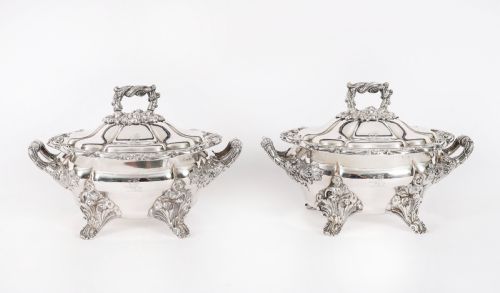


Pair Silver Tureens
These pair silver tureens bring formal dining history to your table, offering matched elegance for serving sauces and warm dishes.
Pair Silver Tureens
When you search for pair silver tureens, you encounter dual serving vessels designed for the formal dining table. These pieces encompass both sauce tureens and larger entree dishes intended to keep food warm during lengthy meals.
The versions you are most likely to meet on this page span the Georgian, Victorian, and Edwardian periods. They appear predominantly in silver plate and Old Sheffield plate, alongside sterling silver examples.
Makers and workshops produced these matched pairs in oval and circular forms, often incorporating lids and warming bases. The selection balances intimate sauce vessels with substantial serving dishes.
How They Were Made
Silversmiths and manufacturers utilised sterling silver, copper, and base metals as foundations for these items. Old Sheffield plate involved fusing a thin sheet of silver onto a copper core, a technique visible along exposed edges.
Electroplated nickel silver and standard silver plating became prominent methods during the nineteenth century. Manufacturers applied silver layers over base metals and nickel silver to achieve the appearance of solid silver at a different scale of production.
Some warming dishes include compartments designed to hold boiling water or hot bricks, ensuring the gravy stayed liquid through long Victorian dinners.
What Varies in Quality
The distinction between tiers rests in the crispness of the chased and applied ornamentation. Superior examples retain sharp decorative borders, handles, and crests without softening from excessive polishing over generations.
Weight and structural balance separate standard production items from distinguished workshop output. Heavier gauge metals and robust internal joints ensure that covers fit snugly and warming bases perform their function properly.
William Grundy·Hamilton & Inches·Edward & John Barnard·Walker and Hall·Elkington·Matthew Linwood·Cresswick·Dan Holy·Tiffany & Co·Collis & Co·Christofle of Paris·Harrods·Elkington & Co·James Dixon and Sons·William Hutton & Sons
The Pair Silver Tureens Glossary
- Old Sheffield plate
- A composite material formed by fusing silver to a copper ingot before rolling into sheets. This early method shows a thin silver layer with hints of copper beneath.
- Entree dish
- A shallow covered vessel used for serving main courses or side dishes at the table. These often double as warming dishes when paired with a base.
- Sauce tureen
- A small vessel equipped with a lid and handles, specifically designed for holding gravies and sauces. They frequently accompany larger serving platters.
- Silver plate
- A coating of silver applied over a base metal such as copper, nickel, or Britannia metal. This process allowed workshops to produce affordable domestic wares.
- Electroplated nickel silver
- A base alloy of copper, nickel, and zinc coated with silver using an electrical current. This technique superseded older plating methods during the Victorian era.
Pair Silver Tureens: Frequently Asked Questions
What is the difference between sauce tureens and entree dishes?
Sauce tureens are smaller vessels specifically created for holding gravies, creams, and liquid accompaniments during a meal. They usually feature fitted lids and small handles for passing around the table.
Entree dishes are broader, shallower containers meant for presenting main courses or substantial side dishes. Many include warming stands or water compartments beneath the main bowl.
How do I care for silver plated tureens?
Silver plated items require gentle cleaning with a soft cloth and specialised silver polish to preserve the metallic layer. Avoid abrasive cleaners that can wear away the thin silver coating over time.
Store these vessels in dry environments and handle them carefully by their bases rather than delicate handles or finials. Regular, gentle dusting helps maintain the surface lustre.
Can I use antique tureens for serving food today?
Most silver and silver plated tureens remain functional for serving dry foods, warm dishes, and sauces during modern dining occasions. Ensure the interior surfaces are clean and free from tarnish before food contact.
Items featuring Old Sheffield plate or delicate electroplate should be washed by hand rather than placed in an automatic dishwasher. Acidic foods should not be left in contact with the metal for extended periods.
How do I identify the period of a tureen?
Makers' marks, hallmarks, and style indicators help establish the manufacturing era of each piece. Georgian examples often display simpler lines or neoclassical motifs, whereas Victorian pieces tend towards heavier ornamentation.
Researching the specific workshop stamps on the base provides a reliable date range. Stylistic details such as handle shapes and foot mounts also reflect the prevailing tastes of their production decade.