

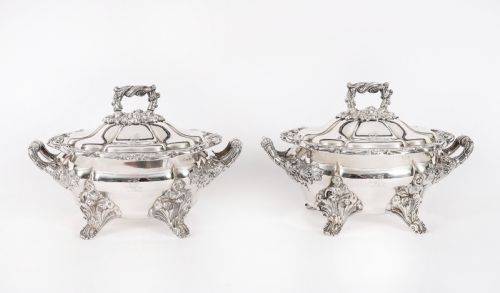


Pair Silver Dish Lids
These pair silver dish lids bring matched elegance to the table, offering practical warmth and traditional style for grand dinners.
Pair Silver Dish Lids
A set of pair silver dish lids forms the matching top portion of a lidded serving vessel, designed to retain heat and present food gracefully at the table. You will frequently find these items listed alongside entrees, tureens, and sauce vessels from various historical periods.
The pieces appearing on this page span the Georgian, Victorian, and Edwardian eras, reflecting changes in dining habits over more than a century. They take the form of oval covers designed to fit specific serving dishes and sauce tureens.
Most examples originate from the nineteenth and early twentieth centuries, capturing the craftsmanship of periods ranging from George III to Edwardian times. They serve primarily as functional covers for tableware, though many retain decorative borders and handles that reflect their period style.
How they were made
Makers utilised sterling silver, silver plate, Old Sheffield plate, and electroplated nickel silver over a copper base to achieve a bright metallic finish. These materials provided durability for daily dining alongside the lustre expected of formal table settings.
The manufacturing process involved shaping base metals like copper or nickel silver and applying layers of silver through early plating techniques or traditional smithing. Silversmiths then added cast handles, borders, and engraving to finish each lid.
Pair Silver Dish Lids Retail Price Guide 2026
Typical asking prices for pair silver dish lids among the pieces listed under this phrase on Sellingantiques today, from the lower quarter to the upper quarter. They describe what is for sale here now, not the wider market.
The listings span the Georgian, Victorian, and Edwardian periods, utilising materials from sterling silver to silver plate and copper.
What varies in quality
The weight of the metal and the thickness of the silver layer separate standard utility pieces from finer examples. Heavier construction ensures the covers retain heat better and feel substantial in the hand.
Refinement in the cast handles and applied borders demonstrates the skill of the maker. Crisp detailing on handles and edges indicates a higher grade of production compared to simpler, mass-produced items.
William Grundy·Hamilton and Inches·Walker and Hall·Elkington·Matthew Linwood·Cresswick
The Pair Silver Dish Lids Glossary
- Silver plate
- A thin layer of silver bonded to a base metal such as copper or nickel silver. This technique allowed makers to produce bright tableware at a lower cost than solid sterling.
- Old Sheffield plate
- An early method of fusing a sheet of silver to a copper core before shaping the metal. Pieces made this way often show subtle tones of copper beneath worn silver highlights.
- Entree dish
- A shallow serving vessel used for individual courses during formal meals. Lids made for these dishes fit securely to keep food warm between the kitchen and the dining table.
- Sauce tureen
- A small vessel designed for holding gravies and sauces, complete with a matching lid. They often appear as matched pairs in Georgian and Victorian table settings.
- Electroplate
- A modern method of depositing silver onto a base metal using electrical current, introduced in the nineteenth century. This process replaced older fusion plating techniques.
Pair Silver Dish Lids: Frequently Asked Questions
What are pair silver dish lids used for?
These lids serve to cover matching serving dishes and tureens, keeping food warm and protected on the dining table. They are designed to fit specific oval vessels used during formal meals.
Historically, they formed part of larger service sets for dinners and luncheons. Today they continue to function as tableware or decorative dining room accents.
How do I tell Victorian from Georgian lids?
Georgian pieces often display simpler, cleaner lines associated with the late eighteenth and early nineteenth centuries. Makers like William Grundy worked during this earlier period.
Victorian and Edwardian examples tend to feature heavier ornamentation, cast handle details, and silver plating techniques developed later in the nineteenth century.
Are these lids made of solid silver?
The listings include both sterling silver and silver plated items. Many examples use a base metal such as copper or nickel silver covered with a layer of silver.
Plate and electroplated nickel silver were common methods for producing durable tableware during the nineteenth century without the high cost of solid silver.
How should I clean silver plated lids?
Clean plated items gently with a soft cloth and a specialised silver polish designed not to strip the thin metal layer. Avoid abrasive cleaners that might expose the underlying copper or nickel.
Regular, gentle dusting and occasional polishing will maintain the shine of the silver surface without wearing away the plating.
Did these lids always come with dishes?
They were originally manufactured as part of matched sets alongside entree dishes or sauce tureens. Over time, lids and bases sometimes became separated or reunited.
When buying, check the fit and proportion to ensure the lid matches the style and period of the accompanying vessel.