





Pair Rosewood Urn Pedestals
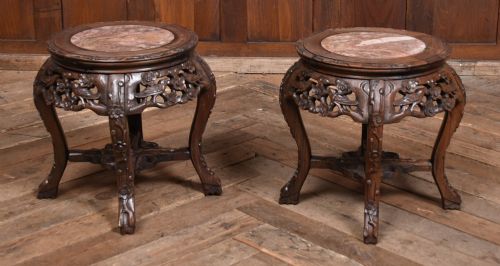
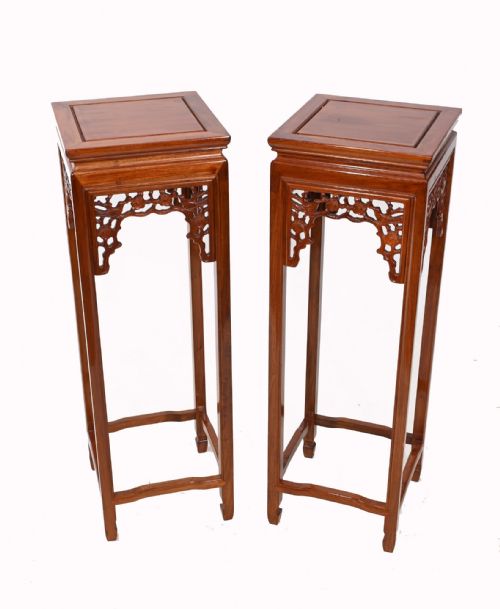
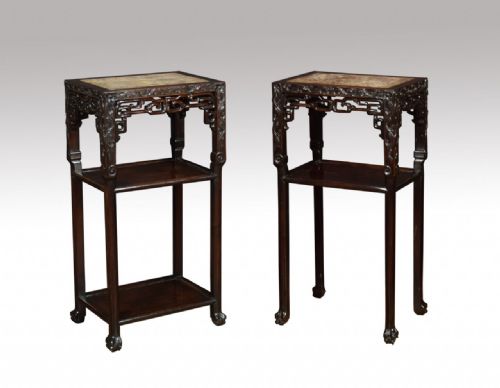
These pair rosewood urn pedestals bring undeniable presence to a room, offering elevated display surfaces shaped by centuries of cabinet-making.
Pair Rosewood Urn Pedestals
When you search for pair rosewood urn pedestals, you enter a distinct category of nineteenth and early twentieth-century display furniture designed to elevate heavy vases, bronzes, and ornamental urns. The selection ranges from compact plant stands to substantial two-tier tables and decorative tazzas.
The majority of pieces encountered here originate from Chinese export workshops alongside notable British makers such as Gillows. These items span Victorian, Regency, and Qing Dynasty aesthetics, reflecting diverse cultural interpretations of decorative support.
Forms vary from simple circular tops to elaborate multi-tiered structures designed for specific interior displays. Whether utilised for botanical arrangements or sculptural urns, each matched pair provides balanced symmetry for formal rooms.
Materials and construction methods
Makers utilised dense exotic hardwoods including rosewood, huali, padouk, and hongmu, chosen for their capacity to support significant weight without warping. These dark timbers often received intricate hand-carving characteristic of Qing Dynasty traditions.
Many examples incorporate inset marble panels, specifically rouge marble, providing a cool, durable surface impervious to moisture from plant pots or urns. Advanced joinery techniques allowed frames to remain rigid despite fluctuations in temperature and humidity.
Select pieces feature delicate mother-of-pearl inlay embedded directly into the dense grain of the timber. Surface finishes relied on hand-applied polish that accentuated the natural figuring and deep red-brown tones of the wood.
Pair Rosewood Urn Pedestals Retail Price Guide 2026
Typical asking prices for pair rosewood urn pedestals among the pieces listed under this phrase on Sellingantiques today, from the lower quarter to the upper quarter. They describe what is for sale here now, not the wider market.
One exceptional Victorian pair carries mother-of-pearl inlay, proving that nineteenth-century artisans loved a subtle shimmer just as much as we do.
Distinctions in craftsmanship and design
The distinction between standard utility stands and superior examples lies in the depth and crispness of the hand-carving. Finer pieces display deeply undercut foliage and geometric patterns that retain sharp relief, whereas lesser examples show softer, shallower incisions.
Material selection significantly dictates overall standard, particularly the uniformity of the timber grain and the quality of the inset marble top. Perfectly fitted stone inserts without excessive filler indicate meticulous workshop standards during initial assembly.
Structural integrity of the joints and the degree of matching between the two individual pedestals separate ordinary items from exceptional pairs. True matched pairs exhibit identical timber coloration and corresponding grain patterns across both stands.
Gillows
The Pair Rosewood Urn Pedestals Glossary
- Rosewood
- A dense, heavy timber prized for its deep colour and durability in fine furniture. It resists splitting and takes a high polish.
- Rouge marble
- A reddish ornamental limestone with white or grey veining, frequently used for table and stand tops. Its smooth surface provides a stable, heat-resistant platform for heavy vessels.
- Huali wood
- A traditional Chinese hardwood known for its distinct grain and rich tonality. Cabinet-makers favoured it for decorative stands intended for scholar's studios.
- Tazza
- A shallow saucer-shaped vessel or pedestal table raised on a central foot. These pieces function primarily for display rather than utility.
- Hongmu
- A category of dark, dense Asian hardwoods translated literally as red wood. It encompasses several heavy species utilised in Qing Dynasty export furniture.
- Padouk
- A vibrant tropical hardwood ranging from coral pink to deep brownish red. It darkens gracefully with exposure to light over decades.
Pair Rosewood Urn Pedestals: Frequently Asked Questions
What were pair rosewood urn pedestals used for?
These pieces served primarily as elevated platforms for heavy decorative urns, bronze sculptures, and large indoor plants within formal nineteenth-century interiors. Their sturdy construction ensured valuable display items remained secure and prominent.
In both Western drawing rooms and Chinese reception spaces, matched pairs created visual symmetry on either side of doorways, fireplaces, or large windows. The elevated surface also protected delicate flooring from moisture associated with heavy planters.
How do I care for rosewood and marble surfaces?
Maintenance requires simple dusting with a soft, dry cloth to prevent accumulation within carved recesses. Avoid silicone-based polishes, which build up on dense timbers over time.
Marble inserts benefit from occasional wiping with a damp cloth followed by immediate drying. Acidic liquids should remain far from the stone to prevent etching of the polished surface.
Are these stands suitable for modern homes?
Their compact footprints make them highly adaptable for contemporary spaces requiring vertical display height without occupying excessive floor area. They function effectively as lamp tables or independent sculpture plinths.
The neutral dark timbers and classic proportions allow these stands to integrate smoothly into both traditional and minimalist interior schemes.
How can I tell a matched pair apart from assembled ones?
Examine the grain patterns, timber coloration, and carving details side by side under consistent lighting. True matched pairs share identical botanical characteristics in the wood and precise dimensions across both items.
Slight variations in chisel marks or stone veining often indicate that two separate single stands were joined together at a later date to form a pair.