
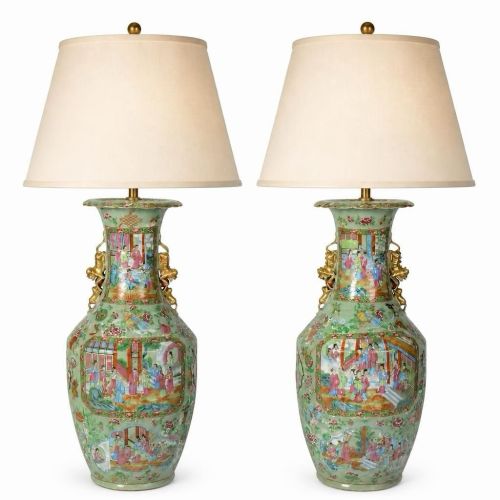


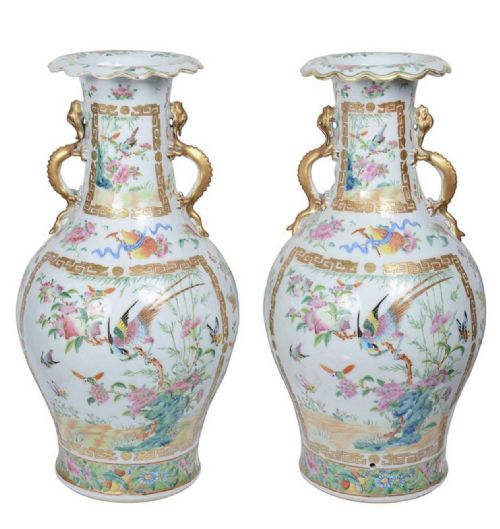
Pair Rose Medallion Lamps
Pair rose medallion lamps bring vibrant nineteenth-century Chinese export porcelain into a room with balanced symmetry.
Pair Rose Medallion Lamps
Pair rose medallion lamps are matching nineteenth-century Chinese export porcelain vessels, often originally vases, that have been adapted as table lamps. They display the distinctive panelled decoration associated with nineteenth-century Cantonese production.
Most examples found here date from the nineteenth century, including specific periods around eighteen hundred, eighteen seventy, and nineteen ten. They combine traditional Chinese forms with standard electrical fittings and fabric or silk shades.
The objects frequently appear under descriptions referencing Cantonese or Chinoiserie styles, reflecting their origins in nineteenth-century Chinese workshops. Buyers encounter them as large table lamps or converted decorative vases.
How they were made
The foundational bodies consist of porcelain, shaped into table lamps and decorative vases during the nineteenth century. Artisans applied polychrome enamel painting to create the characteristic medallion patterns.
Mountings and structural elements utilise brass, gilt bronze, and ormolu to secure the porcelain bodies. Shades incorporate fabric and silk materials to complete the lighting fixtures.
The documented periods span from the nineteenth century through nineteen ten, encompassing Chinese export and Qing dynasty styles.
What varies in quality
The refinement of the enamel painting across the porcelain panels dictates the visual standard of the piece. Crisp detail in the figures and foliage distinguishes finer examples from simpler production.
The integration of metal mounts, whether brass, ormolu, or gilt bronze, influences the overall craftsmanship. Heavier proportions and harmonious mounts indicate superior nineteenth-century manufacturing.
The Pair Rose Medallion Lamps Glossary
- Rose medallion
- A style of nineteenth-century Chinese export porcelain featuring panelled compositions filled with figures, birds, and flowers, painted in enamels. It remains the defining visual characteristic of these lamps.
- Canton
- Referring to the Chinese port city where much of this export porcelain was decorated and shipped during the nineteenth century. It designates the regional origin of the ceramic bodies.
- Ormolu
- Finely ground high-carat gold applied to a bronze base, utilised for mounts on select pieces. This technique adds a warm metallic contrast to the painted porcelain.
- Famille rose
- A major palette of Chinese ceramic enamels dominated by opaque pink, introduced in the Qing dynasty. Rose medallion is a specific development within this broader decorative tradition.
Pair Rose Medallion Lamps: Frequently Asked Questions
Are these original nineteenth century vases?
The ceramic bodies originate from the nineteenth century, reflecting periods such as the Qing dynasty and Chinese export production.
Conversion into lamps typically involves later electrical wiring and compatible fabric or silk shades.
How do I clean the porcelain?
Dust the porcelain and painted enamel panels gently with a dry, soft cloth to prevent surface accumulation.
Avoid chemical cleaners or abrasive materials that might damage the nineteenth-century enamels and gilt bronze mounts.
Can the lamps be rewired safely?
Electrical components can be inspected and updated by a qualified professional to meet current safety standards.
This process preserves the historic porcelain and metal mounts while ensuring domestic utility.
What styles accompany rose medallion?
Listings frequently associate these lamps with Chinese export, Qing dynasty, and Chinoiserie aesthetic categories.
They reflect nineteenth-century Chinese decorative arts produced specifically for international markets.