
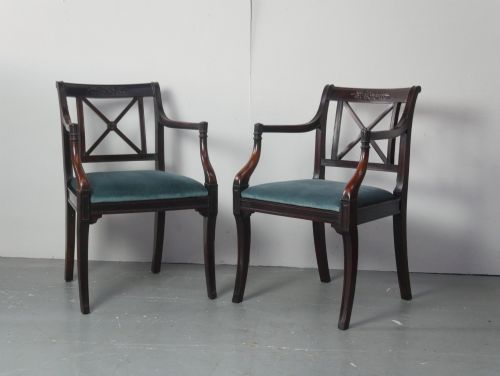
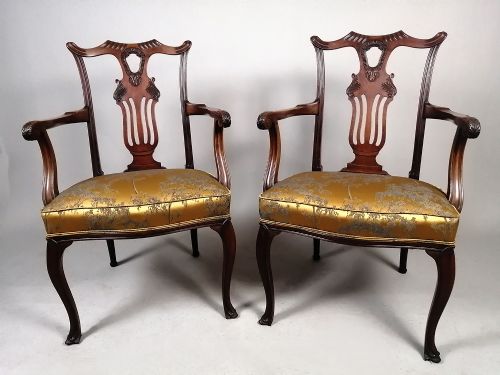
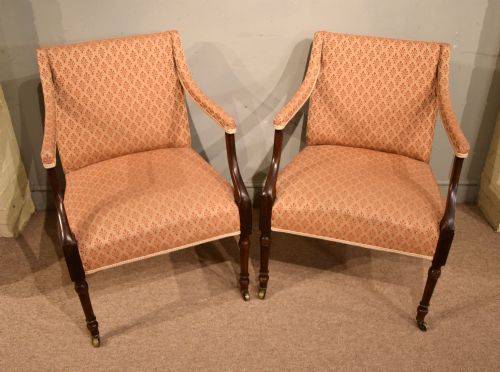
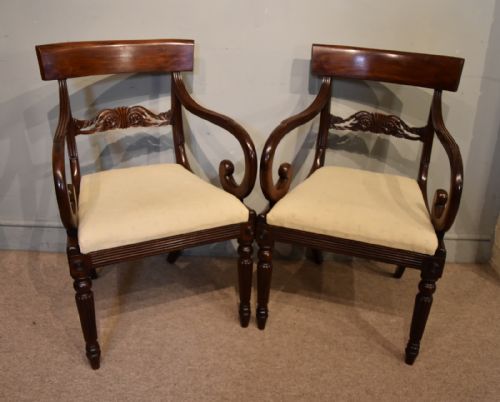
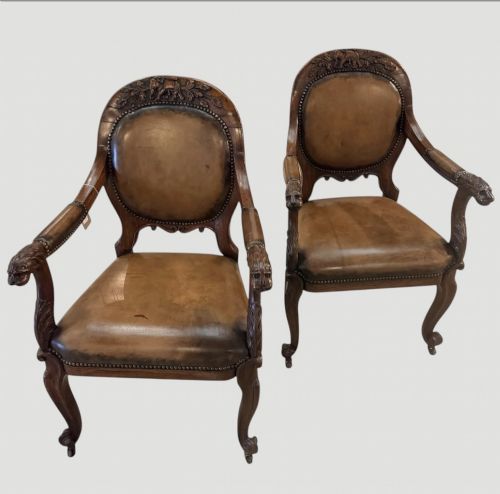
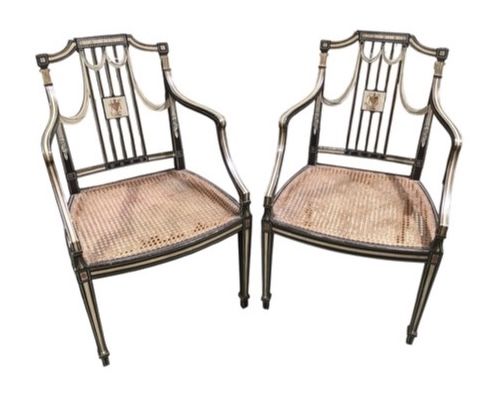
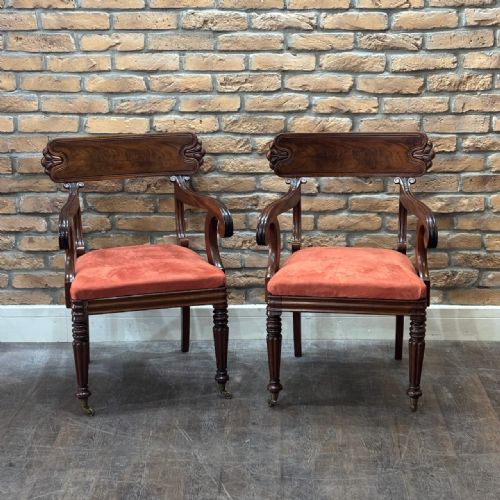


Pair Regency Open Armchairs
Pair regency open armchairs bring balanced proportions and refined seating into a room, uniting architectural elegance with practical comfort.
Pair Regency Open Armchairs
When you search for pair regency open armchairs, you encounter seating designed during the early nineteenth century alongside later revivals from the Victorian and Edwardian eras. The selection spans authentic period examples from the Regency and George IV epochs as well as later interpretations influenced by Regency style.
Most entries consist of mahogany frames featuring open arms, often described as carver chairs, elbow chairs, or library chairs. Alongside standard mahogany, the evidence includes rosewood, painted finishes, ebonised wood, and faux bamboo constructions.
Geographic variations stretch beyond standard English workshops to include Scottish regional pieces, Anglo-Indian items, and Northern Italian examples. Revival pieces from around nineteen hundred appear alongside genuine eighteen-hundreds seating.
Materials and construction
Makers relied heavily on solid and veneered mahogany, shaping the timber into curved back rails, lyre motifs, and scroll arms. Workshops also utilised rosewood, ebonised wood, and painted or gilded surfaces to achieve distinct decorative effects.
Upholstery formed a central part of the construction, utilising fabrics, velvet, and specialised upholstery materials set over sprung or padded seats. Brass details and cane work occasionally complemented the timber frames.
Listings feature mahogany predominantly, alongside rosewood, ebonised wood, and painted finishes.
Judging the quality
Quality rests upon the crispness of carved details, such as the execution of scroll arms, back splats, and structural joints. Superior examples exhibit balanced proportions and refined timber selection that outshine heavier, later revival pieces.
The integrity of the frame and the retention of original timber patination distinguish the finest items. Subtle variations in turning, inlay work, and the quality of secondary woods separate standard production from exceptional craftsmanship.
Henry Thomas Peters of Genoa
The Pair Regency Open Armchairs Glossary
- Carver chair
- An armchair designed with open arms, traditionally placed at the ends of a dining table or utilised as a desk chair. These pieces provide sturdy side support while maintaining an open profile.
- Lyre back
- A chair back featuring a central splat shaped in the outline of a musical lyre. This motif gained immense popularity during the Regency period.
- Ebonised wood
- Timber treated with a dark stain or finish to imitate ebony. This technique created sharp contrast against gilt highlights or light upholstery.
- Faux bamboo
- Wood turned and carved to resemble natural bamboo stalks. Makers employed this decorative technique during periods influenced by Asian design aesthetics.
- Scroll arm
- An armrest curving outward and downward in a continuous spiral shape. This form defines the silhouette of many early nineteenth-century seats.
Pair Regency Open Armchairs: Frequently Asked Questions
What defines a regency open armchair?
These chairs feature defined wooden armrests left open rather than upholstered solid to the seat rail. They typically date from the early nineteenth century or reflect that specific neoclassical aesthetic.
Proportions remain light and architectural, often incorporating saber legs, curved back rails, and classical motifs like lyres or scrollwork.
Were these used at desks or dining tables?
Makers designed these armchairs for versatile placement in libraries, drawing rooms, and studies. Their open arms allowed individuals to sit comfortably while wearing bulky historical clothing.
They frequently served as desk chairs or as the matching carvers positioned at the head and foot of a dining table.
How do I spot a later revival piece?
Revival pieces from around nineteen hundred often display heavier timber scantlings and standardised machine-cut joinery. The patination on the wood tends to appear uniform rather than bearing the deep, varied lustre accumulated over a century.
Examining the construction methods underneath reveals modern fixings or secondary woods that differ from genuine early nineteenth-century practices.
How do I care for antique mahogany frames?
Keep the timber away from direct sunlight and strong heat sources to prevent the wood from drying and splitting. Regular dusting with a soft, dry cloth preserves the polished surface without building up residue.
Feed the polished wood occasionally with appropriate conservation wax to maintain the depth of the grain and protect the finish.