
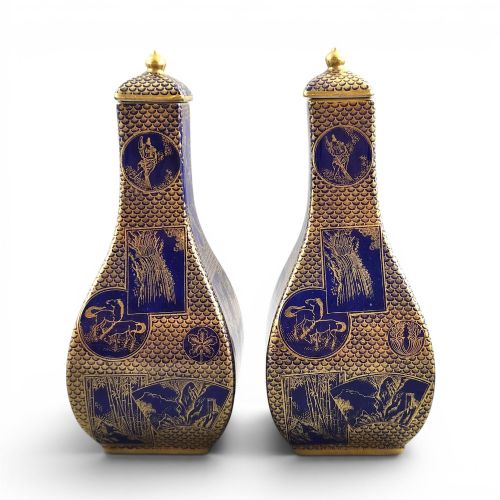
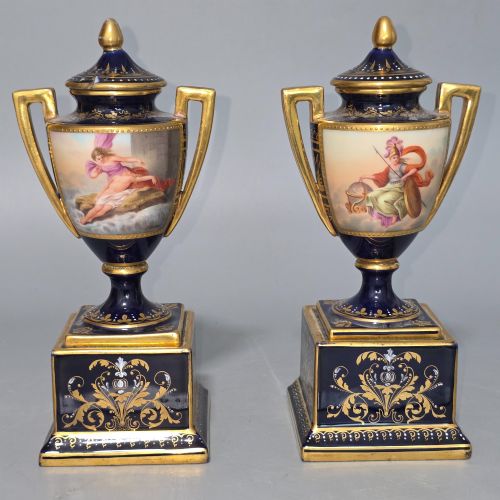


Pair Porcelain Covered Vases
These pair porcelain covered vases offer symmetry and display presence, bringing painted detail and ceramic form together for interior schemes.
Pair Porcelain Covered Vases
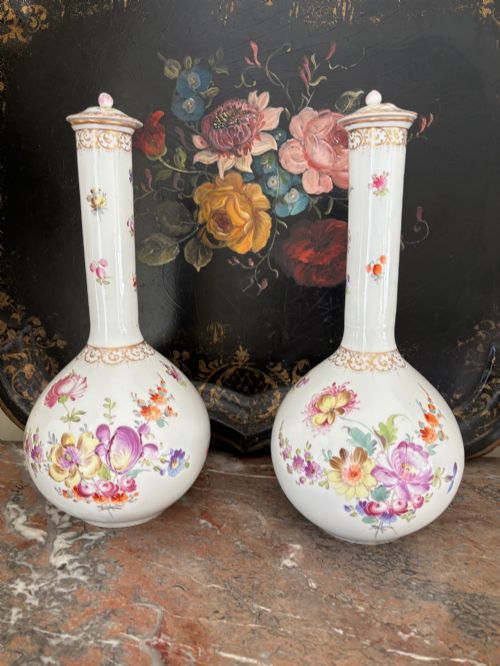
When searching for pair porcelain covered vases, collectors encounter matching vessels designed with fitted lids, spanning urns, jars, and amphora forms. These objects function as decorative focal points, historically positioned on mantelpieces, pedestals, or side tables to create balanced focal arrangements.
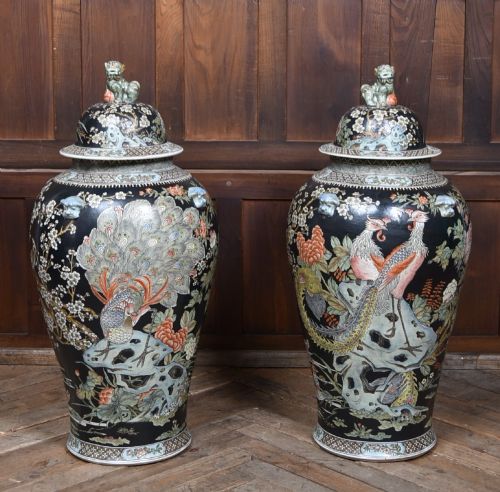
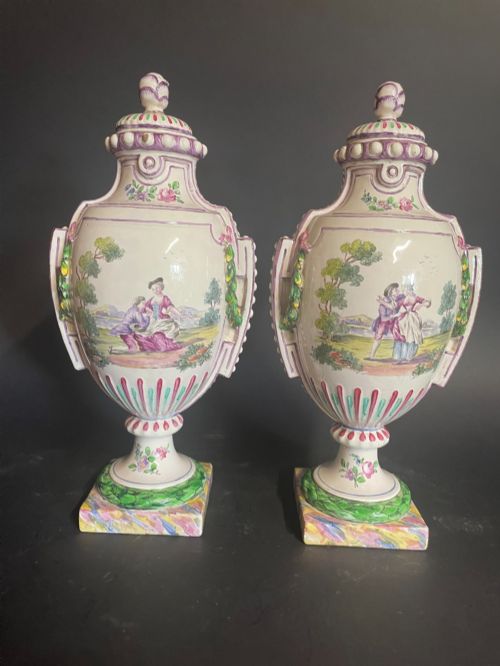
The pieces on this page lean heavily towards nineteenth-century production, incorporating Victorian, Rococo Revival, and Neoclassical design influences alongside Japanese Imari and Chinese blue and white styles. Examples range from compact cabinet pieces to substantial floor jars.
Makers and factories across Britain, continental Europe, and East Asia contributed to this category, utilising porcelain, ironstone, and faience. Lidded vessels often double as pot pourri containers or ginger jars, featuring hand-painted floral motifs, landscapes, or figural scenes.
How they were made
Production relies on refined ceramic pastes shaped by throwing or moulding, followed by high-temperature kiln firing to vitrify the body. Artisans then apply hand-painted enamels, cobalt underglaze, or transfer prints before a second firing fixes the decoration beneath a glossy glaze.
Many European and Asian creations incorporate gilt bronze, ormolu mounts, or applied gold leaf to accentuate the rims, handles, and feet. These metal mounts require precise bronze-casting and chasing techniques to fit the contours of the fired ceramic bodies securely.
Listings feature eighteenth and nineteenth-century periods, alongside materials like ormolu, gold leaf, and faience.
What varies in quality
Quality rests upon the precision of the ceramic form, the weight and purity of the porcelain body, and the crispness of the hand-painted detailing. Superior examples exhibit fine brushwork, balanced symmetry between both pieces in the set, and rich, stable gilding.
The integration of secondary materials such as ormolu mounts distinguishes standard production from finer workshop output. Well-cast mounts that hug the ceramic contours without wobble indicate higher manufacturing standards and skilled assembly.
Sitzendorf·Mason's·Vienna·Derby·Arita·Coalport·Royal Worcester·Augustas Rex·Dresden·Sevres
The Pair Porcelain Covered Vases Glossary
- Imari
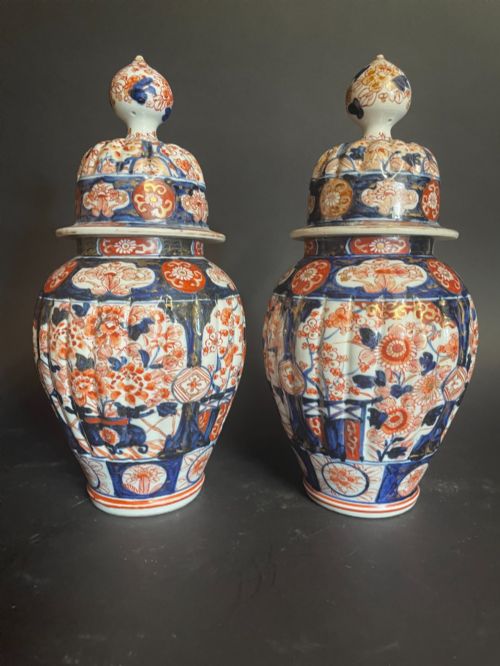
- A style of Japanese porcelain featuring underglaze blue and iron red, often supplemented with gilt details. This aesthetic heavily influenced European factories copying traditional export patterns.
- Ormolu
- Gilt bronze mounts applied to furniture and ceramics during the eighteenth and nineteenth centuries. The technique involves treating brass or bronze with a gold amalgam.
- Faience
- Tin-glazed earthenware produced across Europe, particularly in France and Britain. It offers an opaque white surface suitable for painted decoration.
- Amphora
- A tall ancient vessel shape with two handles, reinterpreted by nineteenth-century porcelain makers for decorative urns. These pieces often feature neoclassical handles and painted panels.
- Ironstone
- A type of durable heavy earthenware patented in Britain to imitate porcelain. It provides a robust body for large jars and vases.
Pair Porcelain Covered Vases: Frequently Asked Questions
How were pair porcelain covered vases used?
These lidded vessels served primarily as decorative garnitures on mantelpieces, consoles, and architectural ledges, providing symmetry to room interiors. Some forms were specifically designed to hold dried flowers or pot pourri, releasing fragrance through small lid perforations.
Larger floor jars and palace vases stood independently in hallways or reception rooms. Their matching covers kept dust out of the contents while completing the balanced vertical silhouette of the pair.
How do I identify Imari style vases?
Imari pieces typically feature a distinct palette combining cobalt blue underglaze with iron red enamel, frequently enriched with gold leaf details. The decorative schemes often incorporate panels of flowers, foliage, and brocade patterns derived from Japanese export ware.
European factories frequently copied this aesthetic during the nineteenth century, producing items labelled as Imari style. Examining the paste, glaze texture, and base marks helps distinguish Japanese originals from European revival interpretations.
What is the difference between porcelain and ironstone?
Porcelain is a vitrified ceramic fired at high temperatures, resulting in a dense, non-porous body that often appears translucent when held to the light. It allows for delicate casting and fine, smooth glazed surfaces.
Ironstone is a heavy, opaque earthenware developed for durability, possessing a sturdier structure less prone to chipping. Makers utilised ironstone for robust jars and vases requiring resilience during daily household use.