
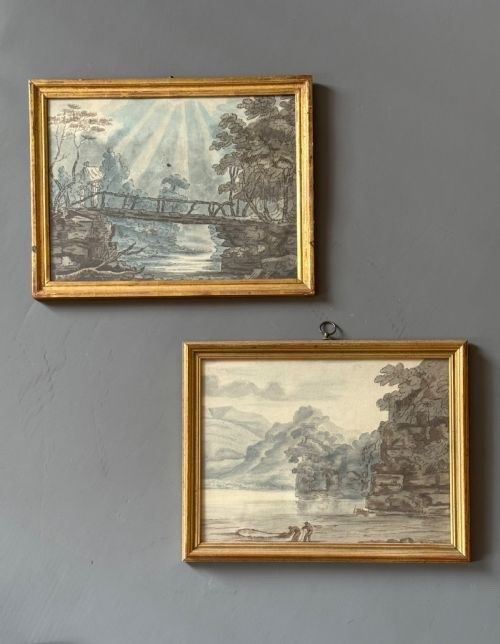
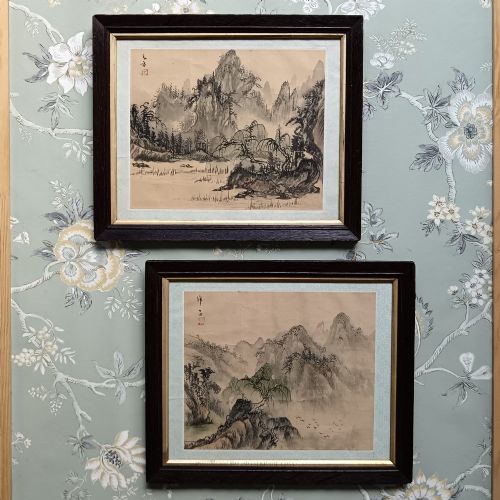
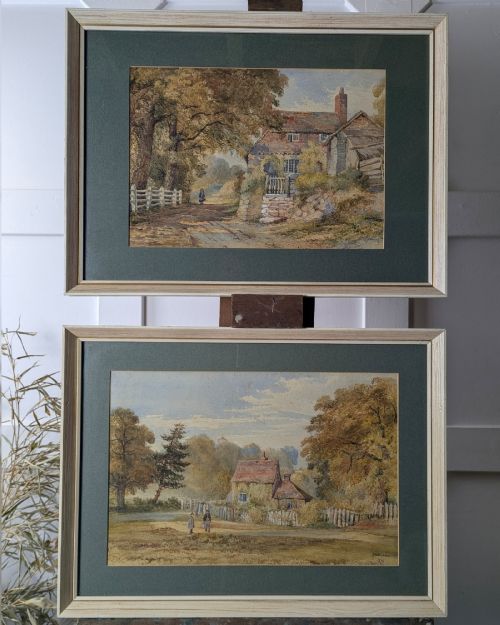
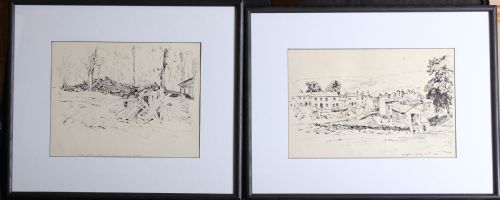
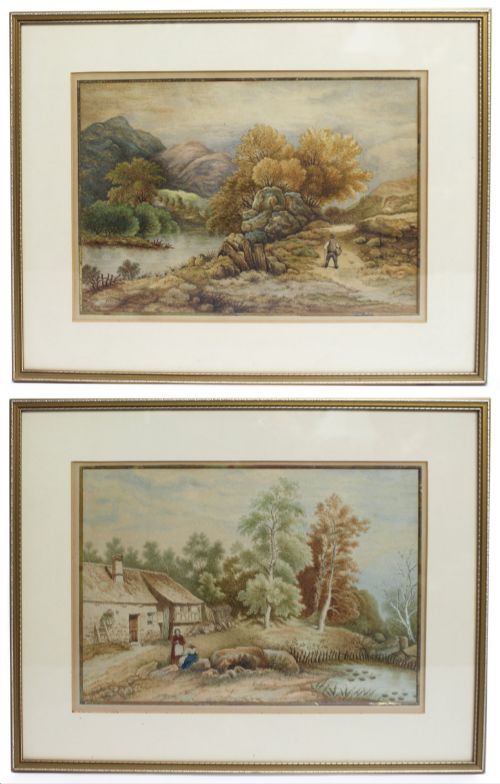


Pair of Watercolour Landscapes
A pair of watercolour landscapes brings twin balanced views to a wall, matching scenes that share a hand and a frame.
Pair of Watercolour Landscapes
A pair of watercolour landscapes consists of two matching painted views produced as companion pieces, often depicting rural scenes, rivers, or moorlands. Buyers seeking a balanced wall display gravitate toward these matched sets for their harmonious composition and unified palette. Most items on this page date from the nineteenth century through the mid-twentieth century.
The subjects range from British country views and coastal marine settings to overseas landscapes such as Venice or Arizona. Many works bear signatures from known artists of the Victorian, Edwardian, and later periods, while others remain by anonymous hands. They appear in formats that include framed paintings, diptychs, and round watercolours.
Materials and construction
These works rely on watercolour pigment applied to paper, occasionally augmented with ink, gouache, or gold leaf, mounted behind glass to protect the delicate pigments. The framing typically involves wood or gilt wood, sometimes ebonised, which preserves the paper surface from environmental moisture.
The execution involves fluid washes of pigment built up on paper support, capturing light and atmosphere with transparent layers. Because watercolours fade rapidly in direct sunlight, the survival of these pieces often depends upon the protective housing of their period frames.
Listings feature paper supports housed beneath glass within wood, gilt wood, and ebonised frames.
Indicators of quality
Quality rests upon the sensitivity of the brushwork and the preservation of the pigment, since fugitive watercolours lose intensity when exposed to excessive light over decades. Finer examples maintain crisp detail in the washes and retain their original harmonious colour balance without heavy fading.
The integrity of the mounting matters significantly, with original period frames adding considerable character and proper sealing against dust and dampness. A well-matched pair demonstrates consistent skill across both sheets, whereas lesser works may show an imbalance in execution between the two components.
Robert A. Nottingham·Fred Lawson·Th. Thibault·F.J. Snell·Alfred George Morgan·Ernest Uden·George Whyatt·Robert Buchan Nisbet·Sidney James Beer·Nora Cundell·Leslie Rackham·Jan van Couver·Benedetto Salviati·James H Hulse·Thomas Bush Hardy·AJ Thornton·ARTHUR CLAUDE STRACHAN·ALFRED RIMMER·WD Scull·T Fairfax·Charles Frederick Allbon
The Pair of Watercolour Landscapes Glossary
- Watercolour
- A painting method in which the paints are made of pigments suspended in a water-based solution. It produces transparent colour washes on paper support.
- Gouache
- An opaque water-based paint method that includes a binding agent and white pigment to create denser, heavier colour applications. It appears frequently alongside traditional watercolour in nineteenth-century works.
- Diptych
- A painting comprising two separate panels or sheets designed to be displayed together as a single artwork. In this category, the term describes paired landscape views.
- Ebonised
- Wood finished to resemble ebony through a staining or painting process. This dark treatment was common on Victorian and early twentieth-century picture frames.
- Gilt wood
- Wood carved and covered with a thin layer of gold leaf or metallic gilt. It provides a reflective border that enhances the tones within the painting.
Pair of Watercolour Landscapes: Frequently Asked Questions
How should I hang a pair of watercolour landscapes?
Hang them at eye level with a small, balanced gap between the frames so the companion pieces read as a unified composition. Keeping them away from direct sunlight protects the paper and pigments from fading.
Ensure the wall space supports the horizontal or vertical alignment of the specific frames. Period glass requires careful handling during installation.
Were these always sold together?
Most pairs were conceived, painted, and framed together by the artist to hang as matching companions. Their shared provenance keeps them united through successive collections.
Occasional pairings bring together two works of identical period, size, and subject by the same hand. The matching frames usually confirm their shared history.
How do I identify the period of a watercolour?
Dating relies on the framing style, paper characteristics, and the clothing or architecture depicted in the scene. Signatures can be cross-referenced with artist registry dates.
Backboard materials and old label fragments also provide clues to the decade of framing. Stylistic shifts from Victorian narrative detail to twentieth-century realism help narrow the timeline.
Can I reframe an antique watercolour?
Original period frames contribute historical context and aesthetic value to the artwork. Retaining them maintains the integrity of the piece as it has existed for generations.
Conservation framing may become necessary if the backing introduces acids to the paper. Any intervention should preserve original mounts and maker stamps whenever possible.