
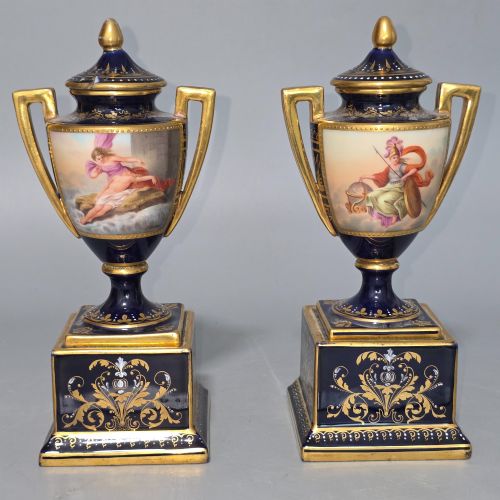


Pair of Vienna Vases
A pair of vienna vases brings neoclassical grace and rich gilding to a mantelpiece, offering striking symmetry and hand-painted detail.
Pair of Vienna Vases
A pair of vienna vases brings together symmetrical decorative porcelain vessels designed for formal display, ranging from amphora shapes to lidded urns and ewers. When you search for a pair of vienna vases, you encounter pieces shaped by nineteenth-century tastes, spanning neoclassical, empire, and secessionist movements.
The objects listed here include nineteenth-century porcelain urns, jugs, and amphora vases with covers, often reflecting royal vienna style or specific workshops. These twin pieces form balanced decorative ornaments traditionally placed upon mantelpieces or pedestals.
Materials and techniques
Potters shaped these vessels from ceramic and porcelain before applying intricate hand-painted designs and enamel work. Artisans enhanced the surfaces using gold leaf, gilt, and gilding to highlight neoclassical and empire motifs.
Certain pieces incorporate moulded glass elements alongside ceramic bodies, while covers and stands complete the construction of taller urns and lidded vases.
Some nineteenth-century makers clearly felt two handles simply weren't enough when three could hold more gold.
Factors of quality
Quality rests upon the execution of the hand-painted scenes and the precision of the gilt work rather than mere scale. Finer examples display meticulous brushwork and balanced proportions that elevate them above standard decorative ware.
The inclusion of signed artists or distinct workshop markers, such as those by Ernst Wahliss or F. Koller, distinguishes exceptional pieces from generic nineteenth-century production.
F. Koller·Ernst Wahliss
The Pair of Vienna Vases Glossary
- Amphora
- A two-handled ancient vessel shape revived during the nineteenth century for decorative porcelain vases and urns.
- Gilding
- The application of gold leaf or gilt paste to ceramic surfaces to accentuate handles, rims, and painted panels.
- Ewer
- A large jug with a wide spout and looped handle, often produced as a decorative pair alongside traditional urns.
- Secessionist
- An artistic movement originating in Vienna that embraced modernist lines and stylized decoration during the late nineteenth and early twentieth centuries.
- Neoclassical
- A revival style drawing on classical Greek and Roman motifs, frequently seen on nineteenth-century porcelain.
Pair of Vienna Vases: Frequently Asked Questions
What periods do these vases come from?
The pieces span the nineteenth century, including specific dates around eighteen eighty, eighteen ninety, and nineteen hundred. Victorian and secessionist influences appear frequently across the inventory.
Craftsmen produced these works during periods when neoclassical and empire revivals dominated European porcelain design.
How were these vases used originally?
Owners displayed these twin vessels on mantelpieces, tables, or specialised stands as formal ornaments rather than for holding flowers. Lidded urns and amphora vases served to showcase wealth and refined artistic taste.
Their symmetrical placement added formal balance to nineteenth-century drawing rooms and parlours.
How do I identify royal vienna style?
Look for hand-painted classical or allegorical scenes framed by rich gilding and enamel detailing on porcelain bodies. Many pieces feature distinct maker marks or stylistic cues tied to Austrian workshops.
Forms range from simple jugs to large decorative urns with matching covers.
How do I care for gilt porcelain?
Dust these delicate ceramic surfaces gently with a soft dry cloth, avoiding harsh cleaning agents that might damage the fragile gold leaf and enamel. Keep them away from direct sunlight to preserve the painted pigments.
Handle lidded pieces with care by lifting the cover separately from the main body.