
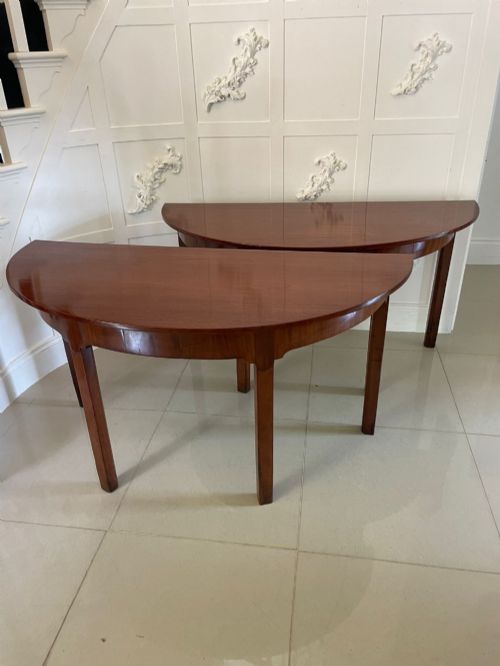
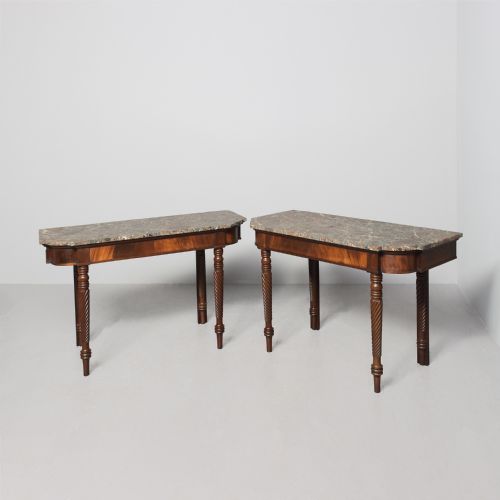
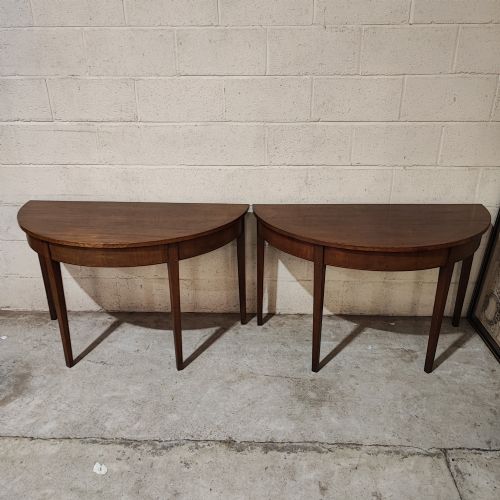
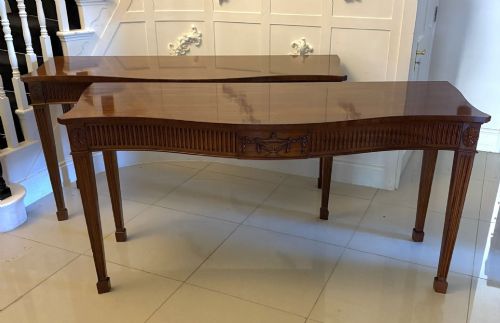


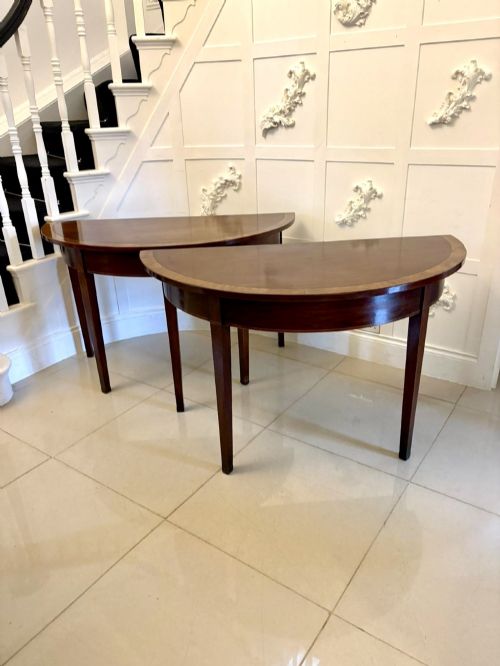
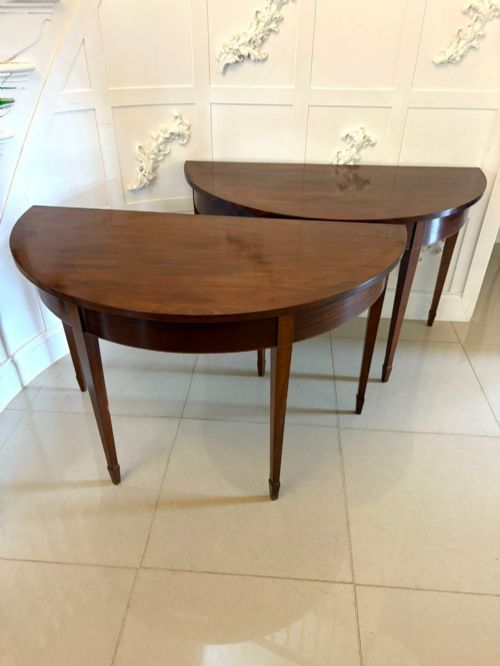
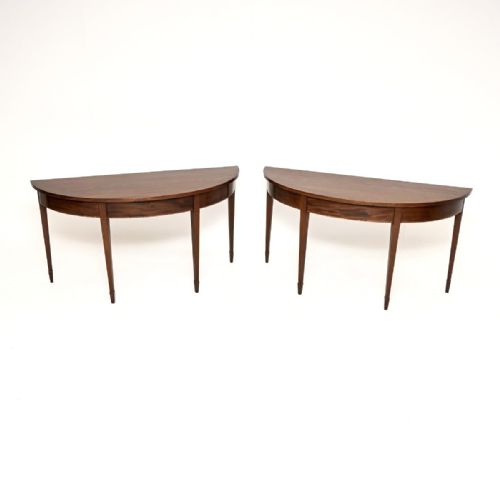

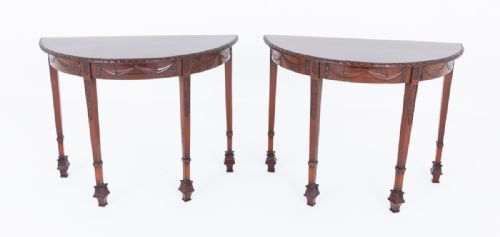
Pair of Mahogany Consoles
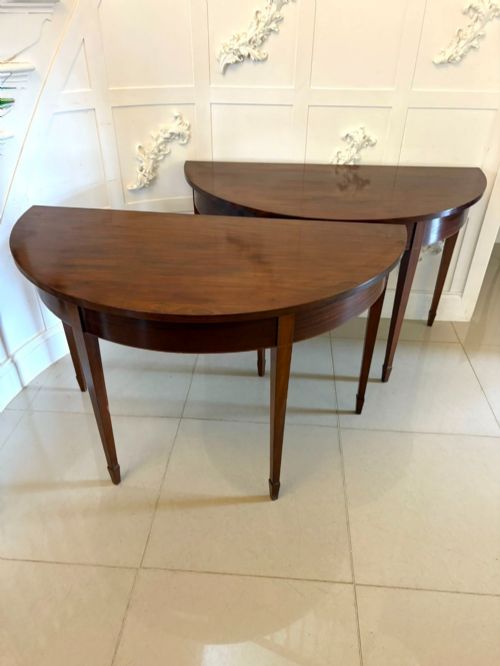
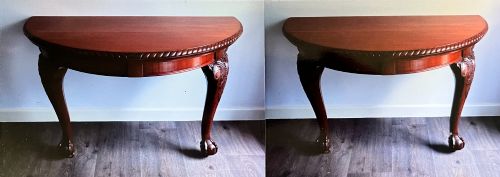
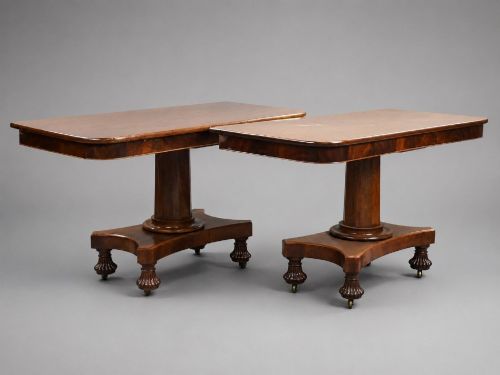
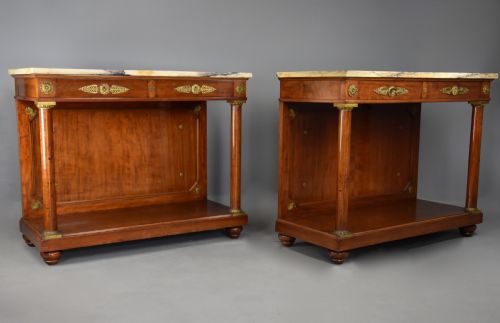
These pair of mahogany consoles bring architectural balance and rich timber grain to a formal hallway or drawing room.
Pair of Mahogany Consoles
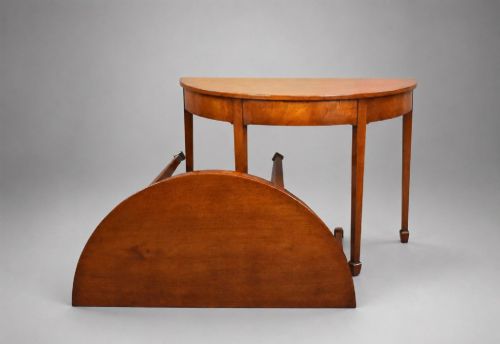
A pair of mahogany consoles consists of two matched tables designed to stand against a wall, frequently taking a demi-lune or D-shaped form to fit snugly in reception rooms and corridors. The pieces on this page span the Georgian, Regency, and Victorian periods, often appearing as half-round side tables that can sometimes join together to form a larger dining table.
Buyers looking for a pair of mahogany consoles will encounter variations ranging from simple rectangular William IV designs to elaborately carved George III and Neoclassical examples. Demi-lune and serpentine shapes dominate the selection, offering graceful curves that soften the linear geometry of a traditional interior.
How they were made
Cabinetmakers utilised dense tropical timber, selecting figured mahogany for its deep colour and decorative grain, frequently enhanced by contrasting veneers such as satinwood or boxwood. Construction relied on traditional joinery, with timber often applied as a veneer over a sturdy oak or pine carcass to achieve sweeping curves without splitting.
Many examples incorporate decorative details like brass inlay, intricate neoclassical carving, or polished marble tops that provide a cool, durable surface. Ebonised highlights and delicate stringing lines were also applied to accentuate the structural outlines of the tables.
What varies in quality
Quality rests primarily in the selection of the timber and the crispness of the carving. Superior tables feature highly figured mahogany with a continuous, matched grain across both pieces, whereas lesser examples use plain wood or mismatched veneers.
The refinement of secondary details distinguishes the better workshops. Finely chased brass mounts, precise inlay work, and robust, well-fitted joinery separate standard production furniture from pieces of exceptional craftsmanship.
Gillows·Krieger Paris·Jean Joseph Chapuis
The Pair of Mahogany Consoles Glossary
- Demi-lune
- Half-moon shape. This form is common in antique console tables designed to sit flush against a wall.
- Serpentine
- A gently undulating line that curves outward in the centre and inward at the sides. It demands skilled woodworking to shape timber into these fluid contours.
- Inlay
- A technique where contrasting materials like boxwood or brass are inserted into recesses in the wood surface. This creates decorative borders and geometric patterns.
- Veneer
- A thin layer of figured wood applied over a stable secondary timber. This method allows cabinetmakers to display striking grain patterns without risking the structural movement of solid boards.
Pair of Mahogany Consoles: Frequently Asked Questions
How do I style a pair of mahogany consoles?
Place them symmetrically beneath a large mirror or pair of paintings in an entrance hall or dining room.
Keep the tabletops uncluttered with perhaps a bronze lamp or a ceramic bowl to let the timber grain remain the focal point.
Can these tables be used for dining?
Certain historic examples were constructed as metamorphic or D-end tables specifically designed to pull apart and serve as side tables when not hosting guests.
Check the height and stability of the particular pair to ensure comfortable legroom before attempting to use them for meals.
How do I tell Georgian from Regency consoles?
Georgian pieces often display restrained classical carving, ball and claw feet, or straightforward bracket supports with figured mahogany tops.
Regency examples tend to embrace bolder neoclassical influences, frequently incorporating brass inlay, ebonised details, and sabre legs.
How do I care for antique mahogany timber?
Maintain the finish by dusting with a soft, dry cloth and avoiding placement near direct heat sources or strong sunlight.
Apply a traditional beeswax polish sparingly once or twice a year to nourish the wood and preserve its deep lustre.