


Pair Large Brass Candlesticks
These pair large brass candlesticks offer substantial presence and utility, grounding a room with historical weight and warm metallic reflection.
Pair Large Brass Candlesticks
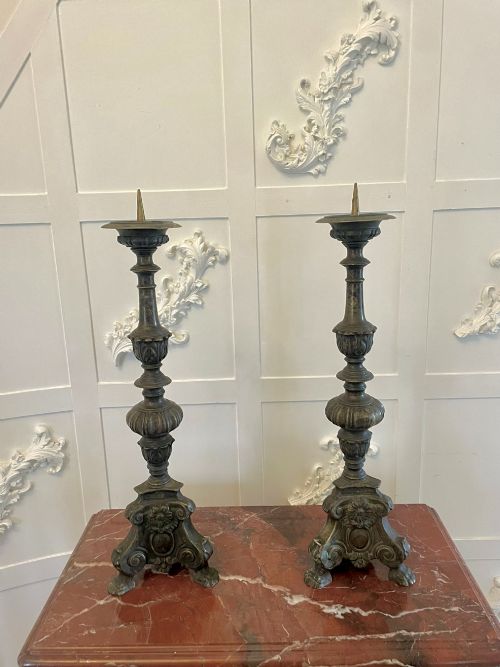
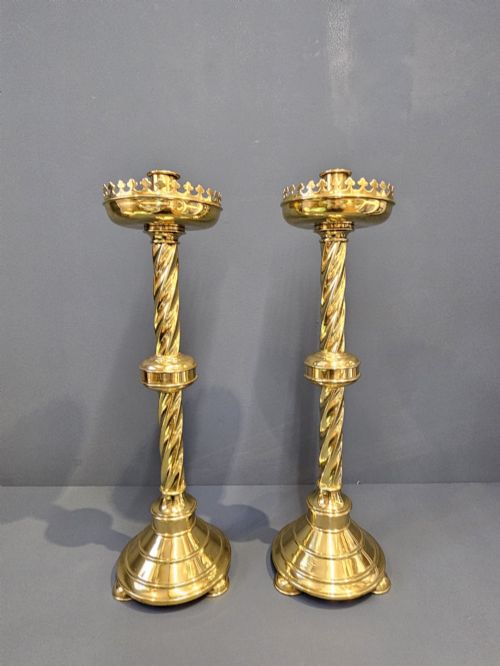
Pair large brass candlesticks emerge predominantly from the nineteenth century, with strong representation from the Victorian era and the Edwardian period. They span domestic lighting forms as well as ecclesiastical church and altar designs, including pricket variants that hold candles on a central metal spike.
Beyond standard domestic brass, the selections encompass related lighting forms such as candelabra and table lamps in materials like bronze, gilt-brass, wrought iron, and occasional combinations of wood with brass mounts. Origin styles range from Gothic Revival and Amsterdam School to French Louis XVI and George III interpretations.
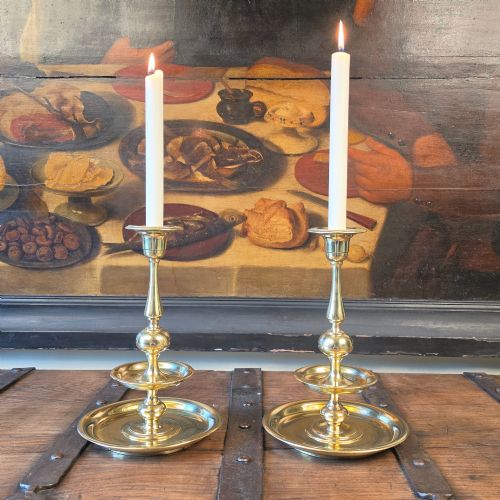
Most examples hail from Victorian workshops, carrying the heavy proportions and ornate casting typical of mid-to-late nineteenth-century manufacture. Buyers encounter both domestic push-up designs and towering church candlesticks originally built for ceremonial spaces.
How They Were Made
Makers utilised casting techniques to produce the robust body forms and detailed ornamentation characteristic of large brass candlesticks. Molten brass or bronze was poured into moulds, allowing for heavy bases, knopped stems, and intricate decorative motifs that often received hand-finishing.
Surface treatments included gilding, patination, and polishing to alter the appearance of the raw metal. Combinations of brass with iron, copper, or carved hardwoods like mahogany and walnut also appear, reflecting diverse period joinery and metalworking methods.
Design influences include Gothic Revival, Amsterdam School, and French Louis XVI aesthetics.
What Varies In Quality
The degree of crispness in the cast ornamentation dictates the visual sharpness of floral motifs, mouldings, and structural joints. Superior examples retain deep relief and clean edges that do not soften through excessive wear or heavy repolishing over time.
Proportion and gauge of the metal set finer items apart from standard production pieces, with heavier, thicker brass castings providing greater stability and a more substantial presence. The complexity of the design, such as ornate pricket spikes or multi-branch arrangements, further distinguishes standard domestic lighting from monumental ecclesiastical commissions.
The Pair Large Brass Candlesticks Glossary
- Pricket
- A candlestick featuring an upright metal spike upon which a wax candle is impaled. This form appears frequently on church and altar pieces.
- Candelabra
- A branched lighting fixture designed to hold multiple candles simultaneously. They often feature matching arms extending from a central shaft.
- Gilt-Brass
- Base brass metal treated with a thin layer of gold or gold-coloured wash to simulate solid ormolu. This finish provides a bright, reflective surface.
- Push-Up
- A mechanical internal mechanism featuring a small ejector plate operated from below, allowing burnt candle stubs to be raised and removed easily.
Pair Large Brass Candlesticks: Frequently Asked Questions
How were church candlesticks used?
Ecclesiastical candlesticks stood upon altars or sanctuary floors during religious services, holding large wax candles to provide illumination and ceremonial focus.
Their substantial height and heavy bases ensured stability during continuous daily use in large stone buildings.
Can these be converted to electricity?
Many examples arrive wired for modern lamps or feature past conversions that integrated internal electrical wiring for standard bulbs.
Buyers often choose to adapt them for domestic table lighting while preserving the original exterior metal components.
How do I date a pair?
Stylistic clues such as Gothic Revival arches, Amsterdam School geometry, or Victorian ornamentation help narrow the production era.
Casting seams, metal composition, and assembly methods also indicate whether a pair originates from the nineteenth century or later periods.
What is a pricket candlestick?
A pricket candlestick uses a sharp metal spike at the top rather than a traditional hollow socket to secure the candle.
This style associates closely with church and altar lighting traditions from the nineteenth century and earlier.