


Pair Large Altar Candlesticks
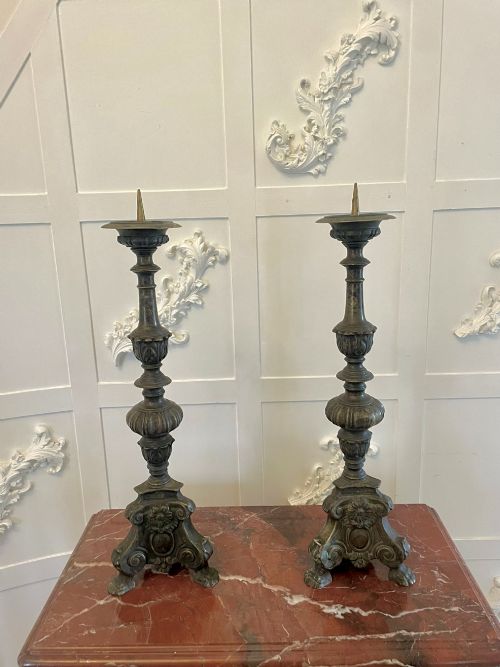
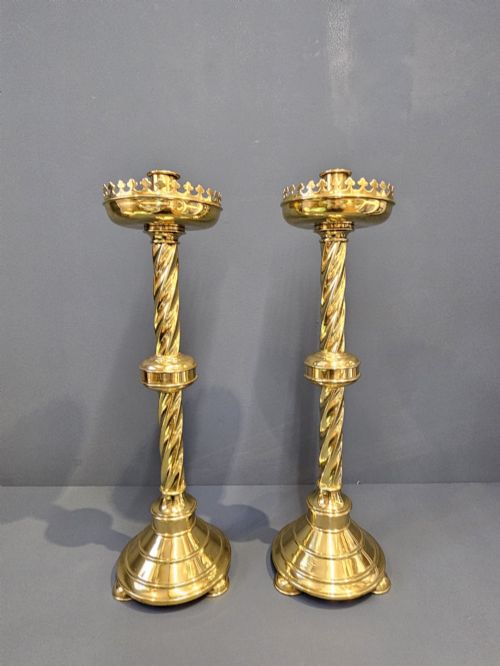
Pair large altar candlesticks bring monumental scale and ecclesiastical presence into a room, fashioned from heavy brass, carved wood, and gilt bronze.
Pair Large Altar Candlesticks
When you search for pair large altar candlesticks, you find substantial church lighting and decorative chapel pieces designed for towering height. These items originate predominantly from the nineteenth century, including Victorian Gothic Revival interpretations and earlier eighteenth-century Italian baroque forms.
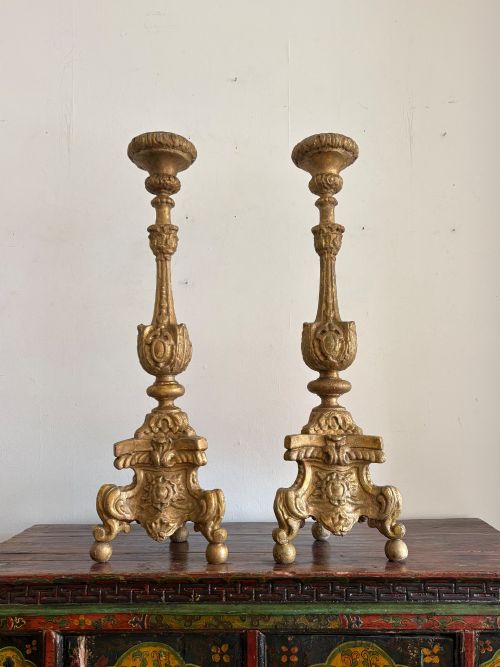
The version most commonly met on this page is the heavy brass ecclesiastical candlestick, often featuring a pricket spike rather than a socket to hold the wax taper. Alongside solid brass, walnut and oak bodies appear with giltwood, gesso, and silver leaf finishes.
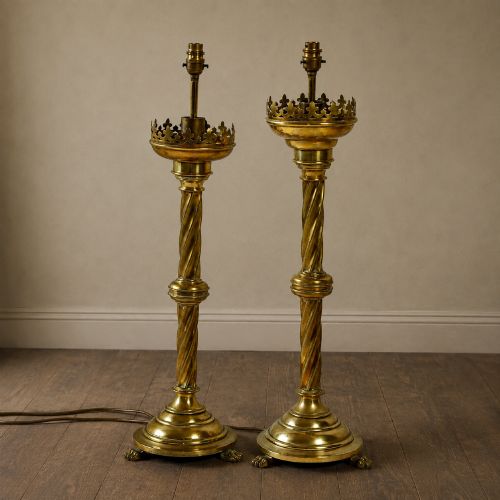
Beyond standard tabletop display, certain examples arrive adapted as table lamps or standard lamps, while others retain their original altar-style proportions reaching seventy-eight centimetres or more in height.
How they were made
Makers utilised cast and turned brass to construct the structural shafts and weighted bases required to support heavy candles without toppling. Metal components frequently combine brass with wrought iron elements, particularly in Amsterdam School interpretations from the early twentieth century.
Wooden alternatives rely on hand-carving in oak or softer timbers, which are subsequently prepared with gesso layers before receiving applications of gold or silver leaf, or traditional paint finishes. French workshops favoured gilt bronze alongside carved wooden structures decorated with marbleised effects.
Listings feature brass, carved wood, gesso, bronze, wrought iron, and silver leaf across periods from the eighteenth century to the Edwardian era.
What varies in quality
Quality rests primarily in the crispness of the casting and the depth of the hand-chasing on metal examples, where sharper decorative details separate superior workshops from mass production. In wooden pieces, the integrity of the underlying carved form and the preservation of the original gilt or silver leaf surface dictate the standard.
Proportion and scale also define the hierarchy, with taller seventeenth and eighteenth-century baroque iterations commanding attention through massive turned profiles and balanced architectural components.
The Pair Large Altar Candlesticks Glossary
- Pricket
- A metal spike on top of a candlestick designed to impale the base of a large candle rather than slide into a socket. This style is traditional for church altars.
- Giltwood
- Timber that has been coated with a thin layer of gold leaf over a prepared gesso base. It is frequently seen on eighteenth-century baroque and revival altar pieces.
- Gothic Revival
- An architectural and decorative style popular during the Victorian era that draws inspiration from medieval ecclesiastical design. It dominates nineteenth-century metalwork here.
- Amsterdam School
- An early twentieth-century architectural and design movement known for expressive forms combining brass and iron. Pieces from this tradition show distinct modernist influences.
Pair Large Altar Candlesticks: Frequently Asked Questions
What is a pricket candlestick?
A pricket candlestick uses an upward-pointing metal spike to secure the candle instead of a traditional hollow cup or socket.
This method was standard for large church candles, allowing the wax to pool and drip down the sides of the shaft.
Were these candlesticks converted to electricity?
Some ecclesiastical candlesticks have been adapted into table lamps or standard lamps by running electrical wiring through the central shaft.
This conversion allows large antique candle holders to function safely with modern light bulbs while retaining their original height and presence.
How do I identify a Victorian Gothic Revival piece?
Victorian Gothic Revival items display architectural motifs such as trefoils, quatrefoils, and heavy clustered columns borrowed from medieval cathedrals.
These pieces typically date from the mid to late nineteenth century and utilise cast brass construction.
What is the difference between brass and gilt bronze?
Brass is an alloy of copper and zinc with a warm golden metallic finish throughout its structure, while gilt bronze consists of a bronze base covered in a thin layer of gold.
French workshops frequently employed gilt bronze for decorative ecclesiastical items requiring intricate chased details.
Where should I place a large altar candlestick?
Large altar candlesticks suit placement on deep sideboards, console tables, or directly on the floor when standing at standard lamp height.
Their substantial height and architectural silhouette require a room with enough vertical space to support their monumental scale.