


Pair Italian Bedside Tables
Pair Italian bedside tables bring continental elegance to a bedroom, offering sculptural form and rich timber grain in a matched set.
Pair Italian Bedside Tables
When you search for pair italian bedside tables, you encounter matching sets designed to sit beside a bed, drawing from periods ranging from the eighteenth century to the mid-twentieth century. The selection includes serpentine chests, drum-shaped cabinets, and marble-topped nightstands shaped by regional tastes like the Florentine tradition or North Italian design.
Most examples you meet on this page rely on walnut and burr walnut, often paired with marble tops, brass accents, or fabric elements. They appear in styles stretching from Italian Baroque and Rococo Revival to Art Deco and Mid-Century Modern, reflecting the shifting aesthetic priorities of Italian cabinet makers across different eras.
How They Were Made
Cabinet makers constructed these pieces using solid wood and supportive framing, veneered with burr walnut to create striking, figured grain patterns across the curved surfaces of serpentine chests and drum cabinets. Carved details and shaped mouldings define styles from the 18th century through the revival periods of the 19th century.
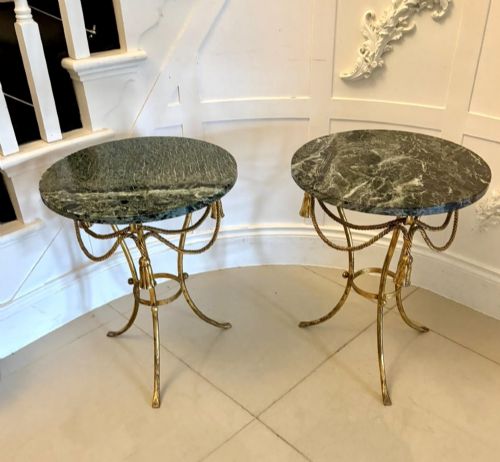
Many tables incorporate inset marble tops and cast brass or gilt metal mounts, requiring precise joinery to marry stone and timber. Surface finishes range from polished walnut to giltwood, while specialty pieces integrate glass and fabric.
Some pairs include tassel details cast in metal, proving that even a bedside table occasionally enjoys wearing a decorative fringe.
What Varies in Quality
The distinction between ordinary and exceptional pairs lies in the execution of the timber veneers and the harmony of the matching set. Superior examples display carefully selected burr walnut grain that flows logically across curved drawer fronts and cabinet doors, maintaining symmetry between both pieces.
Construction methods and secondary materials further separate the tiers. Finely finished marble tops, substantial brass hardware, and crisp, hand-carved decorative elements indicate a higher grade of workshop production compared to simpler, mass-produced revival pieces.
Angelo Brotto for Esperia
The Pair Italian Bedside Tables Glossary
- Serpentine
- A furniture front or top curving inward centrally and convexly outward at the ends. This flowing contour requires advanced woodworking skill to veneer and fit successfully.
- Burr walnut
- Wood taken from a walnut tree growth featuring swirling, knotted grain patterns. It provides a highly decorative surface prized in high-end cabinet making.
- Giltwood
- Wood that has been coated with gold leaf or gold paint. It appears frequently in decorative Italian frames, bases, and lamps.
- Commode
- A low chest of drawers or cabinet. In Italian furniture, these pieces often feature curved bombe profiles and marble surfaces.
Pair Italian Bedside Tables: Frequently Asked Questions
How do I spot Art Deco pairs?
Art Deco pairs typically feature geometric forms, such as drum shapes, combined with smooth walnut veneers and minimal ornamentation.
They reflect the modernist design shifts of the interwar period, diverging heavily from earlier serpentine or carved revival styles.
Are marble tops original?
Many period tables feature fitted marble tops designed to handle daily use and provide a cool, durable surface beside a bed.
Determining originality involves looking closely at the edge bevelling and how the stone rests within the wooden frame.
How do I care for walnut?
Walnut surfaces respond best to gentle dusting with a soft cloth and protection from direct sunlight and extreme humidity changes.
Avoiding harsh chemical polishes preserves the original patina and protects the delicate grain of the veneer.
What defines Florentine tables?
Florentine bedside tables often incorporate local decorative traditions, including specific carved wooden motifs and regional finishing techniques.
They carry the distinct aesthetic hallmarks associated with workshops operating around Florence during the early twentieth century.